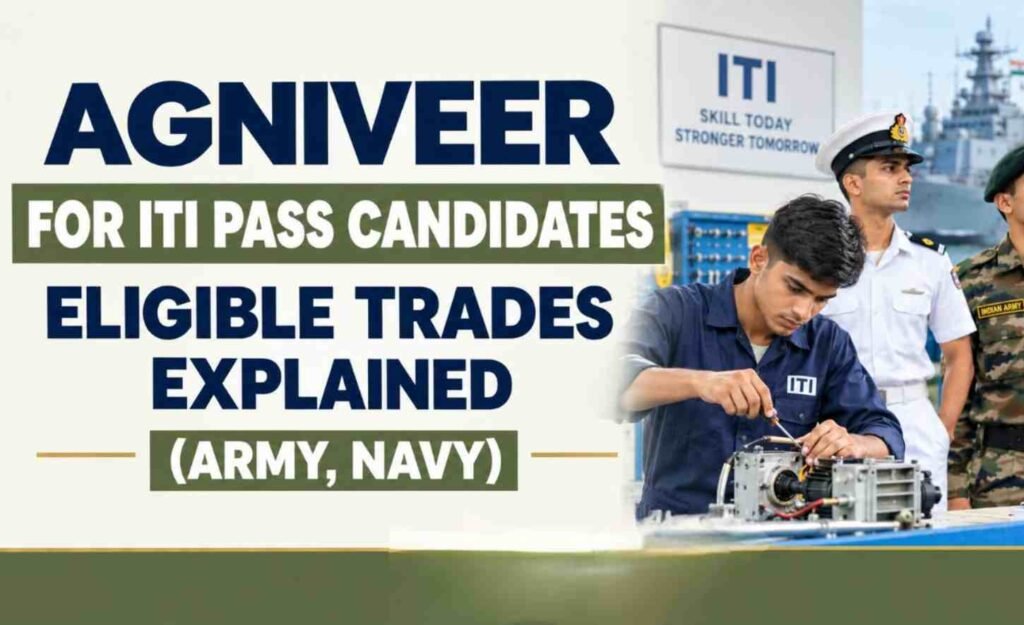
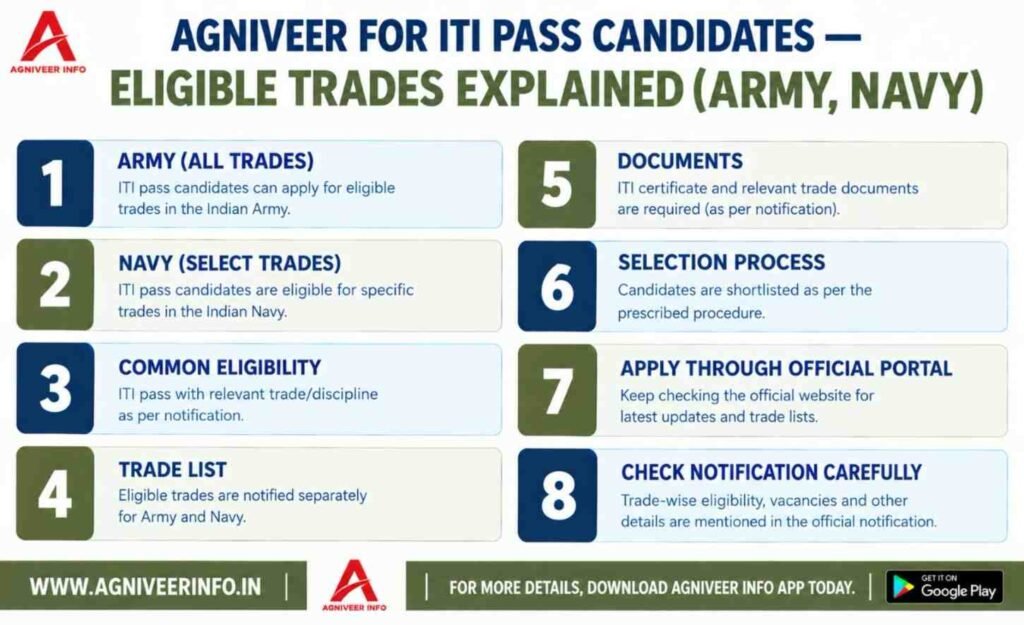
Candidates who hold an Industrial Training Institute (ITI) qualification often show a lot of interest in joining the Indian Armed Forces under the Agnipath scheme. Technical education gives you practical skills in areas like mechanical, electrical, electronic, and civil work, which is why ITI graduates can be a good fit for trade-based military roles.
But having an ITI certificate does not automatically make you eligible for every branch or role in the armed forces, since the entry rules change strictly depending on the specific branch of service, the trade you are applying for, and the official recruitment notice released for that particular cycle.
When you are looking at Agniveer opportunities, as an ITI candidate you need to understand how your practical technical qualification fits in with the general education requirements that are still compulsory. While your ITI training builds up your practical skills, recruitment authorities usually still ask for a specific 10th or 12th class educational background, along with your formal skill certificate.
On top of this, the Indian Army and Indian Navy each set up their trade requirements, selection process, and eligibility rules in a different way, so it is important for candidates to understand these service-specific rules clearly, so that they can move through the recruitment process properly and avoid misunderstanding the eligibility rules.
Can ITI Pass Candidates Apply for Agniveer Recruitment?
Yes, candidates who hold an ITI pass certificate can apply for certain Agniveer recruitment categories, as long as they meet all the set rules on education, age, and physical fitness. However, an ITI certificate alone does not act as a complete, open pass for every Agniveer post, since whether you are accepted depends entirely on the recruitment branch, the target trade, and whether that specific ITI stream is clearly recognised in the official service notice.
On top of this, candidates need to understand that a technical certificate does not let you skip the basic schooling requirement. Most technical and trade-based entries need candidates to have a valid Class 10th (Matriculation) or Class 12th (10+2) qualification from a recognised education board, either alongside or before their ITI training. So an ITI certificate works as a specialised trade qualification, or as something that can add bonus points, rather than something that can fully replace your main academic qualification.
Agniveer Army Trades for ITI Candidates
In the Indian Army, ITI qualifications matter mainly under the Agniveer Technical and Agniveer Tradesmen categories. For Agniveer Technical, candidates who have finished Class 10th with the required minimum marks, which is usually 50% overall and 40% each in English, Mathematics, and Science, along with a two-year technical course from a recognised ITI, can meet the basic education requirement. Candidates who have Class 12th in Science, meaning Physics, Chemistry, and Maths, along with a one-year ITI course in a related field, may also apply, depending on whether it matches the required NSQF level.
The Indian Army also gives bonus marks during the final merit list preparation to technical ITI holders who apply for technical roles, and this depends on whether their ITI course was for one year or two years. For Agniveer Tradesmen, which includes both the 10th Pass and 8th Pass categories, an ITI certificate can show a good practical background, though the actual selection still strictly follows the general education pass marks and physical standards set for those specific tradesman roles.
Agniveer Navy Opportunities for ITI Pass Candidates
The Indian Navy mainly recruits candidates through Agniveer (SSR – Senior Secondary Recruit) and Agniveer (MR – Matric Recruit). For Agniveer SSR, the eligibility usually needs Class 12th with Physics and Mathematics, or a recognised three-year engineering diploma. On its own, an ITI certificate does not usually replace the 10+2 Science subject requirement for SSR, unless the candidate already separately holds the required 10+2 qualification.
For Agniveer MR, the basic education requirement is a Class 10th pass. While an ITI certificate in a field like cooking, stewardship, or maintenance can give useful practical skills for certain onboard trades, selection into MR still strictly depends on how you perform in the general matriculation-level exam and on the physical standards, rather than on any direct exemption given for holding an ITI trade.
ITI Trades That May Be Relevant for Agniveer Recruitment
The technical trades taught at ITI institutes match closely with many of the maintenance and support needs of military units. The streams that often line up with the Army’s technical notices include:
- Mechanical Trades: Fitter, Mechanic Motor Vehicle, Mechanic Diesel, and Turner.
- Electrical & Electronics Trades: Electrician, Wireman, Electronic Mechanic, and Technician Power Electronics Systems.
- Instrumental & Technical Support Trades: Instrument Mechanic, Draughtsman (Mechanical/Civil), and Information Technology/Computer Hardware maintenance.
Candidates should keep in mind that this list reflects the trades that have traditionally been recognised in technical recruitment drives, and whether a specific trade is actually included still depends on the exact wording of the current recruitment notice.
10th, 12th and ITI: What Qualification Is Actually Required?
A common confusion among applicants is whether an ITI qualification can replace the usual schooling requirement. In formal defence recruitment, the secondary (10th) and senior secondary (12th) qualifications are what establish your basic reading, maths, and science ability, while the ITI certificate is proof of your vocational training.
Because of this, an applicant cannot show an ITI trade certificate as a full replacement for Class 10th or Class 12th, unless the official rules clearly state that a specific vocational equivalence is recognised. Candidates need to have the required basic board qualification along with their ITI certificate, so that their application is treated as valid during document verification.
ITI Trade and Educational Qualification Matching
To apply successfully, you need to carefully match your completed ITI branch with the official list of eligible trades published for that particular recruitment rally or batch. Candidates should confirm that their ITI institute is recognised by the NCVT (National Council for Vocational Training) or SCVT (State Council for Vocational Training), as mentioned in the recruitment advertisement.
If you apply for a technical role with an ITI trade that is not listed or does not match, this can lead to rejection during the first document check itself. Candidates should carefully go through the eligibility table in the official notice, to make sure their exact trade code and educational background match what is needed for the role they want.
Selection Process for ITI Candidates
ITI candidates go through the same standard, multi-stage Agniveer selection process that applies to all recruits. The usual stages are:
- Phase I: Online Common Entrance Examination (CEE), which tests general knowledge, science, mathematics, and reasoning.
- Phase II: On-site Physical Fitness Test (PFT), Physical Measurement Test (PMT), and a thorough check of documents.
- Phase III: A full Medical Examination carried out by designated military medical officers.
- Phase IV: Preparing the final merit list, based on written exam scores, any bonus marks that apply, such as the ITI technical bonus in the Army, and medical fitness.
Physical and Medical Requirements
Holding a technical ITI qualification does not give you any relaxation in the required physical and medical checks. Armed forces personnel need to stay in good physical shape, whether their final duties are operational or technical. Candidates need to meet the set standards for height, weight, and chest expansion that apply to their region and entry category.
The medical check looks at visual sharpness, colour vision, hearing, dental points, overall body health, and whether there is any ongoing surgical or medical condition. Candidates are advised to check the specific physical standard charts given in the current notice, to confirm what applies to their region and trade before they apply.
Army vs Navy for ITI Candidates
Choosing between the Indian Army and Indian Navy depends on your technical background, your educational qualifications, and the kind of work environment you prefer.
The Army has specific technical entries where an ITI qualification directly gives you bonus points, or opens a clear path into technical corps such as Electronics and Mechanical Engineers (EME) or the Engineers. This kind of work involves land-based equipment, vehicle maintenance, and field operations.
The Navy, on the other hand, focuses on specialised maritime technology, electronics, and naval architecture, so while an ITI background gives you a useful foundation, getting into Navy technical roles such as SSR mostly depends on having a formal 10+2 Science qualification or a recognised three-year engineering diploma.
Salary, Seva Nidhi and Career After Four Years
Every Agniveer, no matter which service they join, gets the same standard financial package:
- Monthly Package: Starts at ₹30,000 per month in the first year, and rises step by step to ₹40,000 per month in the fourth year.
- Seva Nidhi Package: 30% of the monthly customised pay goes into the Seva Nidhi Corpus fund, and the Government of India adds an equal amount on its own. Once the four years are complete, Agniveers get a lump sum that is fully exempt from tax, along with the interest that has built up.
- Service Duration & Retention: Enrolment is for four years, and up to 25% of each batch may be taken into the regular cadre, based on the organisation’s needs, performance, and merit. Those who exit after four years re-join civilian life with real military experience, a skill certificate, and some financial savings built up.
| Comparison Factor | Army | Navy | ITI Candidate Consideration |
| ITI Eligibility | Accepted for Technical roles and Tradesmen entries with recognized trade streams. | Relevant for MR/SSR baselines; requires matching mandatory 10th or 12th subjects. | ITI credentials must align precisely with the trade lists published in active notifications. |
| Educational Requirement | Class 10th plus 2-year ITI or Class 12th Science plus 1-year ITI for Technical posts. | Class 10th for MR; Class 12th (Physics & Maths) or 3-year Diploma for SSR. | ITI does not replace basic board certifications (10th/12th) unless officially stated. |
| Selection Process | CEE written test, Physical Fitness Test, Medical Exam, and Merit list (with ITI bonus marks). | Computer-based test (INET), Physical Fitness Test, and Medical Examination. | ITI candidates undergo identical physical and medical testing as general candidates. |
| Technical/Trade Relevance | High direct utility in technical arms like EME, Signals, and Engineers. | High general utility for technical branches aboard ships and shore establishments. | Vocational skills assist in technical understanding but do not bypass selection stages. |
Conclusion
Having an ITI pass qualification gives candidates useful vocational skills that fit in well with the technical roles under the Agniveer scheme, but simply holding an ITI certificate does not automatically make you eligible for every Army or Navy trade. Candidates need to clearly understand the difference between the general education qualification, meaning Class 10th or 12th, and their technical certificate, and make sure both sets of requirements are fully met, as laid out in the official guidelines.
Before applying, candidates should carefully read the current recruitment notice released on the official joinindianarmy.nic.in or joinindiannavy.gov.in websites, since checking the recognised trade branches, the age limit, the physical standards, and the subject combinations needed will help you apply correctly and avoid being rejected during document verification.
Get the latest Agniveer updates by joining our WhatsApp channel
Frequently Asked Questions
Q1. Can ITI pass candidates apply for Agniveer recruitment?
A1. Yes, ITI pass candidates can apply for specific Agniveer technical and trade roles, as long as they also meet the required 10th or 12th educational criteria.
Q2. Which ITI trades are eligible for Army Agniveer?
A2. The trades commonly accepted for the Army include Fitter, Electrician, Mechanic Motor Vehicle, Turner, Electronic Mechanic, and Draughtsman, as mentioned in the official rally notices.
Q3. Can ITI candidates apply for Navy Agniveer?
A3. Yes, ITI candidates can apply for Navy Agniveer roles if they meet the basic Class 10th, or Class 12th with Physics and Maths, educational requirement.
Q4. Does ITI replace the 12th qualification for Agniveer recruitment?
A4. No, an ITI certificate does not automatically replace the Class 12th requirement, unless an official recruitment notice clearly states that a specific equivalence is recognised for that entry.
Q5. Is every ITI trade accepted for Agniveer recruitment?
A5. No, not every ITI trade is accepted, since recruitment authorities only accept the specific trades that are clearly listed in the current recruitment notice for that particular role.
Q6. Do ITI candidates have to pass the physical test?
A6. Yes, ITI candidates must fully pass the Physical Fitness Test and the Physical Measurement Test, with no exemption given because of their technical qualification.
Q7. Do ITI candidates need to pass the medical examination?
A7. Yes, every ITI candidate must fully pass the standard military medical examination to be considered fit for the final merit list.
Q8. Where should ITI candidates verify their eligibility?
A8. Candidates should check their eligibility only on the official websites, which are joinindianarmy.nic.in for the Indian Army and joinindiannavy.gov.in for the Indian Navy’s official recruitment notices.
READ ALSO: ARMY AGNIVEER CEE SYLLABUS — COMPLETE SUBJECT-WISE GUIDE