Source: Official sites: Join Indian Army | Join Indian Navy | Indian Air Force
The Agniveer recruitment under the Agnipath scheme depends heavily on a full medical check-up, so that candidates have the physical toughness, health, and ability to work that are needed for active military service in hard operational conditions.
Clearing the physical fitness test shows basic stamina, speed, and physical strength, but doing well in the physical test alone does not mean you are medically fit, because a candidate who easily finishes the physical tasks may still be carrying a health condition, a structural problem, an eyesight defect, or a hidden internal issue that has not come out yet, and this could put their health or their work at risk during military duty.
The medical examination works as a full check done by authorised military medical officers, who judge candidates against the specific health standards that the Armed Forces have set. It is important for aspirants to understand that the medical requirements are not the same for everyone, because the standards often change depending on the service branch, the entry stream, and the specific trade.
Candidates should depend only on the current official recruitment notifications, and not on rumours found online, old blogs, or unofficial charts from coaching centres. This guide explains the structure, the main areas that are checked, the steps followed, and the key things to know about the official medical examination in the Indian Army, Indian Navy, and Indian Air Force.
What Is the Agniveer Medical Examination?
The Agniveer medical examination is a formal clinical check done by military medical staff, to find out whether a candidate meets the medical fitness standards needed for military service. While the physical fitness test checks your short-term athletic ability, the medical examination checks the long-term health of your body’s structure, how well your internal organs work, your eyesight, your hearing, and your general health.
Military service means facing extreme weather, high altitudes, life at sea, and stressful situations, so authorised medical officers carry out these checks according to set service rules, to make sure that recruits can do their duty without putting their own safety or the safety of their unit at risk. The final decision on medical fitness depends strictly on these authorised military standards and on the judgement of the military medical boards.
When Does the Agniveer Medical Exam Take Place?
The exact order of the recruitment process can be different depending on the entry, the service branch, and the official notification instructions. But generally, the medical check happens after candidates have passed the first written exam and the physical fitness test.
Candidates who pass the physical stage are sent to appear before the military medical boards, at the recruitment rallies, naval establishments, or Air Force selection centres that are named for them. In some recruitment models or entries, a first medical screening happens right after the physical test, while the detailed clinical checks or special hospital reviews are done later, over the days that follow.
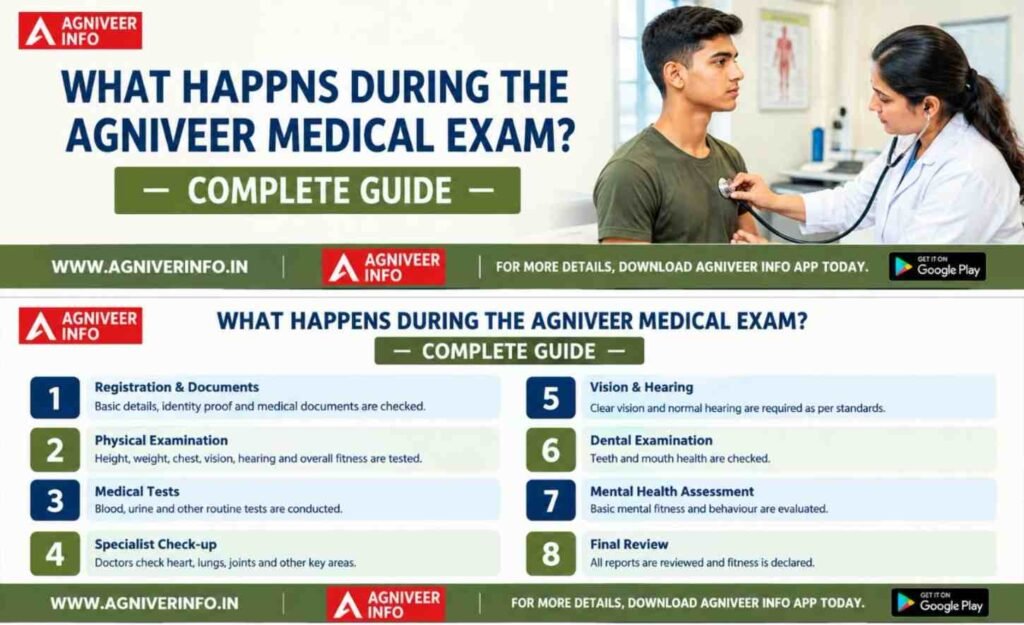
What Happens During the Agniveer Medical Exam?
During the medical examination, candidates go through a wide range of physical, eyesight, hearing, structural, and general body checks, done by special military doctors. The process starts with document checking and basic body measurements, and then moves on to detailed clinical checks of different body systems.
Candidates are checked, step by step, for clear eyesight, colour vision, ear health, hearing, oral hygiene, chest expansion, joint movement, the alignment of the spine, skin conditions, and surgical scars. While this general structure stays the same for everyone, candidates should understand that the exact clinical steps depend on the medical standards that apply to their own service branch and trade.
Height, Weight and Physical Measurements
Body measurements are recorded to make sure candidates meet the minimum body requirements set for military service. Your body’s proportions, including your height, weight, and chest size, along with chest expansion, are checked against the official age-height-weight standards.
These physical standards are very different depending on the service branch, the entry, and the regional relaxations that the official government notifications allow. General charts found online often miss these small differences, so it is very important for candidates to check the current official recruitment documents for the exact measurement rules.
Eyesight and Vision Test
Checking eyesight is an important part of the Agniveer medical examination. The medical officers check your distant vision, near vision, any refractive error (like short-sightedness), and the overall health of the eye, to make sure candidates can do their duties well.
The rules for eyesight are different depending on whether the candidate is applying for a technical, non-technical, aviation, or sea-going trade. Wearing glasses does not automatically lead to rejection for every entry, because some branches allow a certain limit of refractive error, while others, especially operational roles, keep stricter rules for vision without glasses.
Colour Vision Test
Colour perception is checked carefully during the medical exam, because military personnel must be able to correctly tell apart signal lights, navigation markers, camouflage patterns, and operational signs, under all kinds of light.
The medical boards use standard tests, such as Ishihara plates (a set of coloured dot patterns), to check colour vision. The colour perception (CP) standard that is needed depends heavily on the candidate’s trade, which means a certain level of colour vision might be fine for ground duties but not good enough for technical or navigation roles.
Hearing and ENT Examination
The ear, nose, and throat (ENT) check looks at how well you hear and at the structural health of these organs. Medical officers look inside the outer ear canal, check that the eardrum is in good condition, clean any wax build-up, and check for long-term middle-ear infections.
Your hearing is usually tested to confirm that you can hear soft whispers and sound signals clearly at a set distance, in each ear. The nose and throat are also checked, to see if there is any blockage, a bent nasal septum (the wall inside the nose), or a long-term throat condition that could affect normal breathing.
Dental Examination
Dental health is an important part of the overall medical check. The medical examiners look inside the mouth to count the sound, working dental points, check how the jaw closes, and judge the overall oral hygiene.
Candidates are checked for missing teeth, deep cavities, a badly aligned bite, active gum disease, or sores in the mouth. Having small dental problems does not automatically lead to rejection, as long as the candidate meets the minimum number of working dental points that the official service rules ask for.
Physical and Musculoskeletal Examination
The check of the muscles and bones looks at how well you can move, how your body is aligned, and the health of your spine, limbs, and main joints. Candidates do certain movements, so that the medical officers can watch how the joints move, how you walk, your posture, and your coordination.
The checks look for conditions such as very flat feet, strong knock knees, bow legs, deformities of the spine, or a lack of coordination in movement. The medical officers decide whether any such difference in structure would create a problem in your work, or a risk of future injury, under hard physical effort.
Medical History and Previous Surgery
Candidates are expected to give truthful information about their past medical history, hospital stays, major illnesses, long-term conditions, and any surgery. Hiding your medical history is both wrong and dangerous, because a condition that is not revealed can come back under the extreme stress of operational work.
Having had a surgery in the past does not automatically make you medically unfit; the medical boards look at the type of surgery, how long you took to recover, whether any device was left inside the body, and how well the body works now. The final fitness decision depends strictly on whether your past condition meets the authorised military medical standards.
Army, Navy and Air Force Medical Examination — Key Differences
Indian Army
The Army’s medical checks focus heavily on strong stamina in the muscles and bones, physical endurance, and body strength, all needed for long infantry work, duty in high-altitude areas, and different kinds of combat conditions.
Indian Navy
The Navy’s medical standards put extra importance on fitness for life at sea, endurance for sea duty, strict ENT (ear, nose, throat) health, and the eyesight needed for work on ships, in closed spaces, and in naval conditions.
Indian Air Force
The Air Force’s medical checks, especially for Agniveervayu entries, keep strict rules for eyesight, colour vision, and breathing, all matched to the needs of aviation support work, ground duties, and special technical trades.
Common Reasons for Being Declared Medically Unfit
- Eyesight problems or refractive errors that go beyond the limit allowed for the trade.
- Poor colour vision, or failing to pass the required colour perception tests.
- Hearing loss, a torn eardrum, or long-term ear infections.
- Not enough working dental points, deep cavities, or a badly aligned jaw.
- Bone and muscle conditions like very flat feet, knock knees, or a deformed spine.
- Long-term skin conditions, major surgical scars, or an ongoing disease in the body.
Temporary Unfit vs Permanent Unfit
Candidates who are declared medically unfit are put into either a temporary or a permanent unfit category, depending on the condition. A temporary unfit result is given for conditions that can be cured or reversed, such as ear wax, minor skin infections, being underweight, being overweight, or other minor problems that can be treated, and here candidates are given a fixed time to fix the problem and come back for a re-check.
A permanent unfit result is given for structural problems, severe long-term conditions, conditions present from birth, or other medical issues that cannot be reversed and that fall outside the allowed military standards. Candidates who are found medically unfit may be able to appeal for a Review Medical Board, according to the specific rules given in their official medical decision paper.
What Happens If You Are Declared Medically Unfit?
- Read the official written medical paper carefully, to understand the exact reason for your unfitness.
- Note whether the decision says you are temporarily or permanently unfit, and check if you can appeal.
- Follow the exact steps and the timeline that are given for asking for a Review Medical Board, if you are eligible.
- If your condition is temporary and can be treated, get proper treatment from qualified doctors during the review time.
- Keep all your official medical papers and genuine clinical records ready, so you can present them later.
- Stay away from unofficial agents, false promises, or private “guarantees” about military medical clearance.
Common Mistakes Candidates Make During the Medical Exam
- Hiding a past surgery or a long-term medical condition instead of showing real medical records.
- Assuming that clearing the physical fitness test will automatically mean you pass the medical examination too.
- Depending on standards found online that are not checked, unofficial health charts, or rumours on social media, instead of the official notification.
- Ignoring small, treatable health issues like ear wax, dental hygiene, or being over or under the right weight, before the exam.
- Believing that a private medical certificate can change or affect the official decisions of the military medical board.
- Getting nervous during normal clinical checks, which can raise your blood pressure or pulse rate on its own.
How to Prepare for the Agniveer Medical Exam
To prepare for the medical examination, you should take an active approach that focuses on keeping your natural health good and understanding the official rules. Candidates should read the current recruitment notification carefully, so that they know the physical and trade-specific medical standards that apply to them. Keeping good personal hygiene, such as cleaning your ear wax safely and taking care of basic dental health before the rally, stops temporary unfitness that could easily be avoided.
Candidates should get enough rest and sleep before the day of the exam, so that their normal vital signs (like heart rate and blood pressure) stay steady during the first checks. Carrying correct, genuine medical records of any past procedures helps the medical officers make a fair decision. Candidates must strictly avoid trying to trick the tests, taking medicine that is not prescribed to change their body readings, or looking for quick-fix treatment from people who are not authorised, because the military medical boards judge candidates only on real clinical facts and set military rules.
| Medical Area | Army | Navy | Air Force |
| General Examination | Checks physical stamina, structural endurance, overall organ health, and readiness for combat conditions. | Checks physical toughness, ability to handle sea conditions, balance, and health for shipboard duty. | Focuses on fitness, breathing health, agility, and overall suitability for airbase work. |
| Vision and Colour Vision | Tests visual sharpness and trade-specific colour vision, as per Army rules. | Tests distant vision, readiness for night vision, and strict colour perception for navigation at sea. | Keeps strict vision standards and detailed colour vision checks for aviation support roles. |
| Hearing and ENT | Checks the eardrum, wax build-up, and hearing sharpness needed for field communication. | Focuses a lot on eardrum health, the ability to handle pressure changes, and clear hearing. | Checks hearing sharpness and clear nasal airways needed for operational communication. |
| Trade-Specific Standards | Standards change based on infantry, technical, artillery, or support trade needs. | Standards depend on technical, logistics, seamanship, or special shipboard branch roles. | Standards are different for technical streams, non-technical branches, and special aviation support duties. |
Conclusion
The Agniveer medical examination is an important, fair filter, made to be sure that the candidates chosen have the health needed for military duty across the Indian Armed Forces. The physical ability you show in the fitness test must be backed up by clinical medical fitness, judged by authorised military medical staff.
Since the standards are different across the Army, Navy, and Air Force, candidates should always depend on the official recruitment notifications, and not on rumours online. Understanding the process, keeping your general health in good shape, avoiding common mistakes, and following the official steps if you are found temporarily unfit, all help candidates go through the medical examination with a clear mind and confidence.
Get the latest Agniveer updates by joining our WhatsApp channel.
Frequently Asked Questions
Q1. What happens during the Agniveer medical examination?
A1. Candidates go through a step-by-step clinical check, including vision, hearing, dental, bone and muscle, and general physical checks, all done by authorised military medical boards, to decide their overall military fitness.
Q2. Is eyesight checked during the Agniveer medical exam?
A2. Yes, your visual sharpness, near vision, and overall eye health are checked fully, and the limits allowed depend on the specific entry, service branch, and trade.
Q3. Is colour vision tested during the medical examination?
A3. Yes, colour perception is checked using standard test methods, to make sure candidates can correctly tell apart important signal lights, trade-specific signs, and operational markers.
Q4. Are teeth checked during the Agniveer medical exam?
A4. Yes, the medical officers check your oral hygiene, how sound your teeth are, and the alignment of your jaw, to confirm that you meet the minimum number of working dental points that are required.
Q5. Is hearing tested during the medical examination?
A5. Yes, how well you hear and the health of your ear canal are checked, to confirm that you can hear operational instructions clearly and that your eardrums are healthy and undamaged.
Q6. Can previous surgery cause medical unfitness?
A6. Not automatically. The medical boards look at the result of the surgery, how well you have recovered, whether any device remains in the body, and whether it meets the official military standards, before deciding your fitness.
Q7. What happens if a candidate is declared medically unfit?
A7. Candidates get an official written paper stating the reason, and, if they are eligible, instructions on how to ask for a re-check through a named Review Medical Board.
Q8. Are Army, Navy and Air Force medical standards identical?
A8. No, while the general medical ideas are the same, the exact vision, hearing, and trade standards are different, because each service branch has its own kind of operational work.