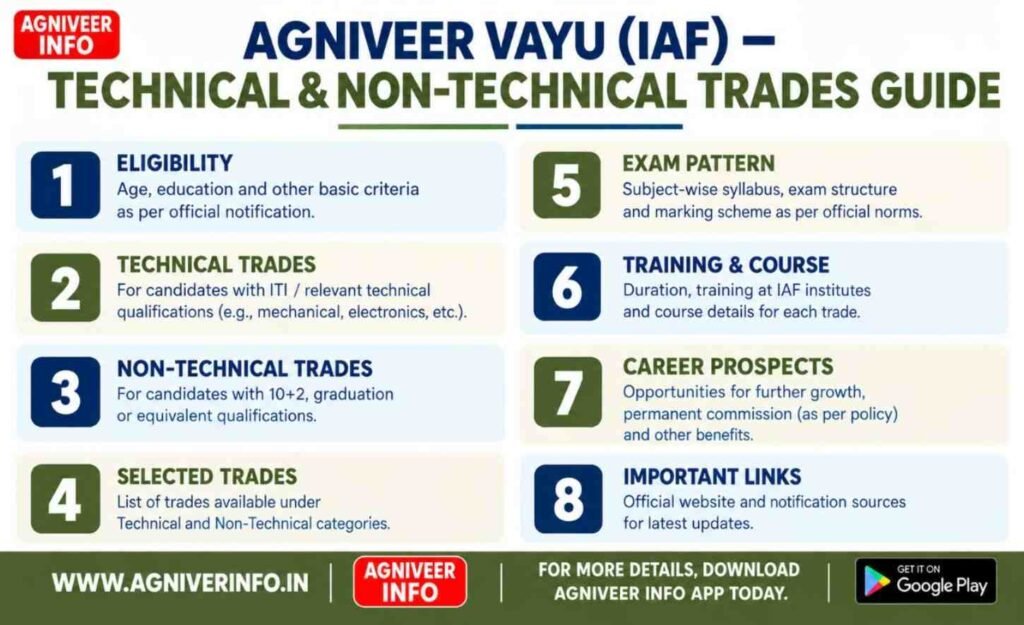
Joining the Indian Air Force through the Agniveervayu scheme is a respected career path, and it needs a clear understanding of how military jobs are actually structured. Candidates going through the recruitment process often come across conflicting descriptions of Agniveer Vayu Technical and Non-Technical Trades, on coaching websites and unofficial forums, but choosing a career stream should never be based on internet rumours or old trade information.
In Indian Air Force recruitment, the split between technical and non-technical categories decides the core nature of the work, the education needed, and the environment you will work in. Technical streams are built around equipment maintenance, keeping systems ready for operation, and managing technology, while non-technical streams focus on operational support, admin work, handling supplies, and base security.
Candidates need to carefully look at their own academic strengths, their natural abilities, and the official eligibility rules given in the latest recruitment notice, before stating their preference. Which trade you get is not simply a matter of personal choice,
since it depends on the official selection process, the vacancies available, your merit rank, and how you perform during training. Understanding this properly stops false expectations, and helps aspirants build a realistic, fact-based plan for their military career.
What Are Agniveer Vayu Technical and Non-Technical Trades?
The way the Indian Air Force works depends on two branches, technical and non-technical, working closely together. Technical trades cover roles that maintain, repair, test, and manage complex military technology, ranging from aircraft engines to advanced radar and communication systems.
Personnel in these roles make sure that combat equipment and ground infrastructure stay fully working, in every kind of weather. Non-technical trades, on the other hand, provide the admin work, logistics, security, and tactical support needed to keep bases running and missions carried out properly.
This support work makes sure that supplies keep moving, that commands are passed on without error, and that airbases stay safe from ground threats. Neither category can work on its own, since success in operations depends on the technical maintenance teams and the non-technical logistics staff working smoothly together.
Technical Trade Profile in Agniveer Vayu
Agniveers who are placed in technical roles go through detailed training to handle advanced air force equipment, mechanical systems, and electronic setups. Their main duties are focused on preventive maintenance, finding and fixing faults, testing parts, and regularly inspecting military hardware.
Technical personnel need to follow strict standard procedures and technical manuals, to avoid any operational failure. Being precise, keeping careful records, and following strict safety rules are all compulsory in every technical task.
Along with physical maintenance, technical personnel also keep an eye on system performance, update service logs, and operate special diagnostic machines. This work needs constant learning, to keep up with modern defence equipment and the changing software used across the services.
Non-Technical Trade Profile in Agniveer Vayu
Non-technical roles form the backbone of military administration, supply chain logistics, airfield security, and airfield management. Personnel in these non-technical streams handle essential admin tasks, maintain operational files, manage supply requests, and support the transport work at the base. Roles that involve ground security and defending the airfield need constant alertness, skill in handling weapons, and a high level of physical stamina. Support personnel also help with weather monitoring, keeping records of flight movement, and running medical assistance facilities.
Non-technical work needs flexibility, attention to detail, clear communication, and good physical fitness. These roles make sure that frontline combat equipment gets constant operational, administrative, and security support, during both routine work and tactical deployments.
Technical vs Non-Technical — Major Differences
The main difference between technical and non-technical trades lies in what they focus on every day, and the core skills they each need. Technical roles need a strong understanding of physical sciences and mathematics, to work with complex engineering systems and electrical circuits. The daily work in technical trades involves hands-on diagnostic work, precise adjustments, and fixing technical faults, whether in hangars, workshops, or radar stations.
Non-technical roles focus more on how smoothly operations run, precise admin work, managing communication, and staying physically ready. While technical personnel focus mostly on keeping systems and hardware working well, non-technical personnel manage the flow of supplies, personnel records, base security, and coordination of operations.
Training for technical streams includes detailed engineering theory, along with hands-on workshop instruction, while non-technical training focuses on admin procedures, security tactics, service rules, and physical stamina. Both streams follow the same military discipline, and both matter equally to the overall defence system.
Educational Qualification and Subject Requirements
Whether you are eligible for the Agniveer Vayu recruitment streams strictly depends on the education rules given in the current official recruitment notice. Candidates applying for technical categories generally need a 10+2 qualification with Physics, Mathematics, and English, meeting the required minimum marks overall and in English.
As an alternative, technical candidates can also apply with an approved three-year engineering diploma, or a two-year vocational course with the specified subjects. Non-technical categories usually need a 10+2 pass in any stream or subject combination, as long as the candidate meets the required overall score and English marks. Your educational background decides which stream you are eligible for at the start, making sure candidates have the basic knowledge needed for their specific trade training.
Training for Technical and Non-Technical Roles
Every selected Agniveer vayu recruit goes through compulsory basic military training, to build physical stamina, precision in drills, service discipline, and tactical awareness. This basic phase builds military values, teaches defence rules, and covers the basics of teamwork, across all streams. After this basic military training, candidates move on to trade-specific training, matched to the role they have been given.
Technical recruits go to special training institutes, to study engineering basics, electrical safety, system diagnosis, and how to operate workshop equipment. Non-technical recruits complete professional courses in military administration, logistics management, security operations, or specific airfield procedures. The training method combines practical exercises with classroom tests, to make sure recruits are fully ready for their operational duties.
Skills Needed for Technical and Non-Technical Roles
Doing well in the technical streams needs strong number skills, a good sense of space and structure, practical problem-solving ability, and a genuine interest in how things work. Technical personnel need to pay close attention to detail, while following engineering diagrams and carrying out maintenance steps. Thinking analytically helps them quickly spot a system fault during time-critical operations.
For non-technical roles, the important skills include clear speaking and writing, good organisation, physical agility, and the ability to stay calm under pressure. Admin support roles need good skill in keeping records, using software, and tracking resources. Security and operational support roles need strong awareness of the surroundings, quick decision-making under pressure, and solid physical fitness. Being adaptable and working well as part of a team matters in both career paths.
Career and Work Profile After Joining
Joining as an Agniveer Vayu gives you real professional exposure, structured military discipline, and practical skill-building during your service period. Technical personnel get hands-on experience with modern machinery, electronic diagnostics, and industrial safety systems, which builds real technical skill. Non-technical personnel build expertise in supply chain work, organisational management, security procedures, and administrative governance. Personnel show teamwork, leadership, and the ability to handle operational stress throughout their service. While the service conditions follow the official rules of the Agniveer scheme, the skills, certificates, and discipline gained give a strong professional base, for a future career, whether inside or outside the armed forces.
How Trade Allocation and Selection Should Be Understood
Which trade you get in the Indian Air Force follows a set organisational process, and not just what the candidate personally wants. While candidates do state their preference based on their education, during the application, the final trade you get depends on several objective factors.
These include your performance in the selection tests, your medical fitness category, your educational qualification, your overall merit rank, and the Air Force’s real-time operational needs. Candidates cannot demand a specific trade as a matter of right. Understanding this helps candidates go into selection with realistic expectations, focusing on their overall performance, rather than fixing their mind on one particular trade title.
Common Mistakes Candidates Make While Choosing a Trade
- Choosing a stream only based on ideas about status, rather than looking honestly at their own academic strengths and the official eligibility rules.
- Assuming technical roles are automatically better than non-technical trades, without recognising how important the support roles actually are to operations.
- Treating non-technical categories as an easy option, while ignoring how demanding they are physically, tactically, and administratively.
- Depending on outdated trade lists found online, and unofficial coaching material, instead of reading the current recruitment notice.
- Missing the specific minimum marks needed in Mathematics, Physics, or English, at the time of applying.
- Assuming that stating a preference guarantees you that trade, without considering your merit rank and the actual vacancies available.
- Judging the entry streams only on short-term impressions, rather than on the long-term skills you will build and how well it actually suits you.
How to Choose the Right Career Direction
Choosing between the technical and non-technical paths needs an honest look at your own ability, academic strengths, and career preference. Candidates who do well in science, enjoy practical mechanical work, and have strong analytical skills, usually fit well into the technical streams. Those who are strong in management, communication, admin work, and physical security duties, often do well in non-technical roles. Aspirants should thoroughly go through the current eligibility rules published by the Indian Air Force, before applying. Matching your own strengths with what the service actually needs helps you perform at your best, during the selection tests, basic training, and your later operational duties.
| Career Area | Technical Orientation | Non-Technical Orientation | Candidate Consideration |
| Work Nature | Diagnostic testing, equipment repair, and mechanical system maintenance. | Base administration, supply chain logistics, and security management. | Evaluate preferences for physical systems maintenance versus operational support duties. |
| Skills | Mathematical reasoning, scientific comprehension, and technical problem-solving capabilities. | Written communication, resource management, and situational operational awareness. | Match candidate skills with core subject requirements and daily trade demands. |
| Training Focus | Theoretical engineering principles, workshop safety, and hardware diagnostics. | Service administration, military law, security tactics, and supply procedures. | Prepare for intensive technical academics or rigorous administrative tactical training. |
| Career Consideration | Technical competence, industrial hardware experience, and system operational expertise. | Organizational leadership, logistics mastery, and administrative infrastructure control. | Choose paths matching long-term career interests and natural individual abilities. |
Conclusion
Understanding how Agniveer Vayu Technical and Non-Technical Trades are structured matters a great deal for anyone looking for a clear career direction in the Indian Air Force. Technical roles focus on mechanical, electronic, and systems maintenance, and need a strong foundation in science along with good analytical problem-solving. Non-technical roles manage essential logistics, admin work, airfield operations, and ground security, and need good communication, organisational discipline, and physical stamina.
Neither stream should be judged based on outdated online ideas or unverified coaching claims. Which trade you get ultimately depends on your eligibility, your competitive merit, your medical standard, and the service’s own requirements. Candidates should carefully go through the latest official Indian Air Force recruitment notice, honestly judge their own academic skills, and prepare in a structured way for every stage of selection.
For daily update join our WhatsApp channel
Frequently Asked Questions
Q1. What are technical and non-technical roles in Agniveer Vayu?
A1. Technical roles focus on maintaining equipment, electronics, and aircraft systems. Non-technical roles manage base administration, supply logistics, airfield security, and operational support.
Q2. What educational background is required for technical-oriented roles?
A2. Technical roles generally need a 10+2 qualification with Physics, Mathematics, and English, or an approved three-year engineering diploma, meeting the official percentage criteria.
Q3. Are non-technical roles easier than technical roles?
A3. No, non-technical roles are not easier. They need a high level of physical stamina, strict administrative precision, alertness for tactical security, and steady military discipline.
Q4. Can Agniveer Vayu candidates choose their trade?
A4. Candidates state their preference at the time of application, but the final trade they get depends on their educational background, selection merit, medical fitness, and the vacancies available in that service.
Q5. What skills are useful for technical roles?
A5. Strong mathematical ability, understanding of science, practical problem-solving, attention to detail, and being comfortable working with mechanical or electronic diagnostic equipment, are all essential.
Q6. What skills are useful for non-technical roles?
A6. Clear communication, administrative organisation, resource management, awareness of your surroundings, physical agility, and strong teamwork, are all important for non-technical roles.
Q7. Does a technical trade guarantee better career opportunities?
A7. Both streams give you valuable skills. Technical trades build engineering expertise, while non-technical trades build administrative and managerial skills, useful across many professional fields.
Q8. Where can candidates verify current Agniveer Vayu trade information?
A8. Candidates should check all the recruitment rules, eligibility criteria, and trade details, only through the official Indian Air Force website and the current recruitment notices.
READ ALSO: AGNIVEER TEMPORARY UNFIT — RE-EVALUATION PROCESS EXPLAINED