
Checking colour vision is an important part of the medical examination for joining the Armed Forces, including the Agniveer entries in the Indian Army, the Indian Navy and the Indian Air Force. In military service, good eyesight means much more than seeing far things clearly,
because personnel often have to tell apart signal flares, warning lights, the displays on special instruments and camouflage patterns, even in dim light or under great stress. Colour blindness, which means a weak ability to see colours correctly, can make it hard to read these important signs, and this is why the medical boards keep strict colour vision standards. In the military medical system, colour vision is graded as CP1, CP2 and CP3 (CP stands for Colour Perception).
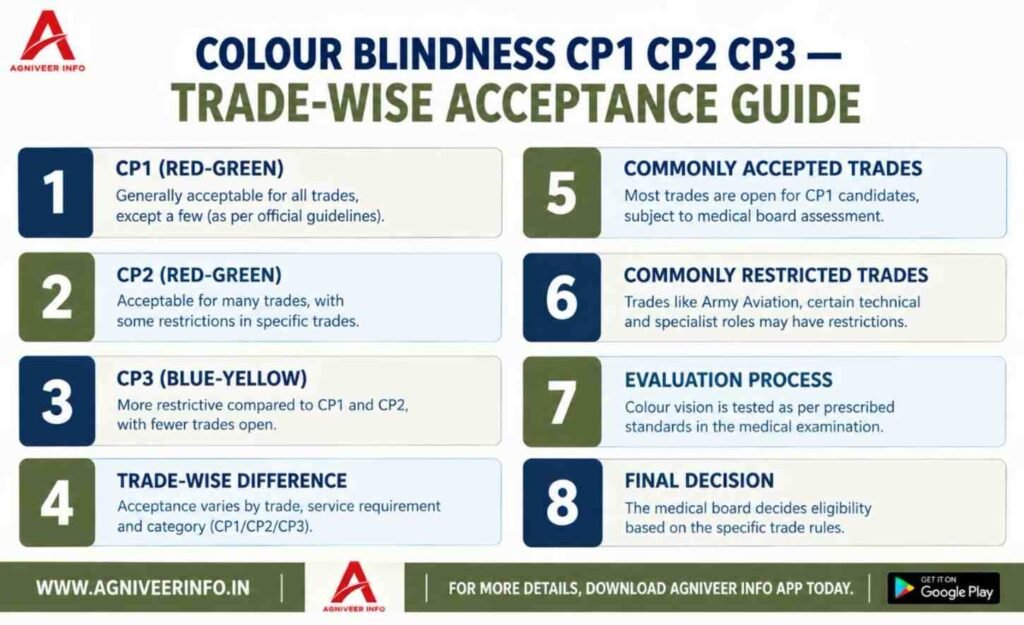
CP1 is the highest standard of normal colour vision, CP2 means normal or nearly normal vision that is good enough for most general duties, and CP3 means a mild weakness in which some fine differences in colour may be missed. Candidates often make the mistake of thinking that one colour grade is accepted in the same way in every branch and trade,
but the medical rules depend a lot on the service branch, on the needs of the trade and on the current official notice for that intake. If you depend on old charts from the internet or on general medical forums, you can be misled, so it is important to understand how the rules work for each trade and each service in practice.
WHAT IS COLOUR BLINDNESS IN DEFENCE MEDICAL EXAMINATION?
In a defence medical examination, colour blindness means that a candidate cannot tell certain colours or fine shades apart, or can do it only poorly, mainly red and green. The defence forces depend a great deal on exact visual identification, so if a signal light on the deck of a warship is wrongly identified, a display in a cockpit is read wrongly, or a marker on the ground is misunderstood, the safety of the operation and the mission can be put at risk.
It is important to know that sharpness of vision (such as 6/6 distance vision) and the ability to see colours are two completely different things. A candidate can have perfect 6/6 vision without glasses and still have a defect in colour vision, and this is why the official medical boards check colour vision as a separate condition in the recruitment medicals.
WHAT ARE CP1, CP2 AND CP3?
The military medical manuals divide colour vision into fixed grades, so that they can decide how suitable a candidate is for different military conditions:
- CP1 (Colour Perception Grade I): This is the best and fullest colour vision, without any defect. Candidates in this grade can quickly and correctly identify signal lights, tiny colour-coded wires and complex displays without any mistake.
- CP2 (Colour Perception Grade II): This means normal or safe colour vision. Candidates in CP2 can reliably identify the main colours such as red, green and white from the distances that are fixed for operations, which makes them fit for the standard combat and technical roles.
- CP3 (Colour Perception Grade III): This means a mild weakness in colour vision. Candidates in CP3 may fail some of the fine plates on the colour vision charts, but they can still tell the basic strong colours apart in controlled conditions.
CP1 VS CP2 VS CP3 — KEY DIFFERENCE
The main practical difference between these grades is how exact the colour recognition must be for special military tasks. CP1 is kept for roles in which even a tiny delay or a small mistake in recognising a colour creates a very big risk, such as military flying or deep-sea work. CP2 gives a high level of safety that covers most of the field duties, technical duties and general combat duties. CP3 is a limited standard, which may be considered only for office, clerical or other support trades that are not critical, depending on the policy of each service.
ARMY AGNIVEER COLOUR VISION STANDARDS
The Indian Army keeps strict physical and medical conditions for all the Agniveer entries. For the main operational roles like Agniveer General Duty (GD), Agniveer Technical and the active combat arms, a colour vision standard of CP2 or better is generally required, so that the candidate stays safe during tactical deployments.
For non-combat, clerical or office support roles, such as Agniveer Clerk/Store Keeper Technical (SKT) or some Tradesman categories, the medical standards in some notices allow CP3 vision. But candidates must check the exact notice of the intake, because the standards are updated as per the needs of the service.
NAVY AGNIVEER COLOUR VISION STANDARDS
The Indian Navy works in risky conditions at sea, in submarines and in naval aviation, where seeing colours correctly is very important for navigation and for identifying signals. So the medical standards of the Navy are especially strict.
The technical and operational trades of Agniveer (SSR) and Agniveer (MR) generally need CP1 or CP2 standards. The Navy usually does not accept candidates with a serious weakness in colour vision (such as CP3 or below) for sea-going, aviation or technical branches, because reading the navigation lights or the control panels wrongly at sea can be very dangerous.
AIR FORCE AGNIVEERVAYU COLOUR VISION STANDARDS
The Indian Air Force uses special vision standards that suit the flight line, technical maintenance and air defence duties. The flying branches strictly need CP1 standards.
For Agniveervayu (Science subjects and subjects other than Science), the technical trades that deal with avionics, radar, aircraft maintenance and airfield safety usually need a high colour vision standard (CP1 or CP2). The non-technical trades may follow the rules given in the recruitment advertisement, but defects in colour vision are still checked carefully.
TRADE-WISE ACCEPTANCE OF CP1, CP2 AND CP3
Eligibility is not the same for everyone, and it is worked out by this formula: Service + Trade + Intake Notification.
- Technical & Engineering Trades: These generally require CP1 or CP2 due to the use of colour-coded wires, diagrams, and testing instruments.
- Operational & Combat Roles: These typically need CP2, so that targets, signals and ground features can be identified correctly.
- Administrative & Support Roles: These may accept CP3 in some Army trades, as long as the role has very few visual tasks that are critical for safety.
WHICH TRADES USUALLY REQUIRE STRICTER COLOUR VISION?
Roles that deal with electrical systems, signals, support for aircraft, weapon systems, navigation and night patrolling always need stricter colour vision (CP1 or CP2). In these branches, if a person fails to recognise red and green markers or system alerts, it can lead to terrible failures in operations.
HOW IS COLOUR VISION TESTED DURING THE MEDICAL EXAMINATION?
The military medical boards check colour vision with standard tools, mainly the Ishihara Pseudoisochromatic Plates (at least the 24-plate edition), which are books of plates made of coloured dots, and, where it applies, lantern tests (such as the Martin-Latinum lantern test). The candidates are asked to name the numbers or trace the lines that are hidden inside patterns of many coloured dots, in standard light. Online tests are useful for knowing your own condition, but they cannot take the place of the official military medical equipment or of the checks by the boards.
CAN COLOUR BLINDNESS CAUSE REJECTION?
Yes, a serious grade of colour blindness, or a grade that is not approved, can make a candidate medically unfit for particular trades. But this does not mean automatic rejection from every entry in all the services. If a candidate fails the CP grade that is needed for a technical trade, he may still be eligible for other entries in which lower CP grades (like CP3) are allowed, as long as he meets all the other conditions.
COMMON MISTAKES CANDIDATES MAKE ABOUT CP1, CP2 AND CP3
- Assuming CP3 causes rejection everywhere: Some non-combat or office trades of the Army may accept CP3, depending on the guidelines in the notice.
- Believing CP2 is accepted for every trade: The highly special roles in aviation, diving or submarines often need CP1 only.
- Confusing distant eyesight with colour perception: Having 6/6 distance vision does not mean that a candidate automatically has normal colour vision.
- Applying Army rules to Navy or Air Force: Each service branch publishes its own medical rules that suit its own working conditions.
- Relying on unofficial internet charts: Charts online do not have a standard screen setting, so they cannot decide the official CP grade.
- Attempting to treat inherited colour blindness: Colour blindness that a person is born with cannot be cured for good by eye exercises, diets or paid visual training programs.
WHAT SHOULD A CANDIDATE DO IF COLOUR VISION IS AN ISSUE?
Candidates who think that they have a problem with colour vision should visit a qualified eye doctor (ophthalmologist) for a proper Ishihara test before applying. If a weakness is found, the candidate should carefully read the latest official recruitment advertisement for the service and the trade that he is aiming for. If he is declared unfit in the first medical, he has the right to appeal before an Appeal Medical Board (AMB) as per the standard rules of the service.
| Colour Vision Factor | Army | Navy | Air Force |
| CP Classification | Evaluates CP1, CP2, and CP3 based on trade requirements. | Employs strict CP1 and CP2 standards across branches. | Mandates CP1 for flying; CP1/CP2 for technical trades. |
| Trade Dependence | Varies between GD, Technical, and Clerk/Tradesman roles. | Dependent on sea-going, technical, or shore-based entry. | Dependent on flying, technical, or non-technical ground roles. |
| Stricter Requirements | Combat, Signals, and Aviation mandate higher CP grades. | Submarine, Aviation, and SSR mandate strict CP standards. | Flight line, avionics, and air traffic require CP1/CP2. |
| Candidate Verification | Check specific Army rally notification for trade rules. | Check official Navy recruitment instructions for branch rules. | Check latest Agniveervayu advertisement for trade criteria. |
CONCLUSION
Understanding the colour vision standards like CP1, CP2 and CP3 is very important for every candidate who wants to join the Armed Forces through the Agniveer entries. The needs of vision are very different on land, at sea and in the air, so there is no single rule for accepting every trade.
Technical and combat roles always need stricter colour vision (CP1 or CP2), while some office roles may accept CP3 under the special rules of a service. Candidates should always read the official recruitment notices, and not unofficial sources on the internet, to check their eligibility. In the end, the decision of the official military medical board is the only final word on whether a candidate is medically fit.
For daily update join our WhatsApp channel
FREQUENTLY ASKED QUESTIONS
Q1. What do CP1, CP2 and CP3 mean?
A1. CP1, CP2 and CP3 are military medical grades that measure colour vision, and they go from perfect colour vision (CP1) to a mild weakness in colour vision (CP3).
Q2. Is CP3 accepted in Agniveer recruitment?
A2. CP3 is accepted only in some support or clerical trades in which the official notices clearly allow it, mainly in particular entries of the Indian Army.
Q3. Is CP2 accepted for every Agniveer trade?
A3. CP2 is widely accepted in many general and technical trades, but the special roles in aviation, diving or submarines usually need the higher CP1 standard.
Q4. Which defence trades require stricter colour vision?
A4. Trades that deal with aviation, electronics, signals, navigation, weapon systems and combat operations need stricter colour vision, so that important signals and displays are identified safely.
Q5. Does colour blindness automatically cause Agniveer rejection?
A5. Colour blindness causes rejection in the trades that need CP1 or CP2, but candidates may still be eligible for some trades that accept lower colour vision standards.
Q6. Are Army, Navy and Air Force colour vision standards identical?
A6. No, the colour vision standards are different in the services, because the working conditions at sea, the safety rules in aviation and the technical needs are very different in the three branches.
Q7. How is colour vision tested during medical examination?
A7. The medical boards test colour vision with standard Ishihara pseudoisochromatic plates and with special lantern tests, in controlled clinical light and under the watch of military medical officers.
Q8. Where can candidates verify the latest CP requirements?
A8. Candidates should check the exact colour vision requirements by reading the official recruitment notices that are published on the official portals of the Army, the Navy or the Air Force.
READ ALSO: AGNIVEER DENTAL POINTS SYSTEM EXPLAINED — 14-POINT RULE