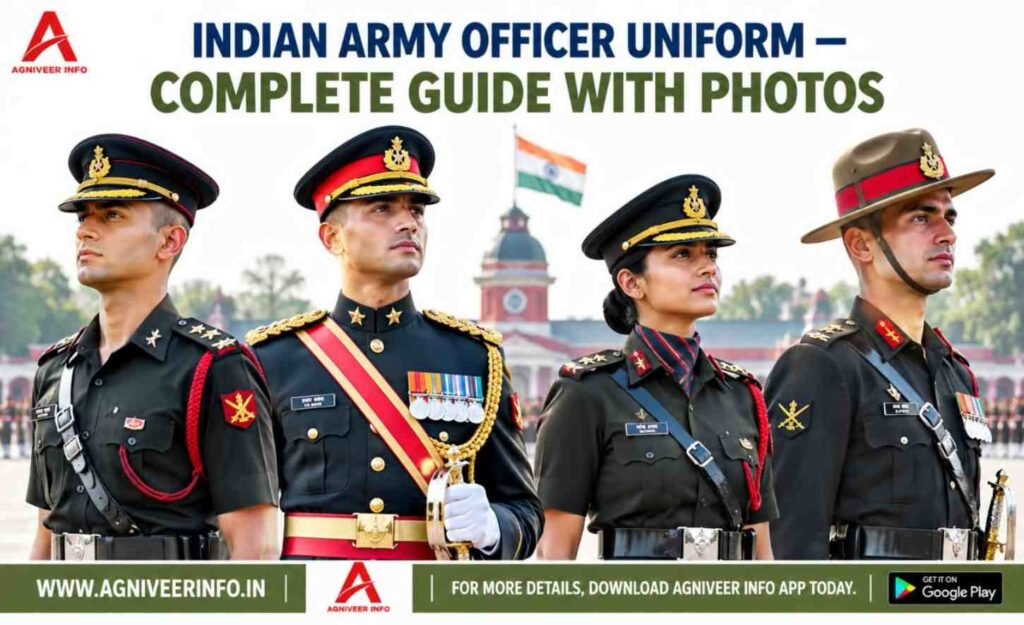
When you see an Indian Army officer walking by, the first things that catch your eye are the sharp look, the bright stars on the shoulders, the colourful ribbons on the chest and the confident walk. Every small detail on that dress tells a story about the officer’s job,
hard work and achievements. But many people wonder why officers do not wear the same dress every day, and the truth is that an Army officer wears different clothes depending on the work that he is doing that day.
An officer wears one type of clothes while training in the hot sun, and a completely different type while attending a grand dinner or a parade. The dress changes according to the duty, the weather, the formal events and the field operations. In this guide,
we will explain the Indian Army officer uniform in very simple words. You will learn about the different types of dress, the rank stars, the chest ribbons, the caps and the special badges, so that you can easily recognise them the next time you see them.
 An Indian Army officer wearing the sharp daily service uniform with rank insignia and ribbons.
1. WHY DOES THE INDIAN ARMY HAVE DIFFERENT UNIFORMS?
Why cannot an officer wear one single dress for everything? Just imagine wearing a heavy suit while running in a dusty jungle, because it would be very uncomfortable and hard to move in. In the same way, wearing a dirty camouflage outfit at an official national ceremony would not look respectful or smart.
The Army gives different clothes for daily office work, physical training, cold weather, grand parades and operational missions. This keeps the officer comfortable while he does physical tasks, and it also makes sure that he looks formal during important government ceremonies.
2. MAIN TYPES OF INDIAN ARMY OFFICER UNIFORMS
To keep things simple, the clothes that officers wear are divided into a few main groups:
- Service Uniform: Worn for daily office work, normal indoor duties and routine meetings.
- Combat Uniform: Worn during field operations, training exercises, tactical missions and jungle postings.
- Ceremonial Uniform: Worn on big days like Republic Day and Independence Day, and at formal military parades.
- Mess Dress: Worn during formal evening dinners, official parties and military gatherings.
| Uniform Type | Main Purpose | Usually Worn For | Key Feature |
| Service Dress | Daily Duty | Office work and routine tasks | Olive green color with rank stars |
| Combat Uniform | Field Operations | Jungle warfare and field training | Digital camouflage pattern with name patch |
| Ceremonial Dress | Public Events | Parades and national days | Accompanying medals, sword, and ceremonial belts |
| Mess Dress | Evening Dinners | Official parties and formal galas | Tuxedo-style dark jacket with miniature medals |
4. INDIAN ARMY OFFICER SERVICE UNIFORM
The daily office uniform is usually an olive green dress. In summer, officers wear an olive green shirt with matching trousers, and in winter they wear a dark olive green jacket along with a tie.
When you look at an officer in this uniform, you will see a name plate on the right side of the chest. On the left side of the chest, you will see colourful strips of cloth that are called ribbons. The shoulder straps hold the metal rank stars, and the belt usually has a brass buckle that shows the Army emblem or the crest of the regiment. Black or brown leather shoes complete this professional look.
5. RANK INSIGNIA: HOW TO IDENTIFY RANKS
The metal badges on the shoulder straps of an officer show his official rank (insignia means a badge or sign of rank). As an officer gets promoted, these badges change:
- Lieutenant: Two stars on each shoulder.
- Captain: Three stars on each shoulder.
- Major: National Emblem (Ashoka Lion Capital) on each shoulder.
- Lieutenant Colonel: National Emblem and one star.
- Colonel: National Emblem and two stars.
- Brigadier: National Emblem along with three stars arranged in a triangle.
- Major General: Crossed sword and baton accompanied by one star.
- Lieutenant General: Crossed sword and baton accompanied by the National Emblem.
- General: Crossed sword and baton, a star, and the National Emblem.
 Metal rank stars and emblems displayed on shoulder straps show an officer’s rank.
6. SHOULDER BADGES AND REGIMENTAL IDENTIFIERS
Apart from the rank stars, the shoulders also carry metal shoulder titles. These metal letters tell you which branch or corps the officer belongs to, such as Artillery, Signals or Engineers.
Some officers wear coloured tabs on their collars. Senior officers like Colonels and above wear special red collar patches, which are called gorget patches. Officers who are posted in special forces like the Para Commandos wear different shoulder flaps and arm badges to show their special training.
7. RIBBONS, MEDALS, AND DECORATIONS
The small colourful strips of cloth on the left chest are called ribbons. Each ribbon stands for a medal that the officer has earned during his career.
Full metal medals are worn only during grand parades and national ceremonies. On the daily service uniform, it is not practical to carry heavy medals, so flat cloth ribbons are used instead. These ribbons tell you about the officer’s awards for bravery, his long service in tough regions like Siachen, and his part in special military operations.
 Ribbons worn on the chest represent full metal medals and honors in a compact form.
8. HEADGEAR (CAPS AND BERETS)
The cap that an officer wears tells you a lot about his corps and his unit. The dark green or black soft woollen cap that is shaped like a round hat is called a beret.
- Green Beret: Worn by the Infantry and many general arms.
- Red / Maroon Beret: Worn by Paratroopers and Special Forces.
- Black Beret: Worn by the Armoured Corps (tank units).
- Dark Blue Beret: Worn by Support Services like Engineers, Signals and the Medical Corps.
- Peak Cap: A formal stiff cap with a visor in front, worn during important indoor events and official visits.
9. REGIMENTAL AND CORPS DIFFERENCES
You might see two officers in olive green uniforms who wear slightly different buttons or caps. This happens because the Indian Army has rich traditions that are kept alive within its different regiments.
Officers of the Gorkha Regiment wear a special broad hat, called the Terai hat, during ceremonies. Sikh officers wear smart turbans that match the colour of the beret of their regiment. The designs of the buttons, the leather belts and the cap badges are different according to the particular regiment that an officer belongs to.
10. COMBAT/FIELD UNIFORM
The combat dress is made for hiding in natural surroundings and for fighting in tough land. The modern Indian Army uses a digital camouflage uniform. This pattern has tiny square pixels of green, brown and khaki colours that help officers to blend into trees, bushes and dry ground.
It is made from strong and light cloth that does not tear easily. The name plate and the rank insignia on combat dress are made of cloth and not of shiny metal, so that enemy forces cannot spot the officers from far away.
 The modern digital camouflage field dress designed to blend into operational environments.
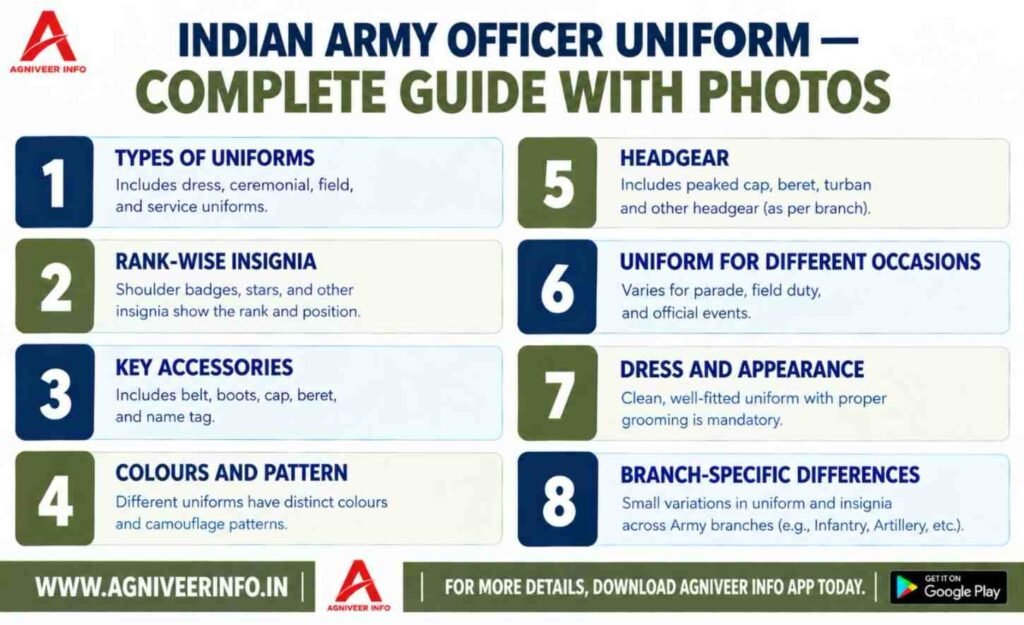
CONCLUSION
The Indian Army officer uniform is much more than a set of smart clothes. Every star, badge, ribbon and cap colour carries a deep meaning, and it shows the rank of the officer, his regiment, his awards for bravery and his years of dedicated service to the nation.
Different uniforms make sure that officers can do their duties well, whether they are standing guard in harsh snow, crawling through thick jungle or representing the nation on Republic Day. When we understand these simple details of the uniform, students, defence aspirants and citizens can better appreciate the pride, discipline and responsibility that the brave officers of the Indian Army carry.
Get the latest Agniveer updates by joining our WhatsApp channel
FREQUENTLY ASKED QUESTIONS (FAQS)
Q1. What uniform does an Indian Army officer wear daily?
A1. An officer usually wears an olive green shirt and trousers in summer for office work. In winter, he adds a dark olive green jacket with a necktie to complete the daily service dress.
Q2. How can you identify an officer’s rank easily?
A2. You can identify an officer’s rank by looking at the metal badges on his shoulder straps. Two stars mean Lieutenant, three stars mean Captain, and an Ashoka emblem shows a Major.
Q3. What do ribbons on an Army uniform mean?
A3. Ribbons are small cloth forms of the full-size medals. They show the military decorations of an officer, his awards for bravery, his long service and his part in special operations during his service career.
Q4. Why do Army officers have different badges?
A4. Badges show the particular regiment, corps, special skills and appointment of an officer. Badges help to tell apart airborne paratroopers, tank regiments, infantry units and high-ranking commanders.
Q5. What is the difference between ceremonial and combat uniform?
A5. Ceremonial uniform is a smart dress that is worn with full medals and swords during formal parades and national celebrations. Combat uniform uses digital camouflage cloth that is made for field battles and jungle training.
Q6. Why do uniforms differ between regiments?
A6. The Indian Army respects its historic traditions. Different regiments keep their own cap badges, belt buckles, lanyard colours and traditional headgear like Sikh turbans or Gorkha hats, to show pride in their regiment.
Q7. What is mess dress?
A7. Mess dress is formal evening wear that is used for official dinners and military galas. It has a tuxedo-style jacket, matching trousers, a bow tie and miniature medals that are worn on the lapel of the jacket.
Q8. Can the Army uniform design change over time?
A8. Yes, uniform designs are updated to improve comfort, camouflage and use in the field. For example, the Indian Army recently took up an improved light digital camouflage pattern for better comfort in operations.
READ ALSO: AGNIVEER ARMY VS NAVY VS AIR FORCE: FULL COMPARISON 2025