

Source: Join Indian Navy
To understand the pay of an Indian Navy Agniveer, you need to look at more than one big number. The pay system under the Agnipath scheme is quite different from the usual military pay scales, so candidates who are thinking about a career in the Navy should know how the monthly pay is divided, how the deductions work, and how the benefits grow over the four years of service.
The Navy Agniveer salary is planned as a package that has three parts: the monthly pay you receive, a fund that is saved for your future, and special service allowances. Many candidates look only at the first big monthly figure, but the real picture has more parts, like the monthly amount that is cut for savings, the equal amount that the government adds, and the final lump sum called the Seva Nidhi (the savings fund that you receive when your service ends).
When you understand these details, you can compare the money you get in hand every month with the money that grows for your future. The official Indian Navy recruitment notification is the main source for the exact figures, rules, and benefits. This guide explains the monthly pay, the in-hand salary, the fund contributions, the allowances, and how your money grows over the four years of service.
What Is Navy Agniveer Salary?
The salary of an Indian Navy Agniveer follows a special pay model that was brought in under the Agnipath scheme. Regular military personnel get pay based on the usual pay matrix (the table of pay levels), military service pay, and the old pension system, but an Agniveer works under a fixed package for a fixed period of service. So the word “salary” here means a monthly package that has many parts, and not just a simple basic pay figure.
This pay model has two parts, which are the money that you get directly and the money that is saved for you. A fixed share of the monthly package goes into the Corpus Fund, and the central government puts in the same amount as you do. It is important to know the difference between the full package figure and the money that actually comes into your bank account, so that you can plan your finances well. Candidates should also count the free facilities they get for living and the savings that are kept for later, because this is the only way to see the true value of the service period.
Navy Agniveer Monthly Salary Structure
The monthly pay of a Navy Agniveer follows a fixed scale that goes up with each year of service. The full monthly package starts at 30,000 rupees in the first year and rises step by step over the four years. But this is not the amount that comes into the sailor’s bank account every month.
From the full monthly package, exactly thirty percent is cut as the person’s own share for the Agniveer Corpus Fund, and at the same time the central government puts in the same amount into that account.
The other seventy percent of the monthly package is the base in-hand salary, which is paid straight to the person. When candidates understand this split, they do not mix up the full package with the money they can actually spend every month during service.
Navy Agniveer Salary Year-Wise Breakdown
The pay of a Navy Agniveer grows with fixed increases every year across the four years of the contract. In the first year, the monthly package is 30,000 rupees, and out of this, 9,000 rupees (30%) goes into the Corpus Fund, which leaves a base in-hand salary of 21,000 rupees per month.
In the second year, the monthly package goes up to 33,000 rupees, the monthly share of the candidate goes up to 9,900 rupees, and the in-hand pay becomes 23,100 rupees. In the third year, the monthly package reaches 36,500 rupees,
with 10,950 rupees going into the fund and an in-hand salary of 25,550 rupees. In the fourth and last year, the monthly package rises to 40,000 rupees, the monthly deduction becomes 12,000 rupees, and the base in-hand pay is 28,000 rupees per month.
Navy Agniveer In-Hand Salary
The in-hand salary is the real amount that comes into the Agniveer’s bank account every month after the fund share is cut. Many applicants wrongly take the full package as their take-home pay, but the amount you actually receive each month is seventy percent of the package in every year of service.
Some other things can change the total you take home, depending on where you are posted and what kind of duty you do. The base in-hand amount stays the same for everyone, from 21,000 rupees in the first year to 28,000 rupees in the fourth year, but allowances for special areas or hardship pay can raise your real monthly income.
On the other side, normal personal expenses or deductions that you choose may also apply, depending on your own service arrangements. So when candidates plan a monthly budget, they must keep the fixed take-home pay separate from the allowances that can change.
Navy Agniveer Seva Nidhi Package
The Seva Nidhi package is a big part of the money side of the four-year Agnipath service. It grows from your own monthly share and the equal share from the government over the forty-eight months of service. Since thirty percent of the monthly package is cut and the government adds the same amount, a large savings fund builds up steadily.
When you finish the four years of service, you are paid the total amount that has been saved, along with the interest that is added as per the government’s rules. The total saved amount (without interest) is more than ten lakh rupees, which gives you a good sum of money to start the next part of your life. This lump sum is meant to give financial support to people who want to study further, start a business, or take up another job after leaving the Navy.
Navy Agniveer Allowances and Other Benefits
Along with the base monthly package, Indian Navy Agniveers get some allowances and other facilities that help them do their duties. Whether you get an allowance depends fully on the official service rules and on where you are deployed. Risk and hardship allowances, high-altitude allowances, or island duty pay are given when personnel serve in special operational areas or in special naval posts.
The service benefits also include full medical facilities during the period of service, uniform allowances, and food and a place to stay as per the service rules. Agniveers also get life insurance cover worth 48 lakh rupees for the whole period of service, and they do not have to pay anything for it. All these facilities and protections lower your personal living costs, which makes the net monthly salary worth more.
Navy Agniveer Salary vs Permanent Navy Salary
The pay of an Agniveer is very different from the pay of the permanent regular cadre of the Indian Navy. Regular sailors are paid under the standard military pay matrix, which includes basic pay, military service pay, regular group allowances, yearly increases, and a lifelong pension after they complete the minimum service that is required.
The Navy Agniveer pay model, on the other hand, works on a single fixed four-year contract with a set yearly increase. Agniveers do not get the usual military service pay or a permanent pension when they leave. However, up to twenty-five percent of an Agniveer batch may be selected into the regular cadre, based on the needs of the Navy and on their performance, and from that point they get the standard permanent Navy pay scales.
What Happens to Salary After Four Years?
When the four-year period ends, the regular monthly salary stops and the person leaves active naval service. At the time of leaving, the full Seva Nidhi amount, which is made up of the person’s own savings, the government’s equal share, and the interest that has been added, is paid as one lump sum to help with the move to civilian life.
For the chosen few who are kept in the regular cadre, the regular military pay scales apply. For those who leave, the Agniveer scheme does not give a regular monthly pension or medical cover after service. So the money you have after four years depends on how well you use the Seva Nidhi payout, on the skill certificates you have earned, and on the career chances that come from the government’s reservation schemes.
Is Navy Agniveer Salary Taxable?
The tax rules for the pay of an Agniveer follow the current Indian income tax laws and the official finance acts. The monthly in-hand pay is taxed under the normal income tax rules, based on the tax slab that applies to the person and the tax regime (the tax system) that they choose.
For the Seva Nidhi package, the official rules generally give a tax exemption on the final amount that is paid when the service ends, including the government’s share and the interest. But income tax rules can be changed by new laws, so candidates should check the current official notification and ask financial authorities for the latest tax position.
Common Misconceptions About Navy Agniveer Salary
- Gross package equals take-home pay: Many candidates think that the full monthly package comes into their bank account, but they forget that thirty percent is cut for the fund.
- Government contributions are paid monthly as cash: The government’s share is put straight into the Seva Nidhi fund and is not paid out in cash.
- Seva Nidhi replaces monthly income: The Seva Nidhi is a savings fund that you receive when your service is complete, and it is not a monthly payment.
- Permanent absorption is guaranteed: Being chosen for the regular cadre depends on performance and is limited to a fixed percentage, so it is not automatic for every recruit.
- Allowances are uniform for everyone: Special risk and hardship allowances are given only for certain deployment areas and roles, and not to all personnel.
- Old figures remain accurate indefinitely: The pay structure and the allowance rules can be changed through official government updates, so older figures on the internet may be out of date.
- Navy pay structures match other services identically: The Agnipath framework is the same for all, but allowances for sea duty and naval deployment are different from those of the Army or the Air Force.
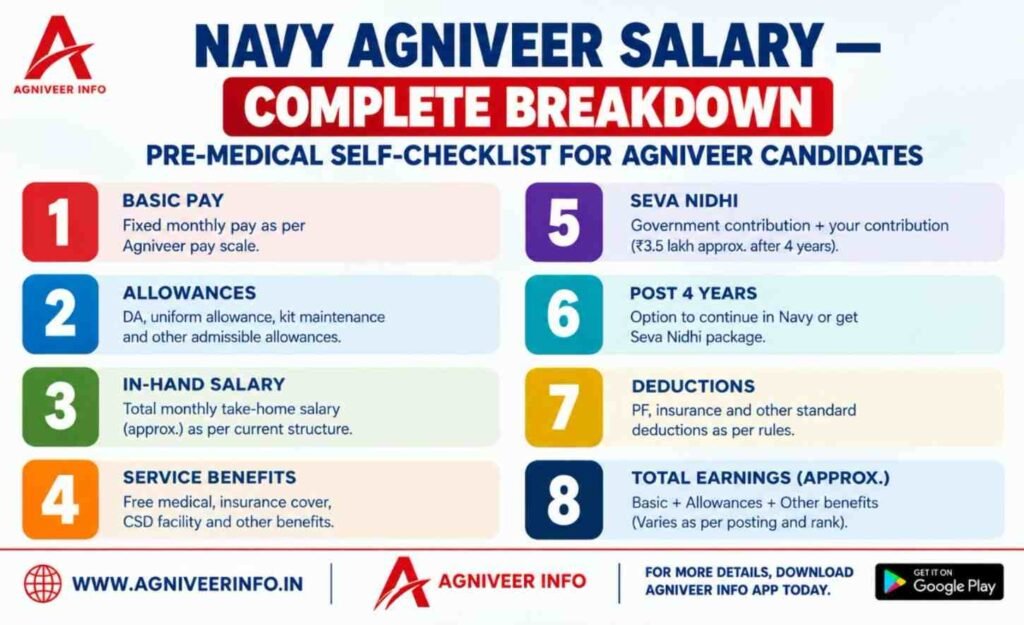
How to Understand Your Navy Agniveer Financial Package
To judge the financial package of a Navy Agniveer properly, you should look at everything together, which means the money you get now, the savings that are kept for you, the facilities you get free, and the capital that builds up in the long run. Instead of looking only at the first monthly cash amount, recruits should count the basic costs that are already covered, like housing, meals, uniforms, and medical care, because these lower their personal cost of living.
The Agniveer Corpus Fund also works as a forced saving plan, which helps you build wealth with discipline. The government’s equal share doubles the amount that the recruit saves over the four years. When you add up the monthly in-hand cash, the free accommodation, the insurance cover, and the final Seva Nidhi lump sum, you get an accurate picture of the total pay.
| Financial Component | What It Means | Candidate Should Understand | Important Note |
| Monthly Package | The total fixed monthly pay fixed for each year of service. | It includes the base pay before the compulsory fund deduction and before allowances. | It goes up every year across the four-year contract. |
| Candidate Contribution | A compulsory thirty percent cut from the full monthly package. | It is cut automatically every month to build the Seva Nidhi fund. | It builds a habit of compulsory saving throughout service. |
| Government Contribution | An equal amount that the central government puts into the fund. | It is the same as the candidate’s cut, so it doubles your monthly savings. | It goes straight into the Seva Nidhi fund and is not paid as monthly cash. |
| Seva Nidhi | The final lump sum that is paid when service is complete. | It is made up of your own savings, the government’s share, and the interest. | It gives you a good amount of capital when you leave after four years. |
Conclusion
The Indian Navy Agniveer salary system is a planned pay model that mixes monthly take-home pay with a large compulsory savings plan. Over the four years, recruits get fixed yearly increases and build a good reserve of money through the government’s equal contributions.
The in-hand monthly pay is seventy percent of the full package, and the remaining part goes straight into the final Seva Nidhi fund. Together with free housing, medical cover, and special allowances during service, the whole package gives financial security both during service and just after it. Candidates who want to apply should always check the exact terms and figures in the official recruitment notification.
Get the latest Agniveer updates by joining our WhatsApp channel
Frequently Asked Questions
Q1. What is the monthly salary of a Navy Agniveer?
A1. The monthly package starts at 30,000 rupees in the first year and goes up every year until it reaches 40,000 rupees per month in the fourth year.
Q2. What is the difference between Navy Agniveer salary and in-hand salary?
A2. The salary is the full package amount, while the in-hand salary is the amount that actually comes into your account after thirty percent is cut for the savings fund.
Q3. What is the Navy Agniveer Seva Nidhi?
A3. Seva Nidhi is the final lump sum that builds up from the monthly cuts of the candidate and the equal contributions of the government, and it is paid with interest when the service is complete.
Q4. Does the government contribute to the Navy Agniveer fund?
A4. Yes, every month the central government puts an amount equal to thirty percent of the monthly package into the person’s Seva Nidhi fund.
Q5. Does Navy Agniveer salary increase every year?
A5. Yes, the monthly package goes up every year, from 30,000 rupees in the first year to 40,000 rupees in the fourth year.
Q6. What benefits are available to Navy Agniveers?
A6. Agniveers get in-hand pay, the Seva Nidhi savings, free medical facilities, housing, uniform allowances, and life insurance cover worth 48 lakh rupees for which they do not pay anything.
Q7. Does every Navy Agniveer become a permanent employee?
A7. No, being made permanent is not automatic. Up to twenty-five percent of each batch may be kept in the regular cadre, based on the merit and the needs of the Navy.
Q8. Where can candidates check the latest Navy Agniveer salary details?
A8. Candidates can check the current official figures, allowance rules, and service conditions directly on the official Join Indian Navy recruitment website.