KNOW YOUR FORCES — BASIC MILITARY TRAINING WHAT TO EXPECT
Source: Indian Army Official Website, Indian Navy Official Website, Indian Air Force Official Website, Indian Coast Guard Official Website
Last updated: 19 November 2026
Basic Military Training: Introduction
In this guide on basic military training, you will learn about physical conditioning, drill and discipline and weapon training. For most Agniveer aspirants, basic military training is the single biggest unknown before joining service — a transition from civilian life to a highly structured, disciplined military environment. Understanding what to realistically expect can help reduce anxiety, set proper expectations, and allow aspirants to mentally and physically prepare in advance.
What Is Basic Military Training?
With recruit training in mind, basic military training, sometimes called recruit training, is the initial period of training every newly enlisted soldier, sailor, or airman goes through after selection, before being posted to a specific unit or trade. Its purpose is to transform civilians into disciplined service personnel by building physical fitness, weapon handling skills, basic military knowledge, and, importantly, the mental toughness and teamwork required for military life. The exact duration and content vary somewhat between the Army, Navy, and Air Force, but the broad purpose and many core elements are similar across all three services.
For more details on this topic, read this: Military Daily Routine and Discipline for Agniveers
Physical Conditioning
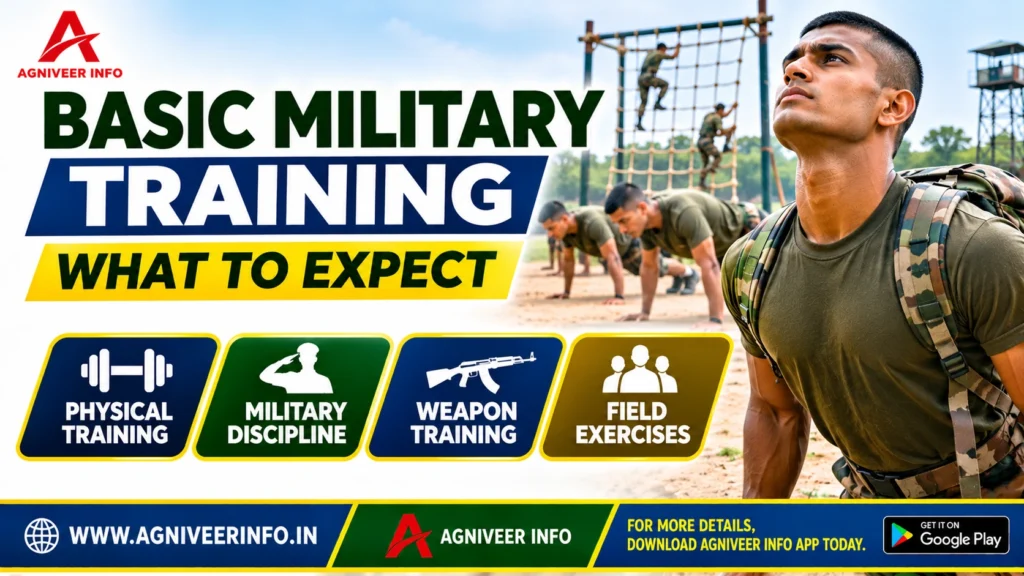
From the very first days, physical training is a central part of basic military training. This typically includes:
- Running and endurance training: Regular runs, gradually increasing in distance and speed, to build stamina and cardiovascular fitness.
- Obstacle courses: Physical courses involving climbing, crawling, jumping, and balance exercises designed to build functional strength and confidence under physically demanding conditions.
- Strength training: Exercises such as push-ups, pull-ups, and other bodyweight exercises to build overall strength.
- Swimming (where applicable): Particularly relevant for Navy and certain specialised roles, though basic water confidence training may be included more broadly.
For basic military training, physical fitness standards are tested periodically throughout training, and recruits are expected to show continuous improvement.
Drill and Discipline
Drill, meaning coordinated marching and parade movements, is a major part of early training. While it might seem purely ceremonial, drill instils important qualities: precision, attention to detail, the ability to follow orders instantly, and unit cohesion, since drill only works when everyone moves in perfect coordination. Recruits also learn basic customs and courtesies of military life, including how to address superiors, wear the uniform correctly, and maintain personal and equipment discipline.
Weapon Training
Looking at basic military training, recruits are introduced to basic weapon handling, safety procedures, and marksmanship using the standard service weapon (commonly a rifle). This includes classroom instruction on weapon parts and safety rules, followed by supervised practical training on ranges, gradually building up to live firing exercises once recruits demonstrate sufficient competence and safety awareness.
Basic Military Training: Academic and Basic Military Knowledge
In the context of basic military training, alongside physical training, recruits also receive classroom instruction covering topics such as map reading, basic first aid, military law and conduct, and an introduction to the history, values, and traditions of their specific service and, where applicable, their regiment or unit.
For more details on this topic, read this: INS Chilka Agniveer Training: What to Expect
Field Training
As training progresses, recruits typically move into more advanced field exercises, which may include basic tactics, camouflage and concealment techniques, section-level movement drills, and introductory night training exercises, all conducted under the close supervision of experienced instructors.
Mental and Psychological Adjustment
Basic military training is not only physically demanding but also mentally challenging. Recruits often face a sudden loss of personal routine and independence, strict schedules, and high expectations from instructors. This is intentional — the process is designed to build resilience, discipline, and the ability to function effectively under pressure and fatigue, qualities considered essential for military service. Most recruits find that, while difficult initially, this adjustment becomes more manageable as training progresses and as bonds form with fellow recruits going through the same experience.
What Helps Aspirants Prepare in Advance
In recruit training, building general physical fitness well before joining, particularly running endurance and basic strength, makes the initial transition considerably easier. Developing habits of discipline and punctuality in daily civilian life also helps. Mental preparation — understanding that initial discomfort and challenge are a normal and expected part of the process rather than a sign of failure — is equally important.
Why This Matters for an Agniveer Aspirant
Having a realistic picture of basic military training helps an aspirant prepare more effectively, both physically and mentally, and reduces the shock of transition once actual training begins. It also helps in interviews, where demonstrating awareness of what military training genuinely involves reflects seriousness and preparedness for a career in the armed forces.
5 Key Facts
- Basic military training transforms new recruits into disciplined service personnel through physical, drill, weapon, and academic training.
- Physical training includes running, obstacle courses, and strength exercises, with fitness levels tested periodically.
- Drill and parade training build discipline, precision, and unit coordination.
- Weapon training begins with classroom safety instruction before progressing to supervised range and live-fire practice.
- Mental resilience and adaptability are built intentionally through the structured, demanding nature of training.
Quick Revision
Basic training = physical conditioning + drill + weapon training + academics + field exercises. Physical training: running, obstacle courses, strength building; tested periodically. Drill builds discipline, precision, and coordination; weapon training starts with safety, then live-fire. Mental toughness and adaptability are intentionally developed throughout the process.
Why This Knowledge Matters
Understanding basic military training in context builds a fuller picture of how India’s defence establishment functions as a connected whole, which is valuable both for competitive exam preparation and for developing genuine, well-rounded awareness of the forces an Agniveer aspirant is preparing to join. Topics like this appear again in the general knowledge section of recruitment exams, and you will talk about them often once you start serving.
- For more details on this topic, read the Indian Army Official Website.
- For more details on this topic, read the Indian Navy Official Website.
- For more details on this topic, read the Indian Air Force Official Website.
- For more details on this topic, read the Indian Coast Guard Official Website.
For more details and daily updates, join our WhatsApp channel.
Frequently Asked Questions About Basic Military Training
What is basic military training?
It is the initial training every newly enlisted soldier, sailor, or airman completes after selection and before being posted to a unit or trade, covering physical fitness, drill, weapon handling, and basic military knowledge.
What does physical training in basic military training include?
Running and endurance work, obstacle courses, and strength exercises such as push-ups and pull-ups, with fitness tested periodically. Swimming is included where applicable, particularly for the Navy and certain specialised roles.
Why is drill part of basic military training?
Drill builds precision, attention to detail, the ability to follow orders instantly, and unit cohesion, because it only works when everyone moves in perfect coordination.
When do recruits begin live firing?
Weapon training starts with classroom instruction on weapon parts and safety rules, followed by supervised range practice. Live firing begins once recruits show enough competence and safety awareness.
How can aspirants prepare for basic military training in advance?
Build running endurance and basic strength, develop habits of discipline and punctuality, and understand that initial discomfort is a normal part of the process rather than a sign of failure.
Related reading: military daily routine and discipline | regimental centres of the Indian Army
Disclaimer: This information is for general guidance only. Rules, dates and figures can change, so please check the official source linked above before taking any final decision.