
The Agnipath Scheme was brought in by the Government of India as a big change in the way people are hired for the Indian Armed Forces, which include the Indian Army, the Indian Navy and the Indian Air Force.
The aim was to build a younger, more technology-friendly and more motivated military, and for this reason young men and women are hired as “Agniveers” for a fixed period of four years. If you want to join the forces, you should understand clearly what you get during the service and after it, both in money and in other ways.
The scheme gives you a monthly package, a savings fund that builds up over time, skill certificates and some chances after you leave, but it is still quite different from the older permanent service. To know these benefits properly, you should read the official recruitment notices and policy papers instead of trusting guesses, and you should also keep apart the pay you take home each month,
the lump sum you get at the end, the extra allowances for duty, and the job preferences after service, which are conditions and not sure things. This overview explains each of these benefits, the terms that go with them and the options open to you when the four years are over.
What Is the Agnipath Scheme?
The Agnipath Scheme is the main way of hiring people below officer rank in all three branches of the Indian Armed Forces. Those who are selected serve for a fixed short period of four years, and when the four years are over, up to 25 percent of each batch can be chosen for the regular cadre, which means the permanent, long-term staff of the service. This choice depends on what the service needs, on how well the person has performed and on other tests of fitness for duty. The rest of the Agniveers go back to civilian life with their savings and a certificate that shows the skills they have gained.
Financial Benefits of the Agnipath Scheme
The money you get under the scheme rises every year over the four years. In the first year an Agniveer gets a monthly package of ₹30,000, which goes up to ₹33,000 in the second year, ₹36,500 in the third year and ₹40,000 in the fourth year.
The full package, however, is not what reaches your hand every month. Exactly 70 percent is paid to the Agniveer directly, while the other 30 percent goes into the Agniveer Corpus Fund, so the salary you actually receive in hand starts at ₹21,000 in the first year and rises to ₹28,000 by the fourth year.
Seva Nidhi Benefit
The Seva Nidhi package is the main money benefit an Agniveer receives at the end of the four years. Every month, 30 percent of your full package is cut and placed in the Agniveer Corpus Fund, and the Government of India adds exactly the same amount each month,
rupee for rupee. Over four years you put in about ₹5.02 lakh and the government puts in another ₹5.02 lakh, and when you leave, you receive this saved amount of about ₹10.04 lakh together with the interest it has earned, which means the total you take home is generally more than ₹11 lakh. You do not have to pay any income tax on this amount.
Insurance and Financial Security Benefits
During the four years of service, an Agniveer has life insurance cover of ₹48 lakh, and no premium is cut from the salary for it, so the Agniveer pays nothing for this cover. If an Agniveer dies because of the conditions of service during this period, the family, or the next of kin,
receives certain fixed ex-gratia payments and also the pay that would have been earned for the rest of the four years, as the official rules say. In the same way, if an Agniveer suffers a disability on duty, the compensation is decided by how serious the disability is and whether it was caused by the service.
Salary Allowances and Service Benefits
Apart from the fixed monthly package, Agniveers get allowances that depend on where they are sent and what conditions they work in. These include risk and hardship allowance, field area allowance, rations or money in place of rations, dress allowance, and travel allowance for official duty. Whether you get a particular allowance depends a great deal on your posting,
your role and the rules of your service, so it is not the same for everyone. Also, unlike regular permanent soldiers, Agniveers do not get Dearness Allowance (DA), which is extra money to cover rising prices, or Military Service Pay (MSP), which is a special pay for regular military personnel.
Training and Skill Development Benefits
During the service, an Agniveer first goes through military training and then gets more specialised instruction in operations and technical work. The training covers physical fitness, handling weapons in battle, using technical equipment, maintenance work and the qualifications that go with each trade.
When the four years are complete, those who are leaving receive an official “Agniveer Skill Certificate”, which lists their abilities, qualifications and work skills, and this certificate helps them move into civilian work in areas such as industry, technical security, logistics and management.
Medical and Welfare Benefits
For the whole four years, Agniveers can use the full medical facilities of service hospitals and the wider military medical system. Leave, canteen facilities (CSD) and welfare support for duty are also given according to the rules of each service.
These medical benefits end when the service ends, because the medical benefits that permanent veterans get after retirement, along with their pension, do not apply to Agniveers who leave.
Career Benefits After Four Years
When the four years are over, an Agniveer has two possible paths:
- Regular Service Selection: Up to 25 percent of each batch that is leaving can be chosen for the regular cadre, based on merit, the needs of the service and strict assessment standards.
- Civilian Transition: The rest leave active military service with their tax-free Seva Nidhi lump sum, their skill certificates and four years of military experience.
Employment and Post-Service Opportunities
To help those who are leaving, the central and state governments have announced certain job preferences for them. In recruitment, some priority and reservation is given in the Central Armed Police Forces (CAPFs), the Assam Rifles, state police forces and public sector undertakings, which are companies owned by the government, and this follows the rules of each state and department.
Private companies and defence manufacturers also value military skill certificates for technical, office and security jobs. Still, candidates should remember that these are only recruitment preferences or quotas where the government has officially announced them, and they are not a guarantee of a job.
Benefits of Agnipath Scheme for Defence Aspirants
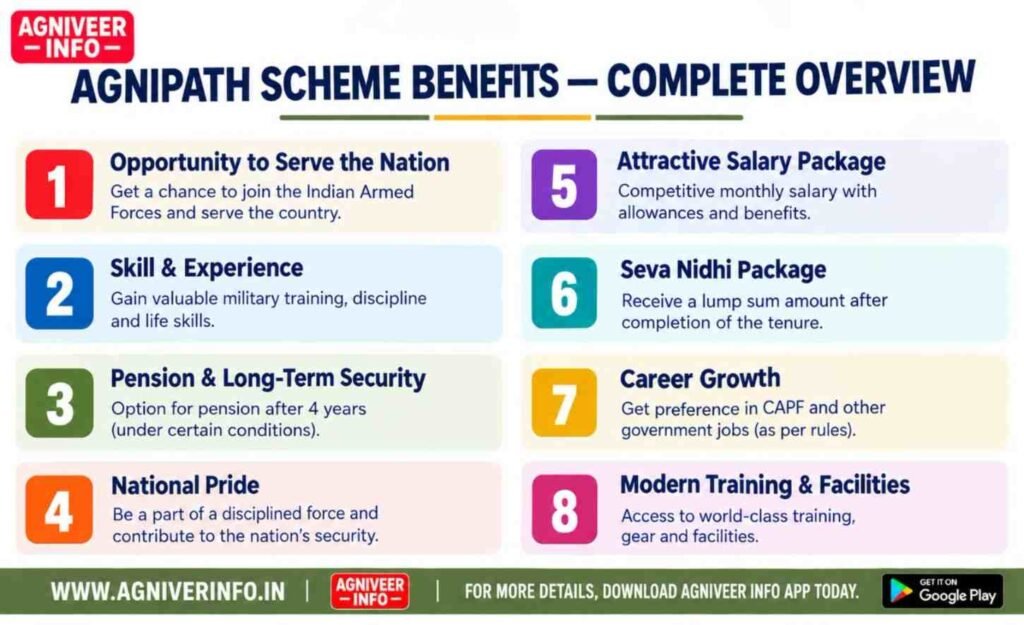
The Agnipath Scheme gives young citizens an early chance to serve in uniform, to learn discipline at work and to see real life in the forces. You also become financially independent early, because you earn a steady monthly package and save regularly through the matched corpus fund.
For those who do not get into the regular cadre, the tax-free Seva Nidhi amount works as starting money for higher studies, professional training or a small business. So when you look at this scheme, you should weigh the hard military experience and the savings against the fact that a place in the regular cadre is not guaranteed.
| Benefit | What It Provides | Who Can Receive It | Important Condition |
| Salary & Allowances | A monthly package that rises from ₹30,000 to ₹40,000, plus field allowances where they apply. | All enrolled Agniveers during the four-year active service. | 30% is cut every month for Seva Nidhi, and DA and MSP are not given. |
| Seva Nidhi | A tax-free lump sum of about ₹11+ lakh, including the government’s matching share and interest. | Agniveers who complete the full four years. | It is paid once at exit, and it is not a monthly income or a regular pension. |
| Insurance & Medical Support | ₹48 lakh life cover that costs the Agniveer nothing, plus use of service hospitals. | Agniveers who are serving at present. | Insurance and medical cover end when the Agniveer leaves active service. |
| Training & Career Benefits | Military training, a skill certificate and a chance to join the regular cadre. | All Agniveers, while up to 25% are chosen for the permanent regular cadre. | Selection for regular service is competitive and not guaranteed. |
Conclusion
The Agnipath Scheme brings together duty in the forces, a planned income and professional growth in one modern plan. Over the four years, an Agniveer gets regular monthly pay, life insurance that costs nothing, allowances for duty and medical care from the military.
The Seva Nidhi package builds a large tax-free amount for the end of service, and it is funded equally by the Agniveer and by the government. When the term is over, up to 25 percent may move on to regular military service, while those who leave get skill certificates and job preferences in several government and private sectors. Candidates should look at all these terms clearly, keeping in mind both the real benefits on offer and the performance standards needed to move ahead after four years.
Get the latest Agniveer updates by joining our WhatsApp channel
Frequently Asked Questions
Q1. What are the main benefits of the Agnipath Scheme?
The scheme gives a salary that rises every year, allowances for risk, life insurance that costs nothing, military training, a skill certificate and a tax-free Seva Nidhi payment after four years.
Q2. What is the Seva Nidhi benefit?
It is a lump sum built from 30 percent of your monthly salary, matched by the same amount from the government, and it returns more than ₹11 lakh tax-free when you leave.
Q3. Do Agniveers receive salary and allowances?
Yes, Agniveers get a monthly package, along with allowances for risk, hardship, rations, dress and travel that depend on the posting and the service rules.
Q4. Do Agniveers receive insurance coverage?
Yes, Agniveers have life insurance cover of ₹48 lakh for the whole four years, and they do not pay any premium from their monthly pay for it.
Q5. What training benefits do Agniveers receive?
Agniveers go through tough military, technical and trade training, and at the end they get an official Agniveer Skill Certificate that proves their skills when they look for civilian jobs.
Q6. Are Agniveers guaranteed permanent military service?
No, regular service is not guaranteed, because up to 25 percent of each batch may be taken in, depending on merit, the needs of the service and how well they have performed.
Q7. What happens after four years of Agniveer service?
Agniveers are either chosen for the regular cadre, or they leave with their Seva Nidhi amount, their skill certificate and the government job preferences that have been announced.
Q8. Does the Agnipath Scheme guarantee government employment?
No, the scheme only gives recruitment preferences and reservations in certain police forces and government departments, and it does not promise a civilian job.
READ ALSO: AGNIVEER 30-DAY PHYSICAL TRAINING PLAN