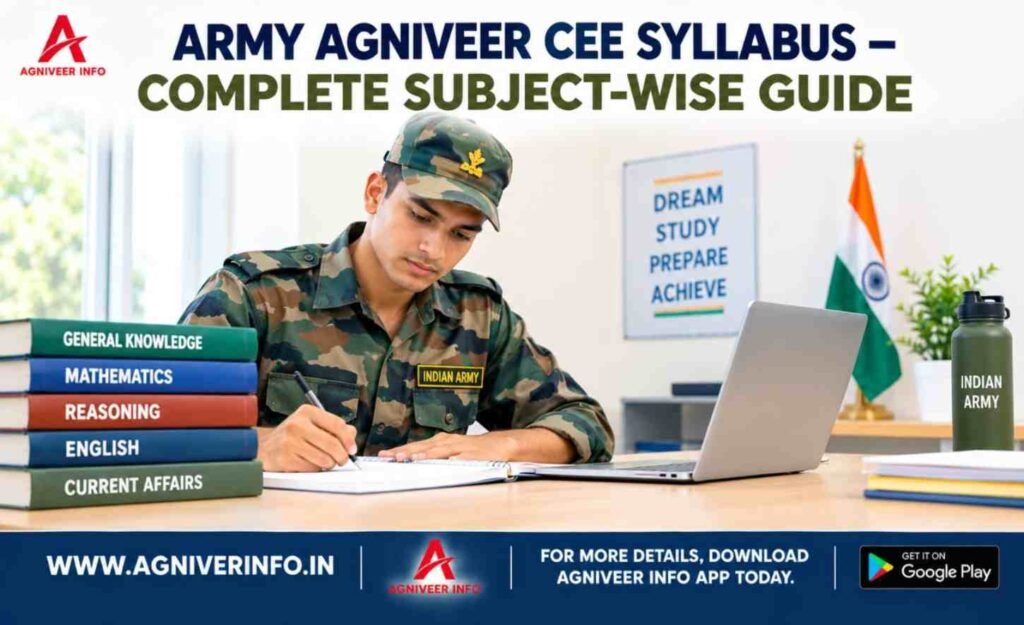
Every year, lakhs of aspirants put most of their effort into the Army physical test and forget that the written exam decides a lot too. The Army Agniveer Common Entrance Examination (CEE) is a big stage of the Agnipath recruitment process, and many candidates lose months studying before they understand what they actually need to prepare, so they end up picking random books instead of following a proper plan.
This is where preparation goes wrong. The Agniveer CEE syllabus is not the same for every candidate, because it depends on your Agniveer category or trade, which can be General Duty (GD), Technical, Clerk/Store Keeper Technical (SKT), or Tradesman, and each one has its own mix of subjects and its own difficulty level. So the smartest first step is to read your latest official notice on joinindianarmy.nic.in before you buy any books.
This guide explains the CEE syllabus subject by subject, along with a preparation plan and the common mistakes, in simple language. Please read it fully before you begin.
WHAT IS ARMY AGNIVEER CEE?
CEE stands for Common Entrance Examination, which is the written test for candidates who apply under the Agnipath Scheme. Many people think the physical test comes first, but in the current recruitment the CEE is an early screening stage that comes before the physical fitness test (PFT) and the medical examination, which means your written result decides whether you even get a chance to run. The exam is objective type, with multiple-choice questions, and it is usually taken on a computer.
If you do not clear the CEE, physical fitness alone cannot take you forward. Categories like GD, Technical and Clerk have different eligibility, subjects and marks, so first confirm your exact category.
ARMY AGNIVEER CEE SYLLABUS AT A GLANCE
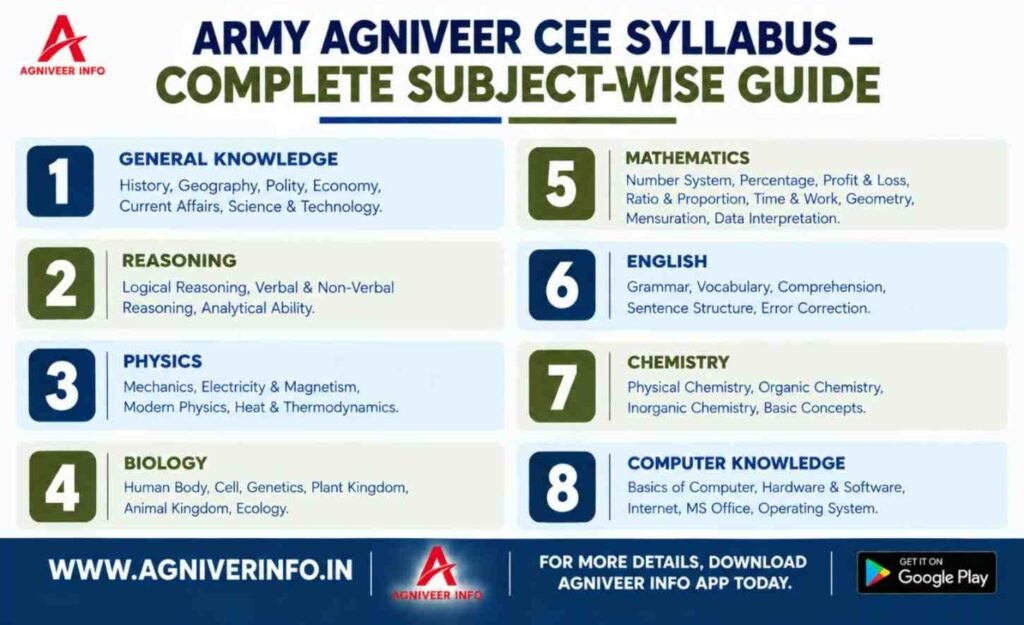
In general, the CEE tests candidates on General Knowledge, General Science and Mathematics, and for categories like Clerk/SKT, English, Reasoning or Computer basics are added on top. The number of questions, the weight of each subject and the total marks are different from post to post, so always match your preparation to the category you have applied for, and not to a general pattern.
GENERAL KNOWLEDGE / GENERAL AWARENESS
General Knowledge checks how much you know about India and about current events, and reading a little every day matters more than reading heavy textbooks. The important areas are:
- Current affairs — recent news and government schemes
- Indian history — the freedom struggle and important battles
- Geography — rivers, mountains, states and capitals
- Indian polity — the Constitution and fundamental rights
- Sports, awards and national events
Since GK questions can come from anywhere, build a habit of reading the news daily, instead of trying to cram everything at the last minute.
GENERAL SCIENCE
General Science tests your basic understanding of science at school level, so you do not need any advanced college books for it. The main areas are:
- Physics — laws of motion, light, sound, electricity and magnetism
- Chemistry — elements, compounds, acids, bases and everyday reactions
- Biology — systems of the human body, nutrition and common diseases
It works better to understand each idea with examples from real life than to learn formulas by heart without knowing what they mean.
MATHEMATICS
Mathematics often decides your final score, because it needs both understanding and speed. The syllabus generally covers school-level arithmetic and basic algebra:
- Number system, simplification, fractions and decimals
- Percentage, ratio and proportion, and average
- Profit and loss, along with simple and compound interest
- Time and work, along with time, speed and distance
- Basic algebra, geometry and mensuration
Practice is the real shortcut here, so solve a mix of easy and medium questions every day, and slowly increase your speed by using a timer.
ENGLISH
For the categories that include English, such as Clerk/SKT, you can expect questions on:
- Grammar — tenses, articles and prepositions
- Vocabulary, synonyms and antonyms
- Sentence correction, comprehension and fill-in-the-blanks
If your English feels weak, start with basic grammar and read a short passage every day, because confidence grows slowly through small efforts that you repeat again and again.
REASONING AND CATEGORY-SPECIFIC SUBJECTS
Some categories include logical reasoning, such as series, coding-decoding and pattern-based questions, and Clerk/SKT may also test basic computer knowledge. Do not add a subject just because an old or unofficial website mentions it, and match your subjects strictly to the category you have applied for.
CATEGORY-WISE DIFFERENCES
| Subject | Main Topics | Preparation Focus | Difficulty |
| General Knowledge | Current affairs, history, polity | Daily reading habit | Easy–Moderate |
| General Science | Physics, chemistry, biology basics | NCERT Class 9–10 | Moderate |
| Mathematics | Arithmetic, basic algebra | Daily timed practice | Moderate |
| English (where applicable) | Grammar, vocabulary, comprehension | Regular reading | Easy–Moderate |
The syllabus is different for General Duty, Technical, Clerk/Store Keeper Technical and the other categories. Technical candidates may get papers with more science, while Clerk candidates get English and computer questions added, so always check the latest official notice for your category.
HOW TO PREPARE FOR ARMY AGNIVEER CEE
A scattered study plan rarely works for an exam with a fixed date, so follow a proper step-by-step plan like this one:
- Check the latest official syllabus for your category
- Find out your exact Agniveer trade or post
- Divide the subjects by your strong and weak areas
- Build the basic ideas before you try the tough questions
- Practise regularly, and not just before the exam
- Take mock tests in conditions that feel like the real exam
- Look at your mistakes honestly after every test
- Revise the weak topics again and again
- Follow current affairs regularly
- Balance your study with daily physical training
This guide is about the CEE, but your fitness training should run along with it, and not start after it.
IMPORTANT PREPARATION TIPS
- Make a daily timetable that you can really follow, and not an over-ambitious one
- Use questions in the style of previous years to understand the difficulty
- Practise with a timer to build speed
- Keep an error notebook for the mistakes you repeat
- Revise your weak areas more often than your strong ones
- Stay away from random study material online that nobody has verified
- Treat every mock test as seriously as the real exam
COMMON MISTAKES TO AVOID
- Preparing from an old or wrong syllabus
- Ignoring the differences between Agniveer categories
- Studying only the easy subjects and avoiding the tough ones
- Leaving mock tests until the last moment
- Learning facts by heart without understanding them
- Ignoring current affairs completely
- Neglecting physical fitness while focusing on books
Get the latest Agniveer updates by joining our WhatsApp channel
FAQS
Q1. What is the Army Agniveer CEE?
A1. It is the Common Entrance Examination under the Agnipath Scheme, an objective-type written test that screens candidates before the physical fitness and medical stages of recruitment.
Q2. Which subjects are included in the CEE?
A2. In general they are General Knowledge, General Science and Mathematics, and English, Reasoning or Computer basics are added for categories like Clerk/SKT. Confirm the exact subjects from your notice.
Q3. Is the syllabus the same for every category?
A3. No. General Duty, Technical, Clerk/Store Keeper and the other categories have different subject weightage, so never assume that one syllabus applies to all posts.
Q4. Is there negative marking in the CEE?
A4. The rules for negative marking differ by category and may change over time, so always check the exact marking scheme in the current official notice before your exam.
Q5. How should beginners start preparation?
A5. First confirm your category, then build the basic ideas from NCERT-level books for Science and Maths, read daily for GK, and after that move on to timed practice and mock tests.
Q6. How important are previous-year style questions?
A6. They help you understand the difficulty and the common topics. Use them for practice and to get used to the pattern, and not as a sure guess of the questions that will come.
Q7. How many hours should a student study daily?
A7. There is no fixed number of hours. Being regular across all subjects, along with balanced physical training, matters far more than studying for very long hours.
Q8. Where should candidates verify the latest syllabus?
A8. Always check joinindianarmy.nic.in, the official website, for the latest notice, syllabus and exam pattern before you change your plan.
CONCLUSION
Understanding the syllabus is truly the first real step towards smart CEE preparation, and it is not a small detail that you can skip. Studying at random without knowing your category wastes time that is better spent on focused practice, so find out your post correctly, check the latest official syllabus, understand which subjects matter most, and build your preparation around real practice and mock tests instead of guesswork.
Your physical fitness should never be left behind while you chase marks in the written exam, because both stages decide your final selection together. A clear syllabus, regular practice, mock tests, honest revision and steady physical preparation make a far stronger plan than studying for long hours without any direction. Start with clarity, and the rest will fall into place by itself.
READ ALSO: AGNIPATH SCHEME 2026 EXPLAINED: ELIGIBILITY, SALARY & SERVICE TERMS