
The last 30 days before an Agniveer physical fitness test are an important time to prepare in an organised way. You should not try to change your body completely in this short time, and you should instead make the fitness you already have work better, move more smoothly and build strength safely.
A plan for 30 days helps you go from general fitness to being ready for the exact tests, without getting so tired that you give up or so hurt that you cannot train. Still, you must understand that one month cannot take the place of many months of regular training, because big gains in speed or strength take time.
Good preparation needs all the parts to work together, which means running, stamina, bodyweight strength, loosening of the joints and rest have to go side by side and not each on its own. If you are preparing for the Indian Army, the Indian Navy or the Indian Air Force, you should also know that the physical standards, the way marks are given and the parts of the test are not the same in each service and trade, so you must check the current official recruitment notice to know the exact test rules.
This Agniveer 30-Day Physical Training Plan is a general guide, and you should change it to suit the fitness you have now. Rest and recovery are part of training too, because they give your muscles time to repair and grow stronger, and this helps you reach the test day in your best condition.
Is 30 Days Enough to Prepare for the Agniveer Physical Test?
For a candidate who is already active, thirty days can make a clear difference to how well the heart and lungs work, how you judge your running pace and how strong your body feels in bodyweight exercises. One month of planned training can make your running pace sharper, add to the number of push-ups you can do and clean up the way you move.
For complete beginners, 30 days is usually not enough to reach top fitness in a safe way. A beginner can still gain a little in stamina and in how freely the body moves, but if you expect a huge change in four weeks, you are more likely to overtrain, which means doing too much for your body to handle, and to get injuries in your muscles and bones such as shin splints, which are painful strain along the front of the lower leg.
The aim of this plan is steady improvement that you can measure, and not a change that is not realistic. If you have a medical problem or a fresh injury, you should talk to a qualified professional before you begin hard training.
Before Starting: Know Your Current Fitness Level
When you know where you stand, you can shape your Agniveer preparation safely. Test yourself in five areas, using controlled, moderate effort and not your absolute limit:
- Aerobic Baseline: See how long you can run without a break and without serious distress.
- Timed Run: Do one timed run at a moderate effort so that you know your starting pace.
- Bodyweight Strength: Find the most push-ups, squats and pull-ups you can do with correct form.
- Recovery Rate: Notice how fast your heartbeat and breathing come back to normal after a workout.
- Mobility Check: Find out whether your hamstrings (the muscles at the back of the thigh), calves, hips or shoulders feel tight.
This first check stops you from pushing too hard, and it makes sure you raise the load slowly and safely, step by step, all through the training.
30-Day Training Structure
Days 1–7: Foundation
Work on your stamina, your running style, light bodyweight exercises and the habit of loosening your joints every day. Keep the effort at a moderate level so that your body has time to get used to the work.
Days 8–14: Progressive Load
Add a little more work bit by bit, with controlled faster running in short bursts followed by rest, which are called intervals, along with stronger bodyweight exercises and planned recovery after each workout.
Days 15–21: Test-Specific Conditioning
Give more attention to judging your pace, practising the movements that your own service asks for, doing strength sets with less rest in between and running test-like practice under conditions close to the real thing.
Days 22–27: Peak Practice
Keep the quality of your exercises high while you control your tiredness. Run at the pace you plan to use in the test and keep your strength work efficient, without doing so much that your muscles get badly damaged.
Days 28–30: Taper and Recovery
A taper means cutting down your training in the last days, so reduce the amount of work a great deal and keep every movement light. Put your focus on moving the joints gently, drinking enough water, getting enough sleep and keeping your mind ready for the day of the rally.
30-Day Running Plan
A good running plan for Agniveer mixes steady runs with controlled interval work. Beginners should run for a while and then walk, and go on repeating this, while stronger runners can work on holding their target pace.
- Week 1: Do easy runs of 20 to 30 minutes at a pace where you could still talk. On two days, add short runs where you build up speed for a few seconds, so that you can practise how your foot lands.
- Week 2: Mix easy runs with one interval session, for example repeating 400-meter runs at a controlled, brisk pace and walking slowly in between until you have fully recovered.
- Week 3: Practise judging your pace with tempo runs, which are runs held at a steady, moderate effort, and add short interval runs so that your body learns to keep going when it is tired.
- Week 4: In the early days, run to fine-tune your pace, and after that, cut your total running distance sharply so that your muscles can recover fully.
Strength Training Plan
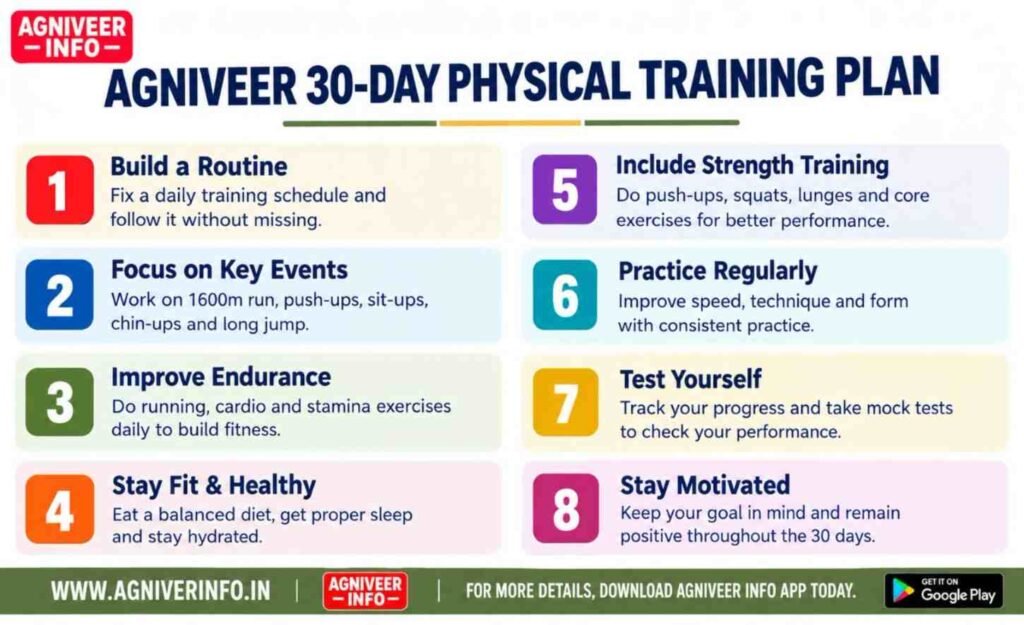
Exercises that use your own body weight build the base for the defence physical tests. Always put good movement ahead of a high count, because doing many repetitions with bad form is not useful.
- Push-ups: Go through the full movement, keeping the middle of your body tight and your chest close to the floor.
- Pull-ups / Chin-ups: Keep your form strict and do not swing, so that you build the pulling power of your upper body.
- Squats & Lunges: These build leg stamina, knee steadiness and joint strength, which you need for running.
- Core Stability: Add planks and leg raises to keep your body steady while you run hard.
Do strength sessions three to four times a week, and give each group of muscles at least 48 hours of rest before you work it again.
Mobility, Warm-Up and Recovery
To stay free from injury, you need to prepare before every workout and loosen up after it. A warm-up that keeps you moving, such as leg swings, high knees and arm circles, gets your joints and muscles ready for the work ahead. After the workout, holding stretches still for a while, which is called static stretching, helps the calves, hamstrings and the front of the hips to stay flexible.
Drinking enough water, eating a balanced diet with plenty of protein and slow-release carbohydrates, and sleeping 7 to 9 hours every night are all very important for recovery. Stay away from dangerous habits such as crash diets, keeping yourself short of water on purpose, and taking supplements that no one has checked. You should never train through sharp pain in a joint or a bone.
Service-Specific Preparation
Army
In the Army recruitment rallies, the 1.6 km run, the pull-ups on the beam and the ability to move quickly on the field carry great weight, so candidates should put most of their effort into the pulling strength of the upper body and into hard running stamina.
Navy
Navy preparation is about continuous running, push-ups and squats, and candidates should practise moving smoothly from one exercise to the next and the stamina of the upper body for pushing movements.
Air Force
The Agniveervayu tests, which are the Air Force Agniveer tests, look at running stamina, push-ups, sit-ups and squats within fixed time limits. So training should aim at bodyweight stamina and strength in the middle of the body.
Sample Weekly Training Pattern
Training Phase Guidance
| Training Phase | Running Focus | Strength Focus | Recovery Focus |
| Days 1–7 | Easy runs to build stamina | Basic bodyweight form | Light joint loosening daily |
| Days 8–14 | Controlled speed intervals | Sets that build up step by step | Active rest and sleep |
| Days 15–21 | Conditioning at target pace | Stamina sets for the tests | Recovery habits that vary between hot and cold |
| Days 22–30 | Cutting down and lower volume | Light work to keep the technique | Full rest and drinking water |
Common Mistakes During a 30-Day Plan
- Running at Maximum Effort Daily: This makes you tired too early, strains your joints and burns you out without building your stamina.
- Increasing Volume Too Quickly: A sudden jump in the distance you run greatly raises the risk of shin splints and tendon injuries.
- Neglecting Bodyweight Strength: If you only run, you will not be ready for the push-up, pull-up or squat parts of the test.
- Ignoring Rest Days: If you skip recovery, your muscles cannot repair, and your performance falls over time.
- Training with Poor Form: Half repetitions in practice can turn into repetitions that are not counted in the official test.
- Compensating for Inactivity: Trying to squeeze months of missed training into four weeks leads straight to injury.
- Training Through Severe Pain: If you ignore sharp pain, a small muscle strain can become a serious setback.
- Relying on Outdated Guidelines: Following advice from social media that no one has checked, instead of the official recruitment notice, leads to wrong preparation.
How to Know Whether Your Preparation Is Improving
Progress shows up in better numbers and in a body that can take more work. These are the signs that your body is adjusting well:
- You hold your target running pace and it feels less hard than before.
- Your heartbeat comes back to normal faster after hard training intervals.
- You do bodyweight exercises with cleaner form and better control of the middle of your body.
- Your muscles feel less sore after workouts and you feel less tired in general.
- You perform steadily without stiff joints or sharp pain.
These signs show that your body is adapting, but they do not take the place of the official rules used to judge you.
Final 3 Days Before the Physical Test
In the last 72 hours, you should stop training hard and start saving your energy. Leave out heavy strength workouts and long runs altogether, and do only light 10-minute sessions of jogging and stretching to keep your body moving without making you tired.
Drink water regularly, eat balanced meals of food you are used to, and sleep a little extra. Get your official papers, admit card and recruitment documents ready early, and reach the testing place rested, focused and ready to follow the official instructions in full.
Conclusion
A 30-day plan gives Agniveer candidates a practical way to organise their running, strength work and recovery before the recruitment test. Success depends on building up step by step, improving your technique and respecting the limits of your body, and not on dangerous overtraining.
When you combine focused stamina work with bodyweight strength and strict recovery habits, you get the most from the fitness you already have. You must check the official physical standards for your own service and adjust the effort of your training to match. Steady effort, smart pacing and proper recovery are the safest way to be ready for the test.
Get the latest Agniveer updates by joining our WhatsApp channel
Frequently Asked Questions
Q1. Can 30 days be enough to prepare for the physical test?
Thirty days can make the fitness you already have work better, improve how well you run and build some strength, but complete beginners may need more time to reach top fitness safely.
Q2. How many days per week should an Agniveer candidate run?
Candidates should run three to five days a week, and they should mix hard training days with easy recovery runs or rest days so that they do not overtrain or hurt their joints.
Q3. Should candidates train every day during the 30-day plan?
No, because hard training every day does not let your muscles recover, so it is important to have one or two rest days or light joint-loosening days each week to perform your best.
Q4. Can beginners follow the same training intensity as experienced runners?
No, beginners should cut down the amount and the effort by using run-and-walk intervals and fewer repetitions, so that they avoid shin splints, heavy tiredness and sudden muscle injuries.
Q5. What exercises should be included in Agniveer physical preparation?
Preparation should be built on basic bodyweight movements, which are running, push-ups, squats, pull-ups, lunges and exercises for a steady core, all done with the right technique.
Q6. How should candidates recover between difficult training sessions?
Recovery needs seven to nine hours of good sleep, enough water, balanced food and light stretching that keeps you moving, and you should not do two all-out efforts on back-to-back days.
Q7. Should Army, Navy and Air Force candidates follow the same plan?
The basic fitness work is alike, but candidates must change their training to match the standards of their own service, including running distances, push-up counts and the needs of their trade.
Q8. What should candidates do during the final three days?
They should cut down their training, do only light movement, sleep well, drink water as usual, eat food they are used to and get all their official recruitment papers ready.
READ ALSO: AGNIPATH SCHEME 2026 EXPLAINED: ELIGIBILITY, SALARY & SERVICE TERMS