
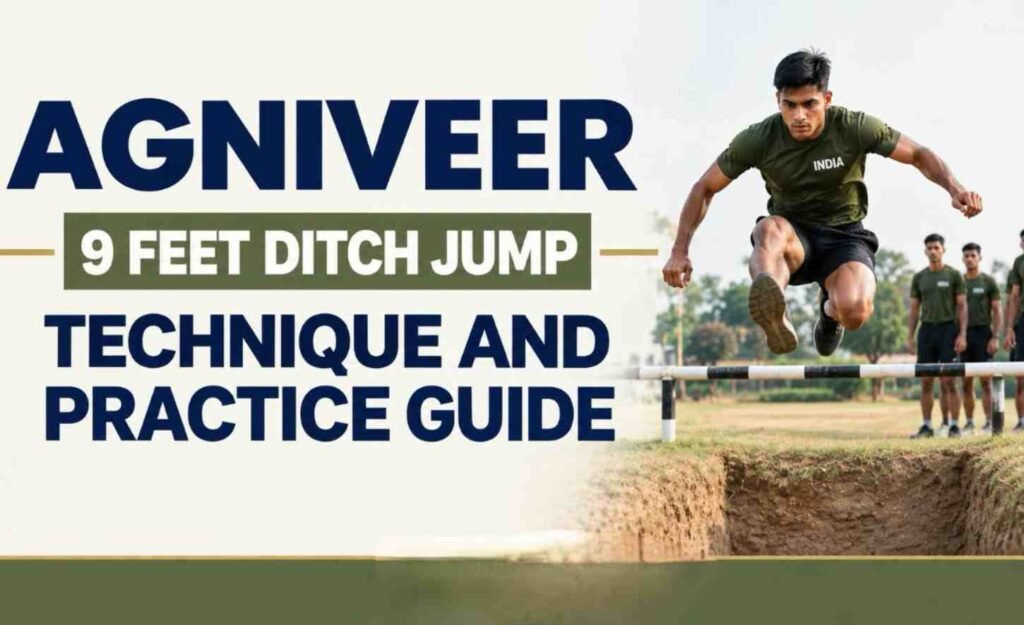
The nine feet ditch jump is one of the most important physical tests for young people who want to join the Indian Army as Agniveers. Many candidates spend hours on running and push-ups, but they often leave the ditch jump until the last few weeks before the recruitment rally, which is the open selection event where the tests are held.
If you try to clear the gap without knowing how the body moves during a jump, you may perform badly, freeze at the take-off line or hurt your joints. Clearing a gap of nine feet takes much more than strong legs, because you also need a controlled running speed, a strong push off the ground, the right body position in the air,
arms that swing together with the legs and a landing that soaks up the shock. When you practise step by step, you build both strength and confidence, and a jump that once made you nervous becomes a skill you can do. This guide explains the main techniques, safe ways to practise, the exercises that build strength and the preparation tips that help you clear the nine feet ditch during your official test.
What Is the 9 Feet Ditch Jump?
The nine feet ditch jump is a physical test in the Agniveer recruitment rallies, and it checks how much explosive power your legs have and how calm you stay while you jump. You have to run up, place your foot down before the line,
jump forward across a gap of nine feet and land firmly on your feet without falling backward. Since the exact marking rules can be different in each rally, you should always check them in the official notice of your own rally before the test.
Why Candidates Struggle With the Ditch Jump
Most candidates struggle for two reasons, which are fear and mistakes in technique. When you see an open pit in front of you, it is natural to feel nervous, and this makes many people slow down just before take-off, which means they lose the forward speed they need to cover nine feet.
Other problems also cut the length of the jump, such as weak hip and buttock muscles, arms that do not swing in step with the legs, and looking down into the pit, and these can make you stumble or touch the edge of the ditch.
The Correct Approach Run
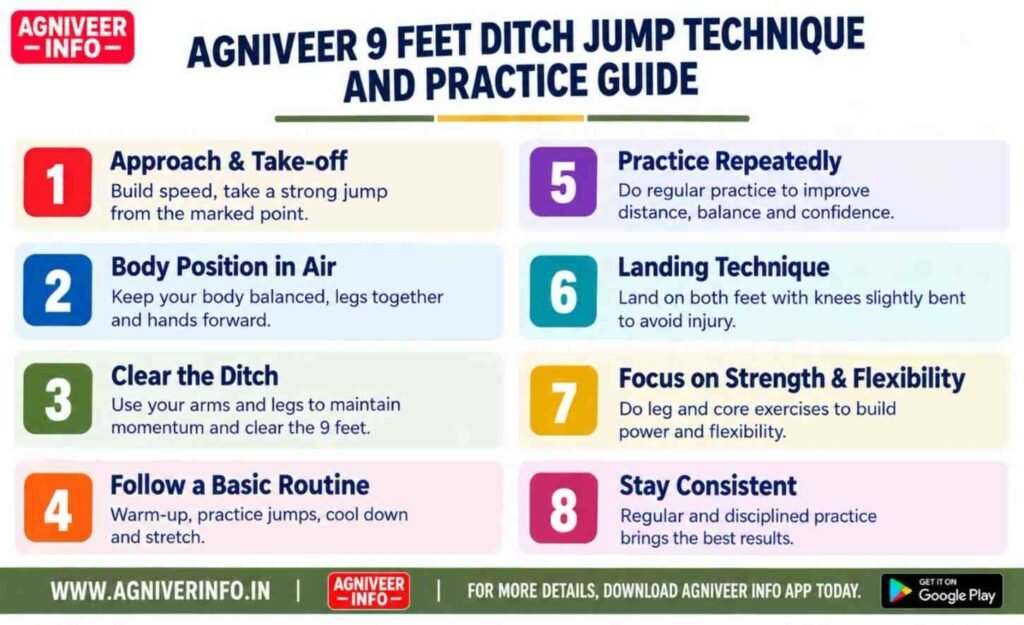
A good jump begins with a run at a steady, controlled speed. You should build up your speed smoothly instead of sprinting wildly, because if you slow down before you launch, you throw away the energy of your movement that carries you forward. Keep your last few steps light, quick and even, and let your hips move right above your take-off foot, so that your forward speed turns cleanly into distance in the air without any pause or doubt.
Take-Off Technique for the 9 Feet Ditch
Place your stronger foot firmly on the ground behind the take-off line, and drive the other knee up and forward with power. At the same time, swing both arms hard to give yourself forward push, and keep your upper body upright while you do it. The main steps are these:
- Plant your take-off foot firmly behind the line.
- Drive the knee of your other leg up and forward.
- Swing both arms with power so that your body flies forward across the gap.
Body Position During the Jump
While you are in the air, keep your middle body steady and do not twist. Pull your knees slightly toward your chest so that they clear the edge of the ditch, and keep your arms stretched forward to help you stay balanced. Look straight ahead at the spot where you plan to land, because this keeps your body in a straight line and stops your chest from dropping forward.
Landing Technique
A proper landing keeps you safe and also keeps your attempt valid. Land on both feet at the same time, with your heels touching the ground first, and bend your knees and hips the moment you hit the ground so that the shock is taken in safely. Then push your arms forward so that your weight stays over your feet, which stops you from falling backward.
Exercises to Improve Ditch-Jump Ability
To build explosive power in your legs, you need exercises that work many muscles together. The main strength exercises are these:
- Barbell Squats: These make your thigh and buttock muscles strong so that you can produce the most power.
- Lunges: These improve your balance on one leg and the movement of your hips.
- Broad Jumps: These train you to push yourself forward from both feet with power.
- Calf Raises: These strengthen your ankles so that your push at take-off is strong.
How to Practise the 9 Feet Ditch Safely
Safety matters a great deal while you prepare. Practise on soft grass or in a sandpit and not on hard ground, because this protects your joints. Start with shorter distances and make them longer step by step as your technique gets better, and do not do too many jumps in one session, since being tired makes mistakes and injuries more likely. If you feel any pain in a joint, or if you become very tired, stop jumping at once.
Best Drills for Improving Horizontal Jumping
Some simple drills help you improve your jump, your rhythm and the timing of your footwork. The main ones are these:
- Broad Jump Series: This builds your forward stretch off both feet.
- Short Bounding: This turns your running speed into strong leaps.
- Step-Up Explosions: This builds the single-leg push that you need at take-off.
Common Mistakes During the Ditch Jump
- Slowing down before launch: This kills the forward speed you need for distance.
- Looking into the ditch: This makes your chest drop and spoils your flight.
- Stepping over the take-off line: This makes your attempt invalid and adds to your worry.
- Landing with stiff knees: This sends the shock of the landing straight into your knees.
- Weak arm swing: This makes you unsteady in the air and cuts your distance.
- Practising while tired: This makes bad habits set in faster and raises the risk of injury.
Warm-Up Before Ditch-Jump Practice
Always warm up with movement before you start to jump. Begin with five minutes of light jogging, and then do high knees, leg swings and exercises that loosen your hips. Add a few small hops that use less than your full effort, so that your fast-acting muscle fibres get ready slowly. Do not hold long stretches before jumping, which are called static stretching, because they can lower your explosive power for a short time.
How to Build Confidence Without Taking Unnecessary Risks
Confidence comes from steady preparation. Do not try reckless jumps over dangerous pits, and instead mark nine feet on safe, flat ground with chalk and keep practising until you clear it smoothly. When you lose your fear through safe repetition, you are able to use the right speed and form on the day of the test.
How to Prepare in the Final Week
In the last week before the test, do less training so that your body can recover. Leave out the hard jumping exercises, which are called high-intensity plyometrics, because they can leave you tired. Do only light practice runs for the approach, drink enough water, eat well and sleep properly, and this way you arrive fresh and have your full power on the day of the rally.
| Training Component | Main Purpose | How It Helps | Common Mistake |
| Approach Run | Build forward speed | Gives you the energy of movement | Slowing down near take-off |
| Take-Off | Turn speed into a jump path | Sends your body across the gap | A broken stride at the line |
| In-Air Control | Keep your body steady | Stops you from twisting in flight | Looking down into the ditch |
| Landing | Take in the shock safely | Stops you from falling backward | Landing with stiff knees |
Conclusion
To clear the Agniveer nine feet ditch jump, you need the right running speed, a strong take-off, a steady body in the air and a controlled landing. When you practise in a planned way, step by step, you build strength and confidence without risking injury. You should also check the exact current qualification rules in the official Indian Army recruitment notice for your own rally.
Get the latest Agniveer updates by joining our WhatsApp channel
Frequently Asked Questions
What is the 9 Feet Ditch in Agniveer recruitment?
The nine feet ditch is a compulsory physical test in the Indian Army Agniveer recruitment rallies, and it checks how well you can jump forward and how confident you are.
How can I improve my ditch-jump distance?
Build explosive power in your legs with squats and broad jumps, and work on the timing of your run-up and on a strong forward push at take-off.
Which exercises help with the 9 Feet Ditch?
The main exercises are weighted squats, walking lunges, standing broad jumps, jumping and bounding drills, calf raises and exercises that keep the middle of your body steady, and together they build your overall forward jumping power.
Should beginners practise the full ditch immediately?
No, beginners should not try the full gap at once, because it can hurt their joints, and they should start with simple broad jumps and build up the distance slowly.
How important is take-off technique?
It is very important, because turning your running speed into a forward jump decides whether you clear the gap cleanly without losing your balance.
How can I improve landing control?
Land on both feet together and bend your knees to take in the shock, and keep your weight forward so that you do not fall backward into the ditch.
Should I practise ditch jumps every day?
No, jumping every day makes you very tired and raises the chance of injury, so keep hard jumping practice to two or three sessions a week so that your body can recover.
Where should I check the latest Agniveer physical-test requirements?
Always check the official Join Indian Army website and the notice issued for your own recruitment zone to confirm the exact current rules.
READ ALSO: AGNIVEER 30-DAY PHYSICAL TRAINING PLAN