KNOW YOUR FORCES — INDIAN ARMY HIERARCHY: SECTION TO COMMAND
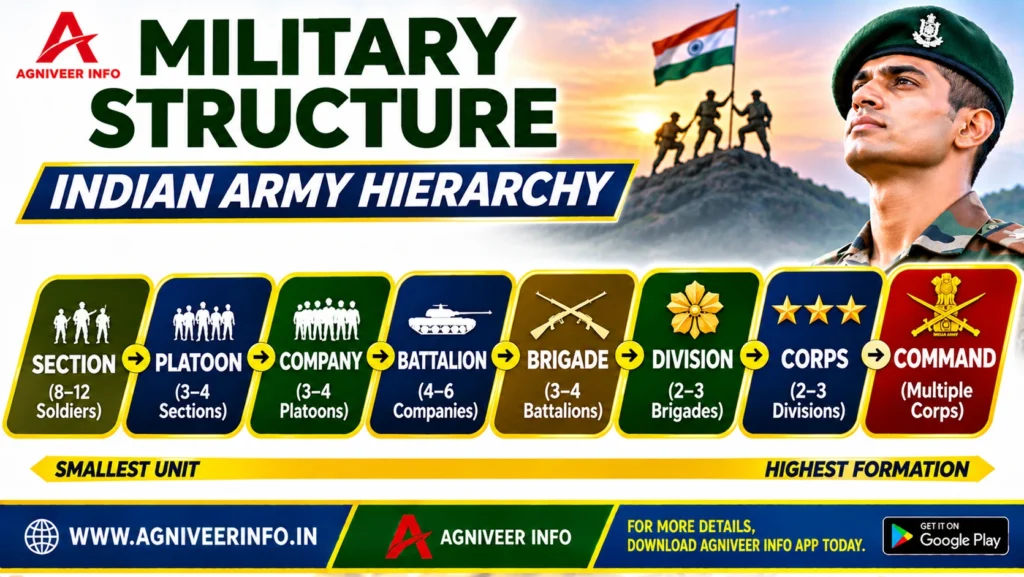
Source: Indian Army Official Website
Last updated: 19 November 2026
In this guide on Indian Army hierarchy, you will learn about the hierarchy explained, why the Indian Army hierarchy exists and supporting arms within larger formations. To understand how the Indian Army organizes its soldiers for training, administration, and combat, it is essential to know the Indian Army hierarchy of military units, from the smallest team to the largest formations. For an Agniveer aspirant, this structure is core general knowledge, frequently tested in recruitment examinations and useful for understanding how the army actually functions on the ground.
What Is the Indian Army Hierarchy?
Looking at Army unit hierarchy, the Indian Army, like most modern armies, organizes its personnel into a hierarchy of units of increasing size, each commanded by an officer of appropriate rank and equipped and trained for a specific scale of operations. This Indian Army hierarchy allows the army to manage everything from small-team tactical actions to large-scale, multi-division military campaigns.
For more details on this topic, read this: Indian Army Ranks and Insignia: Complete Guide
Indian Army Hierarchy: The Hierarchy Explained
When it comes to Indian Army hierarchy, starting from the smallest unit and moving to the largest (all strength figures are approximate and vary by type of unit and formation):
- Section: The smallest basic unit, typically consisting of around 10 soldiers, usually commanded by a Non-Commissioned Officer or JCO such as a Havildar or Naik.
- Platoon: Made up of a few sections, a platoon typically has around 30 to 40 soldiers and is usually commanded by a Lieutenant or a senior JCO such as a Subedar.
- Company: Consisting of several platoons, a company generally has around 100 to 150 soldiers and is typically commanded by a Major.
- Battalion: Made up of several companies, a battalion typically has roughly 700 to 1,000 soldiers and is commanded by a Colonel or Lieutenant Colonel. The battalion is often considered the basic fighting and administrative unit of the infantry.
- Brigade: Consisting of several battalions along with supporting units, a brigade typically has around 3,000 to 5,000 soldiers and is commanded by a Brigadier.
- Division: Made up of several brigades along with additional support elements, a division typically has around 15,000 to 20,000 soldiers (more once support elements are counted) and is commanded by a Major General.
- Corps: Consisting of two or more divisions, a corps typically has tens of thousands of soldiers and is commanded by a Lieutenant General.
- Command: The largest organizational level, a Command consists of multiple corps and covers a specific geographical area of responsibility, commanded by a General Officer Commanding-in-Chief, typically of the rank of Lieutenant General.
Why the Indian Army Hierarchy Exists
Under Indian Army hierarchy, this layered structure allows the army to manage command and control efficiently at every scale — a section leader can manage his small team directly, while higher commanders coordinate larger, more complex operations involving thousands of soldiers, multiple types of equipment, and coordination across different arms such as infantry, artillery, and armour.
On the topic of Indian Army hierarchy, the structure also allows for clear lines of responsibility and communication, ensuring orders can move efficiently from top commanders down to individual soldiers, and that information from the front lines can be reported back up the chain of command.
For more details on this topic, read this: Women in Indian Army: Roles, History and Milestones
Supporting Arms Within Larger Formations
While preparing for Indian Army hierarchy, while the infantry battalion is often used as the reference point for explaining unit sizes, larger formations such as brigades, divisions, and corps typically include a mix of different arms working together, not just infantry battalions. A division, for example, usually includes infantry brigades along with supporting elements such as artillery regiments.
An armoured element, engineers, signals units, and logistics and medical support, all coordinated to work as a single combined-arms formation. This combination of different specialisations within one larger formation is what allows the army to conduct complex operations that require more than just foot soldiers, such as coordinated tank and infantry advances or ordering artillery support during an engagement.
How This Structure Applies to Training
With Indian Army hierarchy in mind, even during training, the Indian Army hierarchy shapes how recruits are organised. Trainees are typically grouped into sections and platoons from the earliest days of basic training, allowing them to build the same kind of small-team bonds and coordination skills they will rely on throughout their service. As training progresses to include larger-scale exercises, recruits gain exposure to how their section or platoon fits into a larger company-level or battalion-level operation, helping them understand their place within the wider organisation even before they are posted to an operational unit.
Why This Matters for an Agniveer Aspirant
Understanding the Indian Army hierarchy helps aspirants visualize how the army is actually organized on the ground, understand the size and scope of different units they might join, and prepare for general knowledge questions in recruitment exams. It also helps build a clearer sense of career progression, since promotion often involves greater responsibility over larger and larger units.
5 Key Facts
- The smallest basic army unit is the Section, with about 10 soldiers.
- A Battalion, with roughly 700 to 1,000 soldiers, is often the basic fighting and administrative unit.
- A Brigade is commanded by a Brigadier and typically has 3,000 to 5,000 soldiers.
- A Division, commanded by a Major General, typically has 15,000 to 20,000 soldiers.
- A Command is the largest organizational level, covering a specific geographical area under a senior General.
Quick Revision
The Indian Army hierarchy scales from Section (about 10) up to Command (largest, area-based). Key sizes: Platoon (30-40), Company (100-150), Battalion (700-1,000). Brigade (3,000-5,000) is commanded by a Brigadier; Division (15,000-20,000) by a Major General. Corps and Command represent the largest operational and administrative formations.
For more details and daily updates, join our WhatsApp channel.
Frequently Asked Questions About Indian Army Hierarchy
What is the smallest basic unit in the Indian Army hierarchy?
The Section, typically consisting of around 10 soldiers, is the smallest basic unit.
Which unit is often considered the basic fighting and administrative unit of the infantry?
The Battalion, typically with 700 to 1,000 soldiers, is often considered the basic fighting and administrative unit.
Who commands a Brigade?
A Brigade is typically commanded by a Brigadier.
What is a Corps made up of?
A Corps consists of two or more Divisions along with supporting elements.
What is the largest organizational level in this hierarchy?
Command is the largest organizational level, covering a specific geographical area.
Related reading: Indian Army ranks and insignia | regimental centres
Disclaimer: This information is for general guidance only. Rules, dates and figures can change, so please check the official source linked above before taking any final decision.