

Many young aspirants who are preparing for the Agniveer physical test face the same problem: they can run 1600 metres without any trouble, but they cannot finish it in a good time. Running four rounds on a 400-metre track looks easy, but finishing within the required time needs a proper plan, because you cannot clear this test by running at full speed every day. A good 1600m training routine needs a mix of speed, stamina, smart pacing, correct running form, strength, and rest.
Beginners often make the mistake of running like a bullet in the first 200 metres, and because of this early rush their body gets tired quickly, their legs turn heavy by the third lap, and their speed drops fast. Improving your timing does not mean pushing your body until it gives up, but it means training in a planned way and building your stamina slowly over time. This step-by-step guide gives you practical and safe Agniveer 1600m running tips to improve your timing on the track.
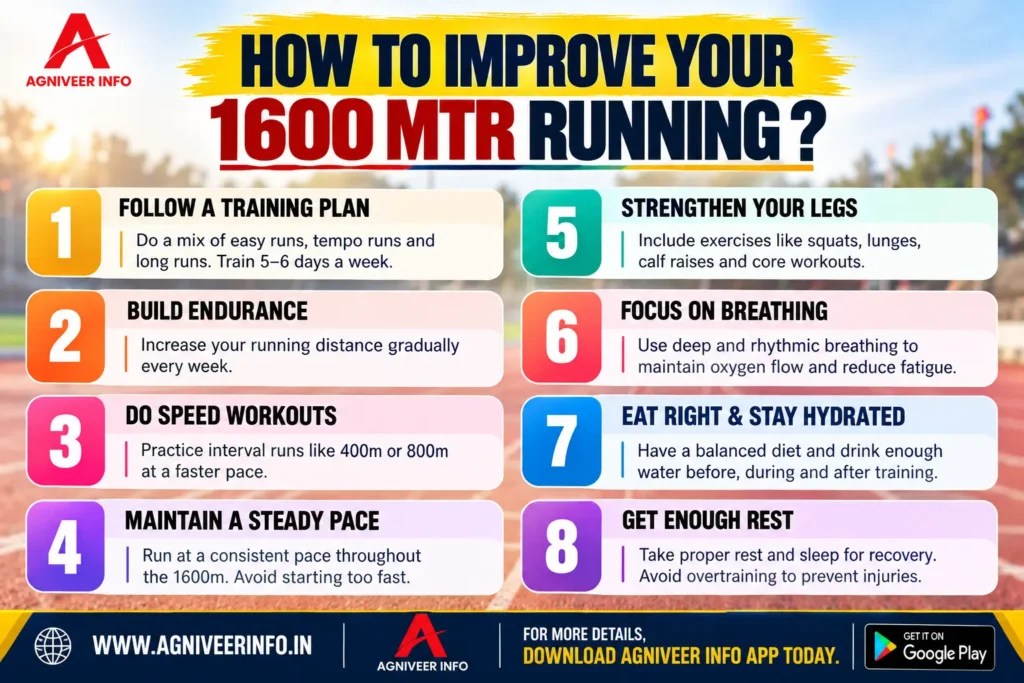
1. First Understand Why Your 1600m Timing Is Slow
Before you change your routine, you need to know why your timing is not improving, because many candidates train hard every morning and still miss their target due to a few basic mistakes. Once you find your own weak spots, your daily practice becomes much more useful.
Here are the most common reasons candidates struggle on the track:
- Starting Too Fast: When you sprint in the first lap, you use up your muscle energy early, so nothing is left for the end.
- Lack of Speed Work: Some candidates only do long, slow runs and never practise fast intervals, so their body is not used to running at a higher speed.
- Weak Leg and Core Strength: If your legs and waist are weak, your legs feel heavy or your waist starts to pain in the last 400 metres.
- Inconsistent Practice: Running hard for two days and then taking three days off because of soreness keeps you from making steady progress.
- Poor Running Technique: Taking very long steps, landing heavily on your feet, or keeping your shoulders tight wastes your energy.
- Ignoring Recovery: If you do not sleep enough or skip rest days, your body stays tired all the time.
2. The Biggest Secret: Learn to Pace Yourself
Pacing is the most important skill in long-distance track running, and running at full force right after the start horn is the quickest way to burn out early. When you run too fast at the beginning, lactic acid (a substance that builds up in tired muscles) collects quickly, which makes your legs feel like heavy bricks in the third and fourth laps.
Your first lap should feel fast but still under control, and keeping a steady, smooth pace across all four laps is much faster than speeding up and slowing down again and again. For example, if your goal is to finish in 5 minutes and 30 seconds, running balanced laps of 82 to 83 seconds each is far better than running a 65-second first lap and then a 100-second third lap. Practise this even pace in your weekly workouts so that your body learns it well.
3. Build a Strong Running Base
You cannot build a fast 1600-metre timing unless you first build good stamina, so beginners should not start their very first week with full-effort sprints on the track. Start by building a strong base with easy, comfortable long runs.
- Run at a slow, steady pace where you can speak full sentences without gasping for breath.
- Increase your total running time a little every week, so that your shins do not start to pain.
- Aim to keep running for 20 to 30 minutes without stopping.
- Always keep a light recovery day after a long run, because your body needs time to settle.
4. Add Interval Training
Interval training means running fast for a short time and then jogging or walking slowly for a short time, and this teaches your heart and lungs to use oxygen better while your mind gets used to high speed.
A basic session is to run 400 metres fast and then walk slowly for 90 seconds, and to repeat this 4 to 5 times. As your fitness improves over the weeks, you can cut the rest time a little or add more repeats. Do not do full-effort interval sessions every day, because your legs need rest to rebuild and become stronger.
5. Use Tempo or Controlled Fast Running
A tempo run is a comfortable-hard effort, where you run at a steady and challenging pace for a fixed time, usually 10 to 15 minutes. This kind of training links your slow endurance runs and your full-speed sprints, so your body slowly gets used to running fast for longer.
- Easy Running: A comfortable effort where you can chat easily.
- Tempo Running: A hard but steady effort where you can speak only in short phrases.
- Sprinting: A full-speed effort where you cannot talk at all.
Controlled fast running teaches your body to handle muscle tiredness better, so you can hold your speed for a longer distance.
6. Strength Training for Faster 1600m Running
Strong muscles help you push off the track with more force and keep a good posture when you get tired in the last lap. You do not need an expensive gym or heavy weights for this, because simple bodyweight exercises are enough.
Add these exercises to your routine twice a week:
- Squats: These make your thigh and hip muscles strong, which gives more power to each stride.
- Lunges: These improve your balance on one leg and also strengthen the back of your thighs.
- Calf Raises: These make your lower legs stronger, which helps you avoid shin splints (pain along the front of the shin bone).
- Planks: These strengthen your stomach and core muscles, so your body stays steady while you run.
7. Improve Your Running Form
Good running form saves your energy and also protects your joints from injury. Keep your upper body upright with a very slight lean forward from your ankles, not from your waist, and keep your shoulders relaxed and low so that your neck does not get tight.
Swing your arms smoothly back and forth from the shoulders instead of crossing them over your chest, and land softly on the middle of your foot under your hips instead of hitting the ground hard with your heel far in front of your body. Look straight ahead instead of staring at your feet.
8. Training Overview: Methods and Benefits
| Training Method | Main Benefit | Beginner Tip |
| Easy Run | Builds your stamina and endurance | Keep the pace light, so that you can talk while running |
| Interval Run | Increases your top speed and stamina | Take full rest between the fast sets |
| Tempo Run | Helps you hold a fast pace for longer | Keep the effort steady and do not sprint |
| Strength Training | Prevents injury and gives power to your strides | Do bodyweight workouts twice a week |
| Recovery | Helps tired muscles rebuild stronger | Take complete rest or go for a light walk |
9. How Often Should an Agniveer Run?
If you run at top speed seven days a week, you will end up with shin splints, ankle pain, and complete burnout. A smart plan mixes hard days with easy recovery days, so that your muscles get time to adjust. Beginners should run 4 to 5 days a week and keep at least two days for light walking, mobility work, or full rest, because your body actually becomes stronger while it rests after hard work and not during the workout itself.
10. Should You Run 1600m Every Day to Improve Your Timing?
No, running the full 1600m at maximum effort every day is not a smart way to train. Your muscles do not get time to repair themselves, which actually lowers your speed and raises the risk of injury. It is better to mix easy base runs, interval workouts, and strength days through the week, and to keep the full 1600m time check for once every two weeks, so that you can test your progress safely.
11. Practical Weekly Approach
A balanced weekly plan for a beginner looks like this:
- Monday: Do an easy 25-minute base run and finish with some light stretching.
- Tuesday: Do an interval session of 4 x 400m fast with walking rest in between, and add core planks after it.
- Wednesday: Take a complete rest day or go for a light 20-minute walk.
- Thursday: Do a 15-minute tempo run, and follow it with bodyweight squats and lunges.
- Friday: Go for an easy 20-minute recovery jog.
- Saturday: Do a timed practice run or controlled pacing drills.
- Sunday: Take complete rest so that your body can recover.
You can change this plan according to your current fitness and how your legs feel each morning.
12. Common Mistakes That Make Your Timing Worse
- Skipping Warm-ups: If you run fast with cold, stiff muscles, you can easily strain the muscles at the back of your thighs.
- Using Heavy Shoes: Thick, heavy flat shoes slow down your foot strike, so your running becomes harder than it should be.
- Training Through Pain: If you ignore sharp pain in a bone or tendon, it can turn into a serious injury.
- Random YouTube Routines: Changing your training every day based on internet videos does not give your body a steady plan to follow.
- Unverified Supplements: Energy powders or chemicals that promise overnight speed can be dangerous, so it is best to stay away from them.
13. Food, Water and Sleep for Better Running
Your body needs good fuel to run well and to recover properly, so eat simple, wholesome meals with rice, roti, lentils, eggs, and fresh vegetables to fill up your energy. Drink plenty of clean water through the day so that your muscles stay hydrated and do not cramp badly. Try to sleep 7 to 8 hours without a break every night, because this is the time when your body’s natural growth hormones repair the muscles that got worn out during training.
14. What to Do If You Have Only a Few Weeks Left
If your recruitment rally is only three or four weeks away, do not double your running distance out of panic, because a sudden increase in running right before a test almost always causes severe shin splints. Instead, put all your focus on getting your pacing right, doing your warm-up properly, eating clean food, and sleeping well. Take full rest for two days before the rally so that your legs feel fresh on the day. Please note that the official recruitment notification is the final authority for all test dates and physical rules.
👉 For more updates on Agniveer recruitment, preparation and defence career opportunities,
join our WhatsApp Channel.
15. Injury, Safety and Common Myths
Always do 10 minutes of dynamic warm-up drills, such as leg swings and high knees, before you run fast. Never train through severe, sharp pain, and if the pain does not go away, please see a doctor as soon as possible.
Common myths and the facts:
- Myth: “Fast running every day makes you fastest.” Fact: It only makes you tired and leads to injuries that keep coming back.
- Myth: “Skipping breakfast makes you light.” Fact: It leaves your muscles without the energy they need.
- Myth: “Energy drinks give you stamina for good.” Fact: They cause a quick sugar crash and can make you dehydrated.
Frequently Asked Questions
Q1. How can I improve my Agniveer 1600m running time?
A1. You can improve your timing by combining easy endurance runs, weekly interval workouts, bodyweight strength exercises, and smart lap pacing, instead of sprinting without a plan.
Q2. Should I run 1600m every day?
A2. No, because running 1600m at maximum effort every day causes heavy muscle tiredness and injuries, so it is better to mix hard workouts with easy runs and rest days.
Q3. How can I improve my running speed and stamina?
A3. You can build stamina with continuous easy runs, and you can build speed with 400m track intervals, hill runs, and regular leg strengthening exercises.
Q4. Is interval training useful for the Army 1600m run?
A4. Yes, because interval training teaches your heart to use oxygen better and helps your muscles handle high speed without getting tired too early.
Q5. How important is pacing in a 1600m run?
A5. Pacing is very important, because running balanced and controlled lap times stops you from getting tired early and helps you finish the last 400 metres strong.
Q6. What should I eat before running?
A6. Eat a light carbohydrate meal that is easy to digest, such as a banana or a small bowl of oatmeal, about 45 to 60 minutes before your workout.
Q7. How many days a week should a beginner run?
A7. A beginner should train 4 to 5 days a week and keep 2 days for rest, so that the muscles can repair.
Q8. How long does it take to improve 1600m timing?
A8. With regular and smart training, good food, and enough rest, most candidates see a real improvement in their timing within 4 to 8 weeks.
Conclusion
Improving your 1600-metre timing for the Indian Army test takes time, and it rewards patience, regular practice, and a good plan. Do not fall into the trap of full-effort sprints every day or dangerous shortcuts that promise quick results. Build a strong base first, learn to keep a steady pace in all four laps, add interval sessions, and keep your legs strong with simple bodyweight exercises. Along with your track work, eat nutritious home food, drink enough water, and sleep well every night. On rally day, stay calm, follow your pacing plan, and run your best race.
👉 Explore our Physical Preparation category for Agniveer fitness and training tips.