

The Agnipath Scheme changed how the Armed Forces recruit people, bringing in a short-term service model for young people joining the forces. Under this system, personnel serve for a fixed four-year period, after which a structured selection process decides who gets to continue in the regular military cadre.
As thousands of recruits finish or move through their service, more and more people are curious about how long-term service actually works. Many candidates want to understand how retention works, and they often confuse it with the direct entry path for officers. The phrase “Agniveer Permanent Commission” comes up a lot in everyday talk, but it actually reflects a basic misunderstanding of the official military terms and structure.
Being kept on in regular service is not automatic, and it is not guaranteed for any candidate who completes the four years. Instead, it is a highly competitive, fair evaluation, governed strictly by the needs of the service, the vacancies available, and individual performance standards set by the Ministry of Defence. Aspiring candidates need to understand the actual official process behind retention, instead of depending on unverified assumptions.
This article explains the official system, the factors used for evaluation, the rules specific to each service, and the realistic outcomes around regular service retention across the Indian Army, Indian Navy, and Indian Air Force.
What Does Permanent Commission Mean for an Agniveer?
In the Armed Forces, a Permanent Commission traditionally refers to an officer-level career path that lets a person serve until they reach the set retirement age. It gives officer rank, administrative authority, and specific benefits that only apply to the officer cadre. Candidates who join through short-service entries can sometimes apply to convert their service into a Permanent Commission, depending on their eligibility and whether a slot is open.
For personnel recruited under the Agnipath framework, the terminology is quite different. An Agniveer joins the military as an enlisted recruit, not as a commissioned officer. This is why being retained after the four-year service does not give you an officer rank, or an official “Permanent Commission.” The correct term used officially is retention in the regular cadre, or enrolment into regular service as a Non-Commissioned Rank, or Personnel Below Officer Rank (PBOR).
Candidates need to understand that moving into long-term service simply means continuing as part of the regular military workforce, and not moving into the commissioned officer cadre.
What Comes Next After Four Years Of Agniveer Service?
Once the four-year service period is complete, every soldier reaches a fixed point where their short-term service ends. At this stage, the military administration follows a two-path process, governed by the applicable government rules and organisational policies.
Enrolment in Regular Cadre: A set percentage of candidates who meet all the performance standards and are within the merit list are offered a place in regular service, which they can choose to accept. Those who accept go on to serve a standard regular term under the existing rules that apply to non-commissioned personnel.
Exit and Transition: Personnel who are not selected, or who choose not to join regular service, move back into civilian life. On exit, they get a tax-free financial package under the Seva Nidhi scheme, made up of their own monthly contribution, matched by the government, along with the interest earned, and an official skill certificate that lists their training and service experience.
Regular service is never guaranteed just by completing the four years, since being retained still depends on the selection process.
Agniveer Selection Criteria for Regular Service
Selection for continuing in regular service is done through a fair, centralised assessment process. Candidates do not move ahead automatically, and instead they are judged across several factors throughout their entire four years of service.
The selection process looks at a full record of a candidate’s service history. The main things checked include how well the candidate did in their initial military training, ongoing performance checks at work, their proven skill in their assigned trade, and their overall physical and medical fitness. The needs of the organisation and the number of vacancies in a particular category play a big part in deciding the final cut-off. The exact weight given to each factor is decided internally by the respective service headquarters, to make sure the selection process matches the current needs of the service.
Is Retention Based on Merit?
Yes, being retained in regular service is entirely based on merit. Since the number of candidates who want to stay on long-term is more than the number of vacancies available, the selection process works as a competition.
Each candidate’s performance record is combined to make a centralised merit list within their specific branch, trade, or regiment. Those who score the highest on this combined evaluation get the regular service slots, up to the approved vacancy limit. Simply having high personal motivation, or doing reasonably well overall, does not guarantee you a spot, if other candidates score higher in the same competitive group.
Role of Performance, Discipline and Conduct
A soldier’s service record is the main proof used during the evaluation for regular service, and this assessment is ongoing, covering their professional, physical, and personal conduct throughout the four years.
- Professional and Technical Skills: How good the soldier is at their core duties, their trade-specific skills, how efficiently they work, and how they respond during training exercises all directly affect their overall evaluation score.
- Discipline and Conduct: Keeping a clean disciplinary record matters a great deal. Any disciplinary issue, recorded warning, or breaking of military rules seriously hurts a candidate’s evaluation, no matter how good their physical or technical scores are.
- Physical and Operational Readiness: Regular physical fitness checks look at stamina, strength, and agility, to make sure the candidate stays fully fit for active duty.
Army, Navy and Air Force Retention Rules
While the overall policy of the Agnipath Scheme is set by the Ministry of Defence and applies to everyone, each branch runs its own evaluation process, matched to its own operational needs.
Indian Army
The Indian Army judges candidates based on unit-level checks, physical efficiency tests, firing scores, tactical skill, and trade skills. Centralised boards go through the performance records across different arms and services, to prepare merit lists specific to each weapon and trade.
Indian Navy
The Indian Navy focuses on technical skill, seamanship, how ready a soldier is for duty aboard naval ships or at shore establishments, and their specific trade qualifications. The performance evaluation includes ongoing professional testing, suited to the naval work environment.
Indian Air Force
The Indian Air Force checks Agniveervayu personnel through a regular system of performance tracking, in both ground duties and technical trades. This assessment covers how well they have picked up technical skills, how well they adapt to complex systems, their discipline, and their performance in trade-specific exams.
How Many Agniveers Can Be Retained?
The official rules state that up to 25% of each Agniveer batch may be taken into the regular cadre of the Armed Forces, after they complete their four years of service.
This is an upper limit, and not something given to everyone automatically. Being retained depends entirely on whether a candidate meets the set eligibility rules, keeps up the required medical standards, and lands within the centralised merit list. The rest of the personnel exit the service with their Seva Nidhi package and the other transition benefits.
Medical and Physical Fitness Requirements
Keeping up high medical and physical standards is a compulsory condition to be retained in regular service, and personnel go through a full medical check before selection.
Candidates need to meet the specific medical classification standards that apply to their branch and their duty. Any permanent medical downgrade, serious injury, or long-term condition picked up during service that makes a candidate unfit for general military duty will directly affect their chances of being taken into regular service, since staying operationally ready is not something that can be compromised.
Does Completing Four Years Guarantee Permanent Service?
No, completing the four years does not guarantee permanent service, or a place in the regular cadre. The service contract is clearly set for a fixed four-year period, and being retained is a separate, competitive selection process that happens once this period ends. Simply being eligible to apply, or being considered, does not mean you are guaranteed selection.
What Happens If an Agniveer Is Not Selected for Regular Service?
Personnel who complete their four years without being selected for regular service leave the Armed Forces cleanly, going back to civilian life with a few clear benefits:
- Seva Nidhi Package: Getting the full amount saved up, made up of their own contribution matched by the government, along with the interest earned.
- Skill Credentials: Being given an official skill certificate that lists the specific training, technical skills, and operational experience they gained.
- Post-Service Opportunities: Getting reserved quotas or preference points in various Central Armed Police Forces (CAPFs), state police recruitment, and public sector jobs, as per the government notices in place at the time.
Exiting does not come with pension benefits, since regular pension rules only apply to personnel serving in the regular cadre, once they complete the required years of pensionable service.
How Can an Agniveer Improve the Chances of Selection?
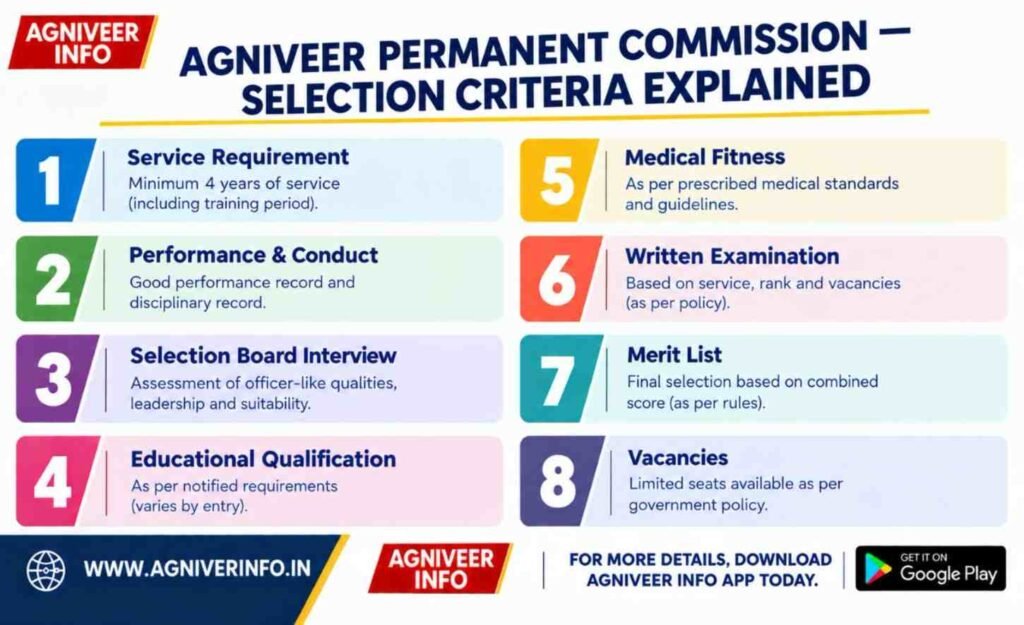
Candidates who want to be retained should stay proactive about their overall professional growth throughout their four years of service.
- Maintain Peak Physical Fitness: Keep scoring high on the regular physical fitness tests and combat efficiency checks.
- Uphold Strict Discipline: Stay away from any disciplinary issue, keep proper military conduct, and build a clean record.
- Master Trade Skills: Show strong technical skill, gain advanced trade qualifications, and do well in your operational duties.
- Excel in Training and Assessments: Treat every internal test, firing practice, and course evaluation as an important part of the final merit score.
| Selection Factor | Why It Matters | Candidate Should Focus On | Important Limitation |
| Performance | Direct measure of professional capability and overall operational value. | Excelling in daily duties, trade tests, and training courses. | Strong performance cannot override a lack of available vacancies. |
| Discipline & Conduct | Essential requirement for military cohesion, safety, and organizational integrity. | Maintaining an unblemished record and adhering to service rules. | Good conduct alone is insufficient without strong professional scores. |
| Medical & Physical Fitness | Ensures operational readiness under demanding operational and environmental conditions. | Maintaining peak physical conditioning and passing medical evaluations. | Fitness cannot compensate for poor technical or trade assessments. |
| Merit, Vacancies & Service Needs | Determines final selection thresholds based on actual organizational requirements. | Ranking as high as possible across all composite scoring parameters. | Candidate performance cannot alter the fixed organizational retention ceiling. |
Conclusion
Being retained in regular service after the four-year Agnipath term is a performance-based opportunity, and not something that automatically happens as part of your career. Candidates need to understand the difference between being retained in the regular cadre and getting an officer’s Permanent Commission, since these are two completely different administrative categories within the Armed Forces.
Selection is decided by merit, ongoing evaluation, strict medical and physical standards, and how many vacancies the organisation actually has. While completing the four years gives you financial support and a valuable skill certificate on exit, long-term service is kept for those who rank highest in the competitive evaluation. Aspirants should focus on doing their job well, staying fit, and keeping perfect discipline, to make the most of their chances under the official service rules.
For daily update join our WhatsApp channel
Frequently Asked Questions
Q1. Do Agniveers get Permanent Commission automatically?
A1. No, candidates do not get an automatic Permanent Commission, since being retained in regular service is a competitive process, open only to a portion of each batch.
Q2. What happens after four years of Agniveer service?
A2. Personnel either get selected for regular service based on merit, or they exit the Armed Forces with their Seva Nidhi financial package and skill certificate.
Q3. How are Agniveers selected for regular service?
A3. Selection depends on a combined merit score, evaluated across training performance, trade skills, physical fitness, discipline, and medical standards, matched against the overall vacancies in the service.
Q4. Does performance affect retention?
A4. Yes, the ongoing performance checks made during the four years directly affect the combined merit score that decides selection for regular service, across all three branches.
Q5. Does medical fitness matter for retention?
A5. Yes, candidates need to meet all the physical and medical standards set by their respective service branch, to remain eligible to be considered for the regular cadre.
Q6. Are all Agniveers retained after four years?
A6. No, only a set percentage who meet the eligibility and merit standards are retained in regular service, while the rest of the personnel exit once their service is complete.
Q7. Is retention the same as officer Permanent Commission?
A7. No, being retained places candidates in the regular cadre as non-commissioned personnel, and it does not give them an officer-level Permanent Commission or officer rank.
Q8. What happens to Agniveers who are not retained?
A8. Candidates who exit receive their Seva Nidhi financial package and skill certificates, which lets them move into civilian careers, or take up the preferential job options in state and police recruitment.