Source: Join Indian Army
Getting ready physically for women Agniveer candidates who want to join the Indian Army Corps of Military Police needs a balanced and well-planned approach. Candidates who plan their training in a proper, step-by-step way have a much better chance of doing well than those who depend only on hard, unplanned workouts once in a while.
A well-planned training routine builds the kind of stamina, muscle strength, joint strength, and mental toughness that the tough recruitment tests demand, so candidates should understand that being physically ready cannot happen in just a few days. To build fitness that lasts, you need patience, regular practice, a slow increase in effort, proper rest, and good food.
Before you start any fitness routine, you should read the current recruitment notification carefully. If you only run long distances every day and ignore your core strength, your upper body, your flexibility, and ways to prevent injury, you often end up tired too soon or hurt without any real need.
To prepare well, you need to train with smart movement, build your lung power, and train safely within your own body’s limits, because copying another candidate’s heavy training plan can actually work against you, since everyone starts with a different fitness level, recovers at a different speed, and moves in a different way. This guide gives a clear, step-by-step way to prepare physically, made specially for women who want to join the Indian Army.
Understand the Physical Requirements First
Every good preparation plan begins with a clear idea of the official standards. The recruitment rules, the physical fitness tests, the medical standards, and the age limits are all fixed by the guidelines that the military recruitment authorities set, so candidates should read the latest official notification for their exact recruitment cycle and region, instead of trusting old guidelines or claims made on social media that are not checked.
The official physical standards test different parts of fitness, such as stamina, quickness, and functional strength, and once you understand these requirements, you can plan your weekly routine well, giving equal importance to speed, stamina, and flexibility. If you prepare without checking the official rules first, you may waste your effort on exercises that do not matter, while missing the parts that are compulsory. When you treat the official recruitment notification as your main guide, your training stays focused, purposeful, and effective.
Running Preparation for Women Agniveer Candidates
Running is a very important part of the military fitness test, and it needs both the stamina to keep going and the speed to push hard for short bursts. To run at your best, you need a good mix of different running speeds, and not just an all-out sprint every day. Beginners should first build a steady base of stamina through easy runs, where you can still talk comfortably, before they add fast interval training.
- Aerobic Base Building: Slow, longer runs build the strength of your heart and lungs, make the tissues that connect your muscles and bones stronger, and improve your stamina without putting too much stress on your joints.
- Interval Training: Running fast for a short time and then walking to recover, done again and again, improves your speed, how well your body uses oxygen, and how fast your legs move.
- Pace Judgment: Regular timed practice sessions help you learn a steady pace, so that you do not get tired too soon during the official fitness test.
You must increase your effort slowly, to protect your shins, knees, and ankles from injuries caused by overuse. When you mix easy long runs with controlled fast sessions, you keep improving steadily without harming your bones and muscles in the long run.
How to Build Stamina Without Overtraining
Building your stamina needs a careful balance between hard work and rest. Overtraining happens when your workload keeps going beyond what your body can naturally handle and repair, and this leads to constant tiredness and worse performance. So you should plan your training week with clear changes in effort, mixing hard workout days with proper rest and recovery time.
Some signs that you are too tired include sore muscles that do not go away, a higher resting heart rate, poor sleep, feeling irritable, and a sudden drop in your running performance. To manage this tiredness, you need to give importance to good sleep, enough food, and planned rest days, because training harder helps you only when you also rest enough, and real improvement in fitness happens during rest, when your body tissues repair and grow stronger.
Strength Training for Women Agniveer Candidates
Functional strength training (training that builds real, useful strength) improves the way you run, makes your stride more powerful, keeps your main joints steady, and protects you from injuries caused by impact. Strong muscles let you keep a good posture even when you are tired, and help you face physical challenges with more confidence and less effort. Your strength workouts should focus on movements that use many joints together, using your own bodyweight or simple free weights.
Basic exercises like squats, reverse lunges, step-ups, push-ups, and bodyweight rows build power in the lower body, steadiness in the upper body, and strength in the trunk. Making your glutes (hip muscles), hamstrings, and calves stronger gives you extra push while running and protects your lower back and knees from constant stress. In resistance training, you should focus on doing the movement correctly rather than lifting the heaviest weight, so that you build the kind of real physical toughness that the hard military fitness tests need.
Core, Balance and Coordination Training
A strong core (the muscles of your stomach, back, and hips) acts like a bridge that carries energy between your lower body and your upper body while you move. Strong stomach, back, and pelvic muscles improve your running posture, stop you from wasting energy, and help you keep your balance on uneven ground. Exercises that make you balance on one leg improve the control of your ankle and the alignment of your hip, which lowers your risk of twisting injuries when you change direction quickly.
Adding plank exercises, bird-dogs (a balance exercise on hands and knees), side planks, and single-leg balance holds to your routine sharpens how your nervous system responds and how well you control your body. Good coordination lets you move well, save your energy, and stay steady even when you are tired. Giving just ten to fifteen minutes every day to core and balance exercises brings a big improvement in your overall control of your body.
Weekly Training Structure for Women Agniveer Preparation
A balanced weekly schedule spreads the physical load evenly, so that no one muscle group gets too tired, while your fitness keeps improving steadily. Candidates should change the amount of training according to their starting fitness level and how fast they recover.
- Monday: A steady, comfortable aerobic run followed by core stability exercises.
- Tuesday: A bodyweight strength session for the lower body, the upper body, and posture-holding exercises.
- Wednesday: Active recovery, with mobility exercises, stretching, and light walking.
- Thursday: An interval running session with a proper warm-up, short fast runs, and enough walking to recover in between.
- Friday: Full-body strength training, along with balance exercises for the ankle and hip.
- Saturday: A run at a medium distance and pace, followed by light stretching.
- Sunday: A full rest day for sleep, drinking water, letting your body recover, and preparing your meals.
Nutrition and Hydration for Physical Preparation
Proper food gives you the energy you need for hard workouts and helps your body repair itself. You should eat wholesome, nutritious food that includes complex carbohydrates (like whole grains), lean protein, healthy fats, fruits, and vegetables, because an unbalanced crash diet or eating too little cuts your energy, weakens your immunity, and raises your risk of injury.
Drinking enough water plays a big part in how well your muscles work, in keeping your body temperature steady, and in keeping your mind sharp. You should drink plain water steadily through the day, instead of drinking a lot just before your workout. Before a workout, eat something with carbohydrates that is easy to digest, so that your energy lasts, and after the workout, eat both protein and carbohydrates together, so that your muscles recover faster and your energy stores are filled again.
Injury Prevention and Recovery
Preventing injury is very important if you want steady progress without a break in your training. Most running injuries happen because of a sudden jump in training, wrong shoes, hard running surfaces, or not warming up properly. You should always start your workout with dynamic movements, so that your muscles, tendons, and joints are ready for exercise.
If you pay attention to what your body is telling you, you can catch small muscle tightness before it turns into a serious strain. You should never keep training through sharp or lasting joint pain, because ignoring these warning signs often leads to a long time away from training. Wearing proper running shoes, changing the surface you run on, sleeping eight hours every night, and doing regular mobility exercises keep your body strong, healthy, and able to handle the training.
Common Mistakes Women Candidates Should Avoid
- Daily High-Intensity Running: Running at your full effort every single day causes deep tiredness and raises your risk of shin splints (pain in the front of the lower leg).
- Skipping Strength Work: If you only run and skip strength training, the muscles that support your running get weaker, and your power and steadiness go down.
- Copying Expert Routines: Following an advanced training plan before you have built your basic fitness often leads to an early breakdown of your body.
- Drastic Caloric Restriction: Cutting your food too much starves the muscles that are working hard, slows your recovery, and weakens your stamina.
- Ignoring Warning Pain: Pushing through sharp joint pain turns a small tightness in the muscle into a long-term injury.
- Neglecting Rest Days: If you skip full rest days, your body tissues do not get the chance to repair themselves properly.
- Rapid Volume Spikes: Increasing your running distance or effort too fast causes serious overuse injuries.
Final Two Weeks Before the Physical Test
In the last two weeks before the official fitness test, you should reduce your training load while still keeping your movements sharp. Trying to build new fitness at this late stage does not work, and it only leaves you tired on the day of the test, so you should cut your training amount by thirty to forty percent, which lets your muscles fully recover and store up energy.
During this time, focus on light interval runs to stay sharp, gentle mobility work, drinking enough water, and keeping a regular sleep schedule. Use running shoes that you are already used to, and eat food that you already know suits you, so that you avoid stomach trouble or blisters. When you give importance to rest, you reach the test feeling fresh, full of energy, confident in your mind, and fully ready to give your best physical performance.
What to Do on Rally Day
On rally day (the day of the physical test), you need a calm mind, a disciplined pace, and smooth use of everything you have practised. Reaching early gives you time to finish the paperwork without feeling rushed, nervous, or stressed, and you should do a full dynamic warm-up, so that your body temperature rises and your muscles are ready for hard, sudden effort.
Sticking to your own pace, instead of trying to match other runners, stops you from getting tired too early. Saving your energy between the different tests, drinking small sips of water to stay hydrated, and following the official instructions carefully all help make the testing day go smoothly. When you trust the weeks of steady, disciplined preparation you have done, you keep your confidence and can perform at your very best.
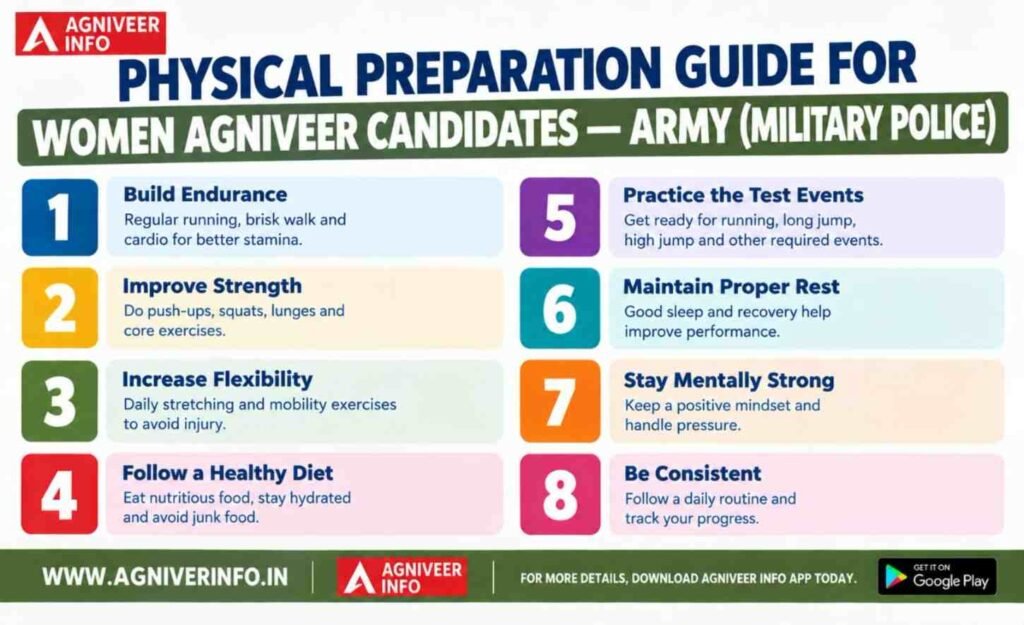
Physical Preparation Summary Matrix
| Preparation Area | Main Focus | Why It Matters | Common Mistake |
| Running | Stamina and controlled pacing. | Builds efficient breathing and running stamina. | Running at full speed in every single session. |
| Strength | Full-body functional muscle development. | Protects the joints, improves posture, and adds power to the stride. | Ignoring strength and resistance training completely. |
| Recovery | Good sleep, rest days, and mobility work. | Lets the body’s tissues repair and prevents constant overtraining. | Treating rest as laziness or a waste of time. |
| Nutrition | Balanced whole-food meals and hydration. | Keeps up the energy for workouts and speeds up muscle repair. | Following harsh crash diets or fasting. |
Conclusion
To prepare physically for women who want to join the Indian Army through the Military Police Agniveer path, you need discipline, a step-by-step plan, and regular practice. Candidates who balance their running with functional strength training, core stability, proper food, and enough recovery build real physical ability.
\Staying away from common mistakes, like running at high intensity every day, following crash diets, and ignoring the early warning signs of injury, keeps your progress steady and safe. Always treat the latest official recruitment notification as the final word for every rule about physical fitness, medical standards, and eligibility. Success comes to those who train wisely, respect their rest, stay disciplined, and keep their focus on being ready for the long run.
Get the latest Agniveer updates by joining our WhatsApp channel
Frequently Asked Questions
Q1. What physical preparation is needed for women Agniveer candidates?
A1. Candidates need a balanced training plan that combines aerobic running, lower-body strength work, core stability, mobility exercises, proper daily food, and planned rest for recovery.
Q2. How should women prepare for Army running tests?
A2. Build your basic stamina with comfortable long runs, add controlled interval sessions every week for speed, practise a steady pace, and increase your weekly distance very slowly.
Q3. Should women include strength training in Agniveer preparation?
A3. Yes, bodyweight exercises like squats, lunges, and push-ups build strong joints, improve running power, support the right posture, and help prevent common overuse injuries.
Q4. How many days should women train each week?
A4. A planned schedule of four to five training days a week gives enough training for fitness gains, while still leaving two full rest days for proper muscle recovery.
Q5. What should women eat during physical preparation?
A5. Focus on wholesome meals with complex carbohydrates, lean protein, healthy fats, and plenty of fresh fruits and vegetables, while drinking enough water and staying away from extreme crash diets.
Q6. How can women candidates avoid overtraining during preparation?
A6. Balance the hard training days with light recovery sessions, aim for eight hours of good sleep every night, watch for signs of too much tiredness, and take the rest days that are needed every week.
Q7. What should women do during the final week?
A7. Reduce your training load a lot to let your muscles rest, keep your movements light and sharp, drink enough water, sleep well, and avoid trying new exercises or unfamiliar food.
Q8. Where should candidates check current Army recruitment requirements?
A8. Candidates should always check the official Indian Army recruitment website or the latest official recruitment notifications, to confirm the exact current rules for physical fitness, medical standards, and selection.
READ ALSO: PRE-MEDICAL SELF-CHECKLIST FOR AGNIVEER CANDIDATES