
KNOW YOUR FORCES — INDIAN NAVY RANKS & INSIGNIA
Source: Indian Navy Official Website
Last updated: 19 November 2026
In this guide on Indian Navy ranks, you will learn about Indian Navy ranks for commissioned officers, sailors and senior sailor ranks and insignia basics. Just like the Army, the Indian Navy has its own distinct rank structure and insignia system, rooted in naval tradition but adapted to India’s own service. For an Agniveer aspirant preparing for Navy recruitment, understanding Indian Navy ranks helps in recognizing seniority and understanding how naval careers progress from entry level to top leadership.
What Are Indian Navy Ranks?
While preparing for Indian Navy ranks, the Indian Navy’s rank structure is divided into Commissioned Officers and Sailors (equivalent to Other Ranks in the Army), with Sailors further including senior sailor grades that function similarly to JCOs in the Army. Naval ranks and insignia often use stripes worn on the sleeve or shoulder, along with stars and the naval crest, reflecting long-standing naval traditions shared with many navies around the world.
For more details on this topic, read this: Indian Army Ranks and Insignia: Complete Guide
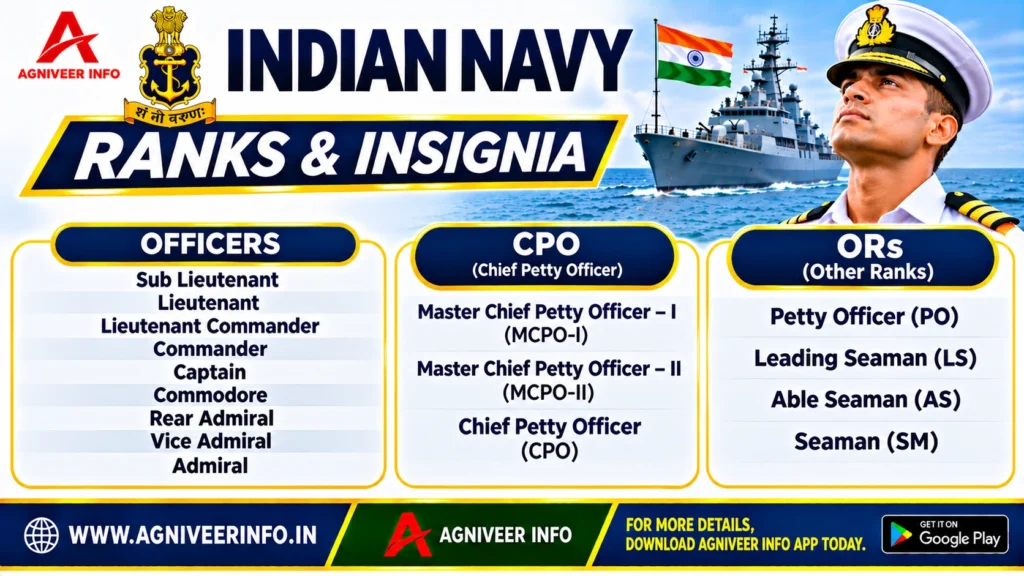
Indian Navy Ranks for Commissioned Officers
From junior to senior, key Indian Navy ranks for Commissioned Officers include:
- Sub Lieutenant
- Lieutenant
- Lieutenant Commander
- Commander
- Captain
- Commodore
- Rear Admiral
- Vice Admiral
- Admiral
- Admiral of the Fleet (a ceremonial five-star rank that has never been awarded in the Indian Navy)
For Indian Navy rank insignia, junior officers typically serve in specific roles onboard ships, gaining experience and specialisation, while senior officers such as Captains and Admirals hold command of ships, fleets, and eventually the entire Navy.
Sailors and Senior Sailor Ranks
In the context of Indian Navy rank insignia, sailors form the backbone of the Navy’s workforce, with ranks that progress based on experience, performance, and selection. Common sailor ranks, from entry level upward, include:
- Seaman II Class (entry-level rank)
- Seaman I Class
- Leading Seaman
- Petty Officer
- Chief Petty Officer
- Master Chief Petty Officer II Class
- Master Chief Petty Officer I Class (senior sailor grades)
Agniveers entering the Navy hold a distinct rank of their own, “Agniveer”, with distinctive insignia. With Indian Navy ranks in mind, those retained in the regular cadre after their four-year engagement continue as sailors under the applicable service rules, while the remaining Agniveers are offered a second two-year engagement, after which willing Agniveers who meet the selection criteria are offered regular enrolment.
Insignia Basics
As far as Indian Navy rank insignia is concerned, naval officer insignia typically use gold stripes worn on the sleeve (for ceremonial and certain uniforms) or on shoulder boards, with the number and arrangement of stripes indicating rank. A curl or loop in the top stripe is traditionally used to distinguish Executive Branch officers from other branches, though this can vary by exact uniform regulations. Senior ranks like Admiral incorporate additional stripes and the naval crest into their insignia.
Sailor insignia typically use anchors, chevrons, and stars on the sleeve or arm to indicate rank, with more senior sailor grades featuring more elaborate insignia designs.
For more details on this topic, read this: Indian Navy Agniveer SSR MR Recruitment 2026: Eligibility
Historical Background of Indian Navy Ranks
Looking at Indian Navy ranks, the Indian Navy’s rank names and much of its uniform tradition trace back to the Royal Navy, reflecting India’s naval heritage as a former British colonial possession. Ranks such as Lieutenant, Commander, and Admiral have long histories in naval traditions across the world, not just in Britain and India, since many navies historically adopted similar rank structures due to shared maritime traditions and the practical need for standardised, internationally recognisable naval ranks when ships from different nations interacted at sea.
On the topic of Indian Navy ranks, after independence, India retained this internationally recognised naval rank structure while gradually Indianising its officer corps and adapting insignia details, such as replacing British crown symbols with India’s own national emblem, to reflect the country’s independent identity.
Rank Equivalence Across the Armed Forces
Under Indian Navy ranks, for purposes of protocol, joint exercises, and tri-service commands, each Navy rank has a broadly corresponding rank in the Army and Air Force, even though the titles differ. For example, a Commander in the Navy is broadly equivalent in seniority to a Lieutenant Colonel in the Army and a Wing Commander in the Air Force, while a Captain (Navy) corresponds broadly to a Colonel and a Group Captain.
When it comes to Indian Navy ranks, this equivalence becomes particularly relevant during joint military operations, ceremonial events, and ministry-level appointments where officers from all three services interact and need a shared understanding of relative seniority. Recognising these equivalences is also useful when following defence news, since officers are sometimes transferred between tri-service organisations where personnel from the Army, Navy, and Air Force serve together under a single unified command structure spanning multiple services.
Why This Matters for an Agniveer Aspirant
Understanding Indian Navy ranks helps aspirants recognize the hierarchy they will work within, understand realistic career progression, and prepare for general knowledge sections of recruitment examinations. It also builds a clearer picture of how sailors can rise through the ranks with experience and dedication.
5 Key Facts
- Indian Navy ranks are divided into Commissioned Officers and Sailors.
- Admiral of the Fleet is a ceremonial five-star rank that has never been awarded in the Indian Navy.
- Sailor ranks progress from Seaman II Class up to Master Chief Petty Officer I Class.
- Naval officer insignia typically use gold stripes on sleeves or shoulder boards.
- Sailor insignia typically use anchors, chevrons, and stars.
Quick Revision
Indian Navy ranks split into Commissioned Officers and Sailors. Officer ranks range from Sub Lieutenant to Admiral of the Fleet. Sailor ranks progress from Seaman II Class to Master Chief Petty Officer I Class. Insignia use gold stripes for officers and anchors/chevrons for sailors.
For more details and daily updates, join our WhatsApp channel.
Frequently Asked Questions About Indian Navy Ranks
What are the two broad categories of Indian Navy ranks?
Commissioned Officers and Sailors.
What is the highest rank in the Indian Navy?
Admiral of the Fleet is the highest rank, though it is a ceremonial five-star rank that has never been awarded in the Indian Navy.
What is the entry-level sailor rank in the Navy?
Seaman is generally the entry-level sailor rank.
What do naval officer insignia typically use to show rank?
Gold stripes worn on the sleeve or shoulder boards, with the number of stripes indicating seniority.
What symbols appear on sailor rank insignia?
Anchors, chevrons, and stars typically appear on sailor rank insignia.
Related reading: Indian Army ranks and insignia | Indian Army hierarchy
Disclaimer: This information is for general guidance only. Rules, dates and figures can change, so please check the official source linked above before taking any final decision.