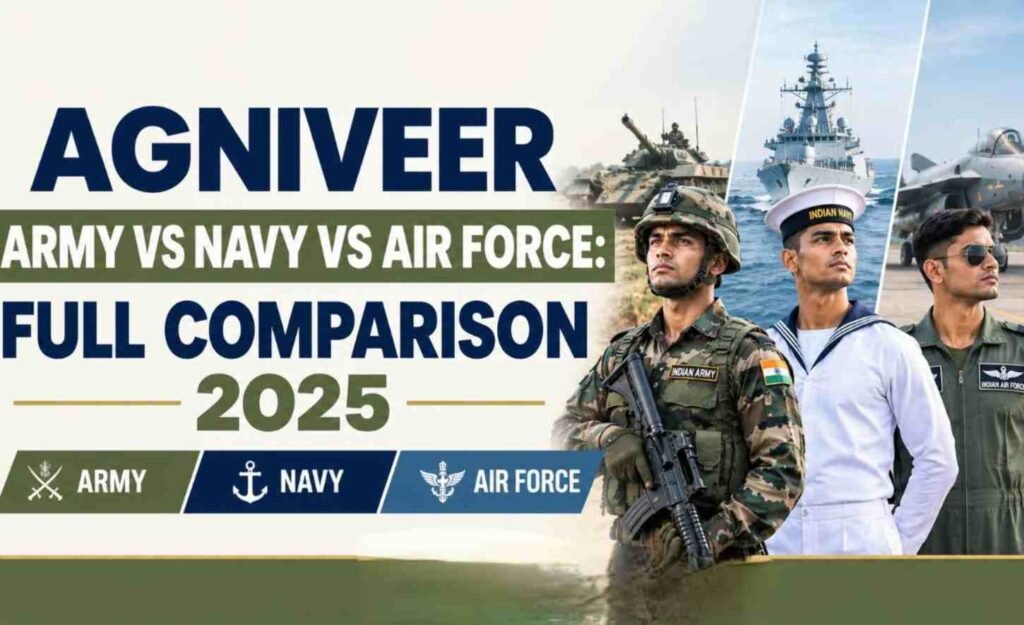
The Agnipath Scheme is a big change in the way the Indian Armed Forces recruit people for short-term active service, and under this scheme, selected candidates serve as Agniveers for four years in the Indian Army, Indian Navy, or Indian Air Force.
While the overall policy, the basic pay package, and the Seva Nidhi benefits are the same across all three branches, it would be a mistake to think these three paths are identical, because each service works in a very different area, ranging from land-based combat to sea security to defending the skies. This is why candidates need to carefully compare the eligibility rules, the educational qualifications needed, the physical and medical standards, and the selection process, so that they can pick the branch that suits their own background and strengths.
Choosing a service only because of the pay or its general reputation can lead to disappointment later, since the daily duties, physical demands, technical work, and overall environment are quite different from one branch to another. The official notices put out by the Join Indian Army, Join Indian Navy, and Indian Air Force portals lay down the exact entry rules that candidates must go through carefully before they apply.
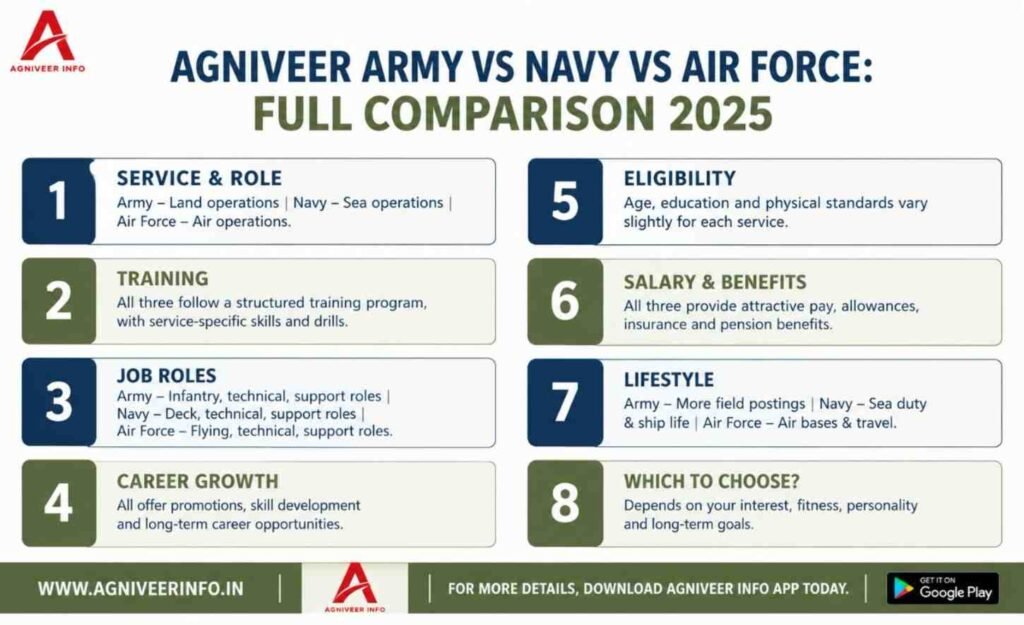
Agniveer Army vs Navy vs Air Force: Basic Difference
The Indian Army mainly works on land, and its duties include ground combat operations, counter-insurgency missions, border security, and infantry or armoured operations, which means Army Agniveers face a lot of physical strain, work in different kinds of terrain, and spend a lot of time out in the field. The Indian Navy protects the country’s maritime borders and handles warships, naval aviation, submarines, and shore bases, so Navy Agniveers get used to life either at sea (called “afloat”) or at coastal naval stations (called “ashore”). The Indian Air Force protects the country’s airspace through aircraft maintenance, airfield security, radar work, and air logistics, which is why Agniveervayu personnel mostly work inside high-tech air bases, maintenance depots, and radar stations.
Eligibility Comparison
- Age Limit: In all three services, a candidate must be between 17.5 and 21 years of age at the time of joining, and the exact birth-date cut-offs are given in each intake’s own official notice.
- Nationality: Candidates must be unmarried Indian citizens, though Nepalese citizens are also allowed to apply for certain Army and Air Force entries under government rules.
- Gender Eligibility: Both male and female candidates can apply for the specific trades open to them in the Army, Navy, and Air Force.
- Marital Status: Every applicant must stay unmarried for the whole four-year service period.
Educational Qualification: Army vs Navy vs Air Force
Each service sets its educational requirements based on the kind of work its trades involve.
The Indian Army offers several entry routes: General Duty (GD) needs a Class 10th pass with 45% marks overall; Technical entry needs 10+2 with Physics, Chemistry, Maths, and English at 50% overall, or an equal ITI/Diploma qualification; Office Assistant/Store Keeper Technical needs 10+2 in any stream with 60% overall; and Tradesmen posts accept candidates who have passed either 8th or 10th class.
The Indian Navy recruits through Senior Secondary Recruits (SSR), which needs 10+2 with Maths and Physics along with Chemistry, Biology, or Computer Science, or a 3-year Engineering Diploma, and Management Recruits (MR), which needs a Class 10th pass with at least 50% marks overall.
The Indian Air Force takes in Agniveervayu candidates under two paths: Science Subjects, which needs 10+2 with Physics, Maths, and English at 50% overall and 50% in English, or a 3-year Engineering Diploma, and Other Than Science Subjects, which needs 10+2 in any stream with 50% overall and 50% in English.
Selection Process Comparison
Army
The process starts with the Phase-1 Common Entrance Examination (CEE), which is held online, and candidates who clear it move on to Phase-2 Recruitment Rallies, which include checking documents, the Physical Fitness Test (PFT), and the Physical Measurement Test (PMT). After this, Phase-3 involves a detailed Medical Examination, and the process ends with the final merit list.
Navy
Candidates first sit for Stage-I, the Indian Navy Entrance Test (INET), which is an online computer-based exam, and those who are shortlisted move to Stage-II, which has a written exam, the PFT, and an initial medical check. Final selection depends on Stage-III, which involves pre-enrolment medical checks and document verification at INS Chilka.
Air Force
Stage-1 is an online test based on either Science or Non-Science subjects, and candidates who qualify move to Stage-2, which includes the physical fitness test, checking of documents, and Adaptability Tests (which check whether a candidate is suited to military life). Candidates who clear Stage-2 then go through Stage-3, the Medical Examination, before the final merit list is prepared.
Physical Test Comparison
The physical standards match the actual work each service expects from its soldiers:
- Army: Male candidates run 1.6 km within a set time (up to 5 minutes 30 seconds for Group I, and up to 5 minutes 45 seconds for Group II), and also do pull-ups on a beam, a 9-foot ditch jump, and a zig-zag balance test, while female candidates have a different, adjusted time for the 1.6 km run.
- Navy: Male candidates run 1.6 km in 6 minutes 30 seconds, along with 20 squats (called Uthak Baithak) and 12 to 15 push-ups, while female candidates run 1.6 km in 8 minutes, along with 15 squats and 10 bent-knee sit-ups.
- Air Force: Male candidates run 1.6 km in 7 minutes, followed by 10 push-ups, 10 sit-ups, and 20 squats, all within set time limits, while female candidates complete the 1.6 km run in 8 minutes, along with sit-ups and squats.
Medical Standards Comparison
Every candidate must be in good physical and mental health, with no active or hidden medical condition. The minimum height needed is different for each service: for the Army, male candidates need to be around 162 to 170 cm depending on the region and trade, while female candidates need 162 cm; for the Navy, the minimum height is 157 cm for males and 152 cm for females; and for the Air Force, the minimum height is 152.5 cm. In all three services, a candidate must be able to expand their chest by at least 5 cm, and eyesight, colour vision (marked as CP-II or CP-III), and rules about tattoos are strictly checked according to each branch’s own rules.
Training and Work Environment
Army Agniveers go through basic military training, followed by trade-specific training at Regimental Centres, and the whole environment is built around physical stamina, being ready for combat, working in the field, and following strict military discipline.
Navy Agniveers complete their basic training at INS Chilka, and their work involves living aboard warships, handling marine technical equipment, doing deck operations, or working at shore support units under sea-related conditions.
Air Force Agniveers get their basic and technical training at designated Air Force Training Establishments, and their daily work includes maintaining aircraft systems, handling technical logistics, watching over radar systems, maintaining weapons, and looking after airfield security.
Salary, Allowances and Seva Nidhi
The pay terms are exactly the same across all three services under the Agnipath Scheme:
- Year 1: Customised Package: ₹30,000/month; In-hand: ₹21,000; Corpus Fund: ₹9,000.
- Year 2: Customised Package: ₹33,000/month; In-hand: ₹23,100; Corpus Fund: ₹9,900.
- Year 3: Customised Package: ₹36,500/month; In-hand: ₹25,580; Corpus Fund: ₹10,950.
- Year 4: Customised Package: ₹40,000/month; In-hand: ₹28,000; Corpus Fund: ₹12,000.
The government also puts in an equal amount into the Agniveer Corpus Fund, and once the four years are complete, the Seva Nidhi package gives about ₹10.04 lakhs (plus the interest earned), and this whole amount is fully exempt from income tax. Depending on where a soldier is posted, the applicable risk, hardship, field, and dress allowances are also given.
Life Insurance and Death Benefits
Agniveers in the Army, Navy, and Air Force all get non-contributory life insurance cover of ₹48 lakhs during their four years of service. If an Agniveer dies while on duty, their family receives the insurance amount, a non-statutory ex-gratia payment of ₹44 lakhs, and the full pay for the remaining part of the four-year term, including the Seva Nidhi contributions.
Four-Year Service and Permanent Retention
Enrolment is strictly for a fixed four-year term, and once this period ends, all Agniveers leave active service. Out of each batch, up to 25% of Agniveers may be taken into the regular cadre, based on their performance, internal assessment, the organisation’s needs, and overall merit during their service. Being taken into the regular cadre is never guaranteed, and the final decision rests entirely with the service headquarters.
Career Opportunities After Four Years
Agniveers who finish their four years get the Seva Nidhi financial support, a Skill Gain Certificate, and real military experience, and several state police forces, Central Armed Police Forces (CAPFs), and private security or technology companies keep certain seats reserved, or give age relaxation, for former Agniveers. Ex-Agniveers can also use their Seva Nidhi money for further studies or to start their own business.
Which Is Better: Army, Navy or Air Force?
Army may suit candidates who prefer:
Outdoor field life, tough terrain, ground combat operations, and the strong traditions of the infantry and regiments.
Navy may suit candidates who prefer:
Life at sea, warship technology, ocean operations, sea travel, and duty at coastal stations.
Air Force may suit candidates who prefer:
Technical work in aviation, life on air bases, radar systems, specialised engineering maintenance, and advanced technology.
| Comparison Factor | Army Agniveer | Navy Agniveer | Air Force Agniveer |
| Eligibility & Entry | 17.5–21 yrs; 8th/10th/12th pass based on GD, Tech, Clerk, Tradesman | 17.5–21 yrs; 10th (MR) or 12th with Physics/Maths (SSR) | 17.5–21 yrs; 12th with Science or Non-Science streams |
| Selection & Physical Test | CEE online exam, Rally PFT (1.6 km run, beam, ditch, balance), Medicals | INET online exam, Stage-II written/PFT (1.6 km run, squats, push-ups), Medicals | Online test, PFT (1.6 km run, push-ups, sit-ups, squats), Adaptability Test, Medicals |
| Work & Training | Field bases, combat arms, ground operations, demanding physical terrain | Warships, naval bases, marine machinery, technical deck and shore duties | Technical airbases, aircraft systems, radar stations, air logistics support |
| Career & Retention | 4-yr term; up to 25% regular cadre absorption; Seva Nidhi payout | 4-yr term; up to 25% regular cadre absorption; Seva Nidhi payout | 4-yr term; up to 25% regular cadre absorption; Seva Nidhi payout |
Conclusion
Choosing between the Indian Army, Indian Navy, and Indian Air Force under the Agnipath Scheme really comes down to your own qualifications, physical ability, and personal career interest, and even though the pay, the Seva Nidhi amount, the insurance, and the four-year service term are the same across all branches, the daily work, selection process, physical standards, and overall environment are quite different from each other.
Candidates who are drawn to ground combat and field endurance should think about the Army, those who are interested in sea systems and life on water should look at the Navy, and those who want to work in technical aviation support should focus on the Air Force. Before applying, aspirants must go through the official notifications carefully.
Get the latest Agniveer updates by joining our WhatsApp channel
Frequently Asked Questions
Q1. Which is better: Army, Navy or Air Force Agniveer?
A1. No single service is better than the others for everyone, because the right choice depends on your educational qualification, your physical fitness, your technical interest, and whether you prefer to work on the ground, at sea, or in the air.
Q2. Are Agniveer salaries different in Army, Navy and Air Force?
A2. No, the basic pay scale, the monthly in-hand amount, the corpus contributions, and the final Seva Nidhi package are exactly the same across the Army, Navy, and Air Force.
Q3. Which Agniveer entry has the toughest physical test?
A3. The Indian Army’s physical rally test is usually seen as the toughest, because of its strict running time limits, beam pull-ups, and other field-based physical scoring.
Q4. Are educational qualifications different across the three services?
A4. Yes, the Army accepts candidates from 8th to 12th pass depending on the trade, the Navy needs either 10th pass (for MR) or 12th with Maths and Physics (for SSR), and the Air Force needs 12th pass with 50% overall marks and 50% in English.
Q5. Is the medical test the same for all Agniveers?
A5. No, even though the general health standards are the same for everyone, the height limits, eyesight standards, and other specific medical requirements are different for the Army, Navy, and Air Force.
Q6. Do Army, Navy and Air Force Agniveers serve for four years?
A6. Yes, every Agniveer, no matter which of the three services they join, is first enrolled for a fixed four-year term under the official terms of the Agnipath Scheme.
Q7. Can Agniveers be retained in regular service?
A7. Yes, up to 25% of the Agniveers in each batch can be chosen for regular cadre service, based on their performance, internal assessments, and the vacancies available in the organisation.
Q8. How should candidates choose between Army, Navy and Air Force?
A8. Look closely at your academic marks, your height, your physical stamina, your medical fitness, and whether you would rather work on the ground in combat, aboard a naval ship, or on a military airfield.
READ ALSO: AGNIVEER CHEST MEASUREMENT STANDARDS — HOW IT’S TESTED