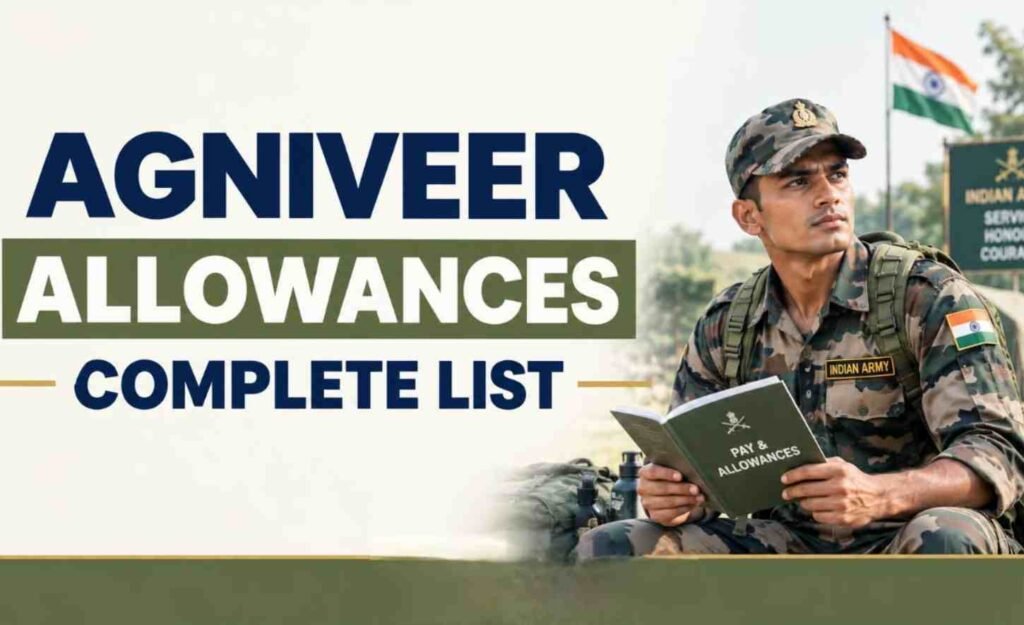
Under the Agnipath scheme, people who join the Indian Armed Forces serve as Agniveers for four years. While the basic pay follows a fixed monthly package that goes up every year, Agniveer allowances are the extra payments and benefits given to personnel on top of this, depending on their duty.
It is important for candidates to understand that allowances are completely separate from the basic package, because the basic salary is the core payment for service, while allowances change based on things like the kind of duty a soldier is doing, where they are posted, how risky the job is, and how tough the environment is.
This is why not every Agniveer gets every allowance listed by the government. An Agniveer posted at a quiet peace station will get a different set of allowances compared to one posted in a high-altitude area or an active operational zone, and since the Indian Army, Indian Navy, and Indian Air Force each have their own duty requirements, the rules for who gets which allowance also differ across the three services. Because of this, candidates should always check the official recruitment notices of the service they are joining, instead of guessing what they might get. This guide explains the different Agniveer allowances, who is eligible for them, and how they work.
What Are Agniveer Allowances?
An allowance is extra money or a benefit that the government gives to cover certain expenses, tough duties, or difficult working conditions that come up during military service. Unlike the basic monthly package, which stays fixed and is paid to every Agniveer of the same service year, allowances depend on the situation a soldier is actually in. They exist to make up for hard postings, dangerous terrain, special duties, and official travel.
Since allowances depend fully on where a person is posted and what work they are doing, candidates should never treat them as guaranteed income every month. An allowance that a soldier gets while posted in a special field area will stop or change as soon as they are transferred to a peace station, so understanding this helps you avoid wrong guesses about your actual take-home pay.
Agniveer Allowances — Complete List
The Agnipath policy makes sure that Agniveers get the allowances that match normal military duty needs. Instead of giving the same set of allowances to everyone, the system gives specific allowances based on the conditions a soldier is actually working in.
- Risk and Hardship Allowance: Given to personnel who are posted in operational areas where there is physical danger, harsh weather, or hazardous combat duty.
- Field Area Allowance: Given to Agniveers who are posted in areas marked as modified field areas, field deployment zones, or active counter-insurgency areas.
- High-Altitude Allowance: Paid to those posted at military bases above certain officially fixed heights.
- Travel and Transport Allowance: Covers the cost of approved official movement, short duty transfers, and other travel connected to service.
- Dress and Clothing Entitlements: Given either as actual uniform items issued every year, or as an approved cash allowance to maintain the uniform.
- Ration Provisions: Given either as proper food at military messes, or as an approved cash allowance for rations.
Risk and Hardship Related Allowances
Risk and hardship allowances exist to recognise and pay for the extreme conditions faced by soldiers in dangerous or hostile places, since military duty often means facing physical danger, combat zones, and very harsh weather.
Who gets these allowances is decided strictly by the official rules of the Ministry of Defence, based on exactly where a soldier is posted and what work they are assigned. So, an Agniveer doing routine office or maintenance work in a peaceful cantonment does not qualify for risk allowances, and the entitlement only begins once the soldier is officially posted to a place marked as high-risk.
Field Area, High-Altitude and Difficult-Location Allowances
Where an Agniveer is posted plays a big part in deciding their actual monthly pay, because military posts along sensitive borders, active deployment zones, or harsh physical areas come with special extra allowances.
For example, high-altitude allowances are divided into different levels depending on how high the post is, and in the same way, field area allowances change depending on whether a place is a full field area, a modified field area, or a peace area. To be eligible, a soldier must have an official posting order to that particular area.
Travel, Ration, Clothing and Other Benefits
It helps to understand the difference between direct cash allowances, official refunds, and the actual goods or services given by the armed forces.
- Ration Provisions: Agniveers get free, proper food rations. In operational areas or certain field posts where there is no mess facility, an approved cash ration allowance may be given instead.
- Clothing and Uniforms: Uniforms are usually given directly as physical items and clothing needed for duty, along with the rules for maintaining them.
- Travel Entitlements: Official travel for training, short duty postings, or approved leave travel concession (LTC) is given either as direct tickets or as a refund of travel costs, based on military rules.
Army, Navy and Air Force Allowances
While the overall pay structure of the Agnipath scheme is the same across all three services, the different working conditions in each branch naturally lead to differences in which allowances apply.
Army Agniveer
Army Agniveers are often posted at land borders, high-altitude mountain posts, counter-insurgency areas, and other field postings, so Army personnel are more likely to qualify for field area and high-altitude allowances linked to land postings.
Navy Agniveer
Navy Agniveers spend long periods at sea on naval ships, submarines, or coastal air stations, and their sea postings come with their own special arrangements, ship duties, and naval facility benefits that are different from land postings.
Air Force Agniveervayu
Air Force Agniveervayu personnel serve at air force stations, technical maintenance depots, and airfields, so their benefits are based on airfield conditions, their technical trade, and the special support work they do for aviation operations.
Are Agniveer Allowances Included in In-Hand Salary?
An Agniveer’s monthly package is fixed, starting at ₹30,000 in Year 1 and going up to ₹40,000 by Year 4. Out of this package, 30% is taken out every month for the Agniveer Corpus Fund, and the government adds an equal amount on its own, so the base take-home salary is the remaining 70%.
Any cash allowance that applies is added on top of this base take-home pay, which directly raises the total salary credited during the months a soldier qualifies for it, and allowances are never reduced for the Seva Nidhi fund. On the other hand, benefits that are not in cash, such as free rations or uniforms, are service facilities and do not add to the cash pay.
Do All Agniveers Receive the Same Allowances?
No, Agniveers do not all get the same allowances. While the basic monthly package is the same across all three services for a given year of service, the allowances change from person to person.
These differences come from five main things: the service branch, the technical trade, the actual place of posting, how risky the duty is, and the current government rules. So even two Agniveers from the same batch will end up with different monthly take-home pay if one is posted to a peaceful cantonment and the other to a high-altitude border post.
Important Things Candidates Should Know About Allowances
Candidates should think about the salary structure in a practical way. Allowance entitlements cannot be transferred and stop as soon as a soldier moves out of the place or role that made them eligible, so candidates should not calculate their expected four-year earnings by assuming they will get the maximum allowance every month. Official military notices and government orders remain the only real authority on allowance rates and who can get them.
| Allowance/Benefit Category | Purpose | Eligibility | Important Note |
| Risk/Hardship | Pays for exposure to physical danger and combat duty | Posted in officially marked hazardous operational areas | Stops once transferred to a non-hazardous, peaceful posting |
| Field/Location | Makes up for difficult living conditions and harsh terrain | Posted to high-altitude or officially marked field areas | Rates change based on the official altitude and area level |
| Travel | Covers official transport and duty-related movement costs | Doing approved official travel or duty transfers | Given either as direct tickets or as a refund of expenses |
| Ration/Clothing/Other | Meets nutrition needs and provides proper military clothing | Given to everyone during active military service | Mostly given as actual goods and services rather than cash |

Conclusion
Agniveer allowances are extra financial and practical benefits meant to support soldiers who are working in tough service conditions. Unlike the fixed monthly package, allowances depend completely on where an Agniveer is actually posted, how risky the duty is, and the local conditions there. Candidates should keep in mind the clear difference between base take-home pay, Seva Nidhi contributions, and the allowances that vary across the Army, Navy, and Air Force, and checking the official government recruitment notices remains the best way to get accurate, up-to-date information on allowance rules.
Get the latest Agniveer updates by joining our WhatsApp channel
Frequently Asked Questions
Q1. What are Agniveer allowances?
A1. Agniveer allowances are extra payments given on top of the basic salary to make up for specific duty risks, difficult posting locations, and operational expenses.
Q2. Does every Agniveer receive the same allowances?
A2. No, allowances depend on where a soldier is posted, how risky the duty is, how tough the environment is, and which service they belong to, so monthly earnings can be quite different from one posting to another.
Q3. Are Agniveer allowances included in in-hand salary?
A3. Any cash allowance that applies is added to the take-home salary and raises the total cash pay, but benefits that are not in cash, like rations, are given as service facilities instead.
Q4. Do Army, Navy and Air Force have identical allowances?
A4. While the main policy is the same for all three, the different nature of the work, such as sea duty, land border postings, or airfield duty, means each service has its own specific allowance rules.
Q5. Can posting location affect Agniveer allowances?
A5. Yes, where a soldier is posted directly decides which special allowances they can get, including field area, high-altitude, and difficult-terrain allowances, as set by defence service rules.
Q6. Are risk and hardship allowances guaranteed?
A6. No, risk and hardship allowances are not guaranteed, and they are only paid when an Agniveer is actually posted in an officially marked hazardous area.
Q7. Are travel and ration benefits counted as salary?
A7. No, travel concessions and ration benefits are service entitlements or refunds meant to cover practical needs, and they are not counted as regular taxable salary.
Q8. Where should candidates verify the latest allowance rules?
A8. Candidates should verify the latest allowance rules only through the official recruitment portals of the Indian Army, Indian Navy, Indian Air Force, or the Ministry of Defence.
READ ALSO: AGNIVEER ARMY VS NAVY VS AIR FORCE: FULL COMPARISON 2025