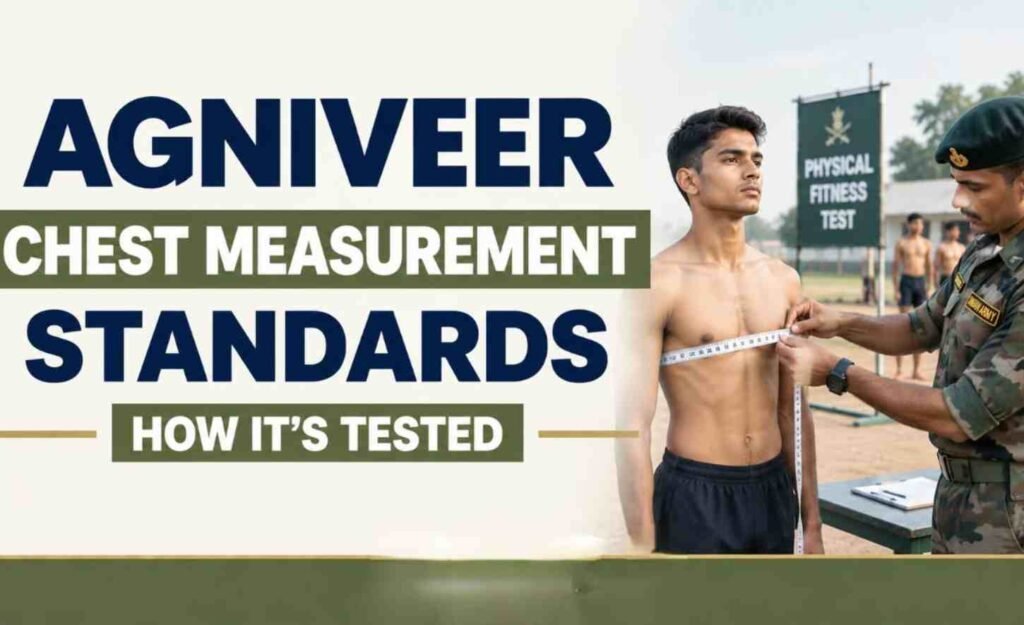
Physical and medical tests during Indian defence recruitment make sure that candidates have the body development and lung capacity needed to handle the tough demands of military service, and among these tests, Agniveer chest measurement standards work as an important sign of good structural health, lung capacity, and overall physical fitness.
Candidates often get confused here, because they do not understand the difference between plain chest size and chest expansion, and understanding this difference matters a lot since the physical requirements are not the same across the armed forces.
Chest standards change depending on the service branch, the entry type, the trade, the candidate’s gender, their category, their region, and the exact instructions given in the official notice.
Trusting random charts or rumours found online can lead to poor preparation or wrong expectations, so it helps to remember that the physical standards are set by medical and recruitment officers to make sure candidates can safely handle tough duties.
Meeting or crossing a physical benchmark does not guarantee selection on its own, because chest measurement is only one part of the whole recruitment process, which also includes written exams, physical fitness tests, detailed medical checks, and the final merit list. This article explains the standards, how the testing is done, and how you can prepare for it across the three services.
What Is Chest Measurement in Agniveer Recruitment?
Chest measurement in military recruitment checks a candidate’s physical development, chest size, and how well their lungs work, and it is not about how muscular or good-looking someone’s body looks. Medical boards actually check two separate things: the static chest size and the functional chest expansion.
The static measurement shows the bone frame and muscle mass of the body, while the expansion shows how well the chest wall moves and how much lung volume a person has. Evaluators use a standard tape that does not stretch, and they place it at fixed points on the body to take the reading. So even a candidate with a big, muscular upper body will not automatically meet the military’s physical standard if their chest does not move or expand enough.
Agniveer Chest Measurement Standards
The official standards change depending on the recruitment branch, the trade, the candidate’s gender, and the official notice for that intake. Male candidates in every branch must meet certain chest measurements, while female candidates applying to the Indian Army, Navy, and Air Force are generally not required to meet a minimum static chest size. Even so, female candidates still need to show proper chest development and healthy lung expansion during their medical exam.
For male Indian Army Agniveers, whether in General Duty, Technical, or Office Assistant/Tradesmen roles, the usual unexpanded chest size needed is 77 cm, along with a required minimum expansion of 5 cm. Indian Navy Agniveers and Indian Air Force Agniveervayu candidates are mainly checked on how well their chest actually expands, and they too need a well-developed chest with a minimum expansion of 5 cm. Depending on the trade or the region, these baseline numbers may change slightly, so candidates should always check the official recruitment notice for their case.
Minimum Chest and Chest Expansion: What Is the Difference?
It is important to understand the difference between minimum chest size and chest expansion so that you can judge your own readiness correctly. Minimum chest circumference is simply the measurement taken around the torso while breathing out normally, and it shows the basic structural size of the body.
Chest expansion, on the other hand, is the difference between the measurement taken after breathing all the way out and the measurement taken after breathing all the way in, and this shows how well the chest wall moves, how flexible the ribcage is, and how much lung capacity a person actually has. So, a candidate with a medium-sized chest who can expand it properly is actually in a better position than a broad-chested candidate who cannot show the required chest movement.
How Is Chest Measurement Tested?
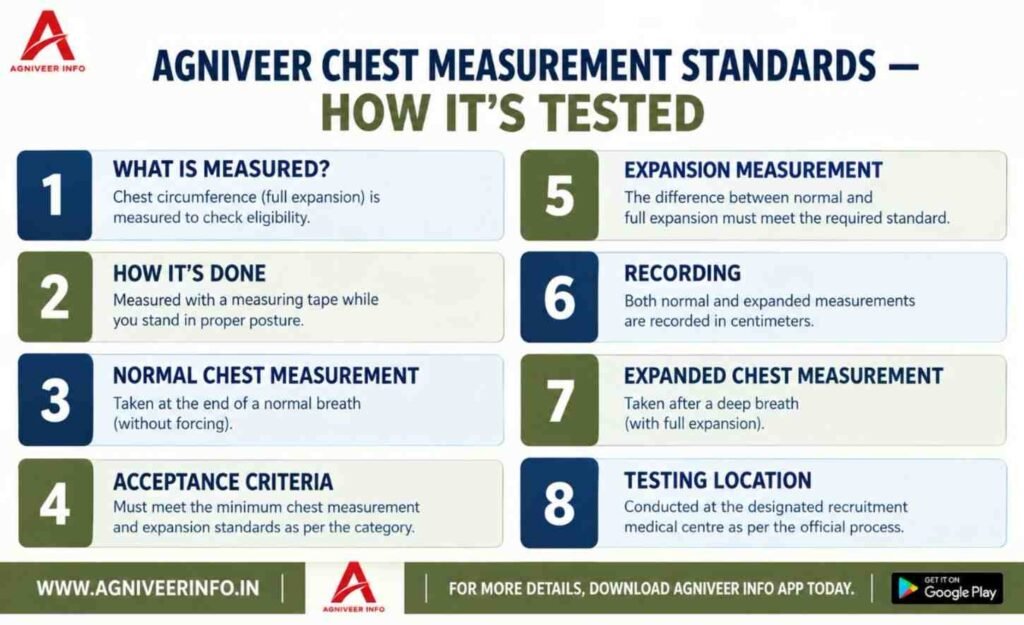
This test is done during the physical measurement test or the medical check-up by recruitment staff. The candidate has to stand upright on level ground with relaxed shoulders, looking straight ahead, with their arms hanging naturally or briefly raised so that the tape can be placed.
The evaluator wraps a flexible, non-stretchable tape around the chest, usually going across the lower edge of the shoulder blades at the back and just above the nipples at the front, and the tape is kept snug against the skin without pressing into it. First, the evaluator notes down the reading while the candidate is breathing normally, and then asks the candidate to breathe in fully so that the expanded reading can be taken. It is the official recruitment method that is followed, and not any other way of measuring.
What Happens During Chest Expansion Measurement?
To check the expansion, the evaluator first notes the reading while the candidate is breathing normally, without any special effort, and this is the unexpanded value. The candidate is then asked to take a deep breath and expand the chest fully, but without raising the shoulders too much or bending the back in an unnatural way.
The evaluator then reads the tape again at the point of full inhalation, and the unexpanded reading is subtracted from this expanded reading to get the total chest expansion. For example, if the unexpanded chest measures 78 cm and it goes up to 83 cm on full inhalation, the candidate has achieved a 5 cm expansion. Candidates need to do this expansion smoothly, without forcing it or making any unnatural movement.
Army vs Navy vs Air Force Chest Standards
The requirements differ a little between the three services, based on their own operational needs and entry rules:
- Indian Army: Looks at both the baseline static chest size, which is usually 77 cm for standard male entries, and a required 5 cm expansion.
- Indian Navy: Focuses on proportional body development along with a required minimum expansion of 5 cm, checked during the medical screening.
- Indian Air Force: Checks Agniveervayu candidates on their physical proportion along with a required minimum chest expansion of 5 cm.
Candidates should always read the specific notice for their chosen service to confirm the exact physical requirement for their trade.
Category-Wise or Region-Wise Chest Relaxation
Certain physical relaxations are officially given to candidates from specific regions and categories, since people from different regions naturally have different body builds. Candidates from hill regions, including Garhwal, Kumaon, Himachal Pradesh, Jammu & Kashmir, Ladakh, and the North-Eastern states, may be given a relaxation in the static chest size that is otherwise required.
Relaxations are also given to candidates from recognised tribal communities or certain sports categories, as mentioned in the official recruitment rules. However, these relaxations apply mainly to the static chest size, and the required chest expansion, usually 5 cm, generally stays firm so that proper lung function can still be checked. To get a relaxation, candidates must show valid supporting documents at the time of rally registration.
How Candidates Should Prepare for Chest Measurement
To prepare well, candidates should work on building upper-body strength while also improving how well their chest wall moves, and this can be done by combining strength exercises with breathing practice:
- Strength Exercises: Do push-ups, dips, pull-ups, and chest presses regularly, since these build up the chest, upper back, and the muscles between the ribs.
- Respiratory Practice: Practise deep breathing from the stomach and full chest expansion, so that the ribcage becomes more flexible over time.
- Posture Correction: Keep an upright posture, since rounded shoulders can make the chest measurement look smaller than it actually is.
- Overall Fitness: Focus on staying fit overall, rather than trying sudden or unsafe methods just before the test.
Can Exercise Increase Chest Measurement?
Regular strength training helps to increase upper-body muscle over time, and this can slowly increase the chest size. Deep breathing exercises also help by improving how flexible the ribcage is and how well the muscles between the ribs work, which helps with expansion.
That said, exercise cannot change the basic bone structure of an adult’s body. Unsafe shortcuts, holding the breath for too long, or taking supplements will not bring any lasting physical change and can actually be risky for health. Steady and regular physical training remains the safest and most reliable way to improve chest development and movement.
What If Your Chest Measurement Is Below the Standard?
If your own rough check shows that you are below the official standard, you should first look at the current notice for your trade, region, or category, since the exact rule may be different for you. Always measure yourself using the proper method, rather than guessing at home in a casual way.
If the gap is small, focus on targeted upper-body strength training along with breathing exercises to close it. If a candidate is found short during the actual rally, they should follow the official appeal process given by the recruitment board, and should never try to fake or manipulate the measurement.
| Service / Category | Chest Requirement | Expansion Requirement | Important Note |
| Army Agniveer | Generally 77 cm unexpanded for male general entries | Minimum 5 cm expansion required | Standards vary by trade and candidate region |
| Navy Agniveer | Proportional chest development based on height and weight | Minimum 5 cm expansion required | Evaluated primarily during medical examination |
| Air Force Agniveervayu | Well-proportioned chest development required | Minimum 5 cm expansion required | Applies to all male Agniveervayu entries |
| Special Categories | Relaxation permitted on baseline static chest | Minimum 5 cm expansion usually maintained | Requires official category or domicile certificates |
Conclusion
To understand the Agniveer chest measurement standards properly, you need to know the difference between basic chest size and chest expansion, because while the baseline size shows muscular and structural development, the expansion shows how well a person can breathe and how fit their lungs are.
Since the exact rules change across the Indian Army, Navy, and Air Force, and also across regions, categories, and trades, candidates should always check the official recruitment notice instead of depending on random charts. When preparing, focus on your posture, your strength training, and healthy breathing habits. Meeting the chest standard is one important part of being eligible, but final selection still depends on how you perform in all the physical, written, and medical tests together.
Get the latest Agniveer updates by joining our WhatsApp channel
Frequently Asked Questions
Q1. What is chest measurement in Agniveer recruitment?
A1. Chest measurement checks a candidate’s upper-body physical development, chest size, and lung function, to make sure they meet the basic military physical standard during recruitment.
Q2. Is chest expansion different from chest circumference?
A2. Yes, chest circumference measures the static torso size while breathing out normally, while chest expansion measures the difference between fully breathing out and fully breathing in.
Q3. Do all Agniveer services have the same chest standard?
A3. No, while a 5 cm expansion is generally required across all services, the baseline static chest requirement is different between the Army, Navy, and Air Force entries.
Q4. How is chest expansion generally measured?
A4. Evaluators place a non-stretchable tape around the chest, note the reading during normal breathing, and then subtract it from the reading taken after breathing in fully.
Q5. Can exercise increase chest measurement?
A5. Resistance training can increase the upper-body muscle size, and breathing exercises can improve chest movement and expansion, though exercise cannot change the adult skeletal bone size.
Q6. Do category or regional relaxations apply to chest standards?
A6. Yes, official relaxations in the static chest size are given to candidates from certain hill regions, tribal categories, and sports backgrounds, as long as they provide valid supporting documents.
Q7. What should a candidate do if chest measurement is below standard?
A7. Candidates should check the official notice for the exact criteria, work on targeted upper-body strength and breathing exercises, and follow the official appeal process if found short during a rally.
Q8. Does meeting the chest standard guarantee Agniveer selection?
A8. No, meeting the chest standard only satisfies one physical requirement, and final selection still depends on clearing the written test, the full physical fitness rally, and the complete medical examination.
READ ALSO: COLOUR BLINDNESS CP1 CP2 CP3 — TRADE-WISE ACCEPTANCE GUIDE