
Many Agniveer candidates prepare seriously for the Common Entrance Examination (CEE) and the physical fitness test, but they often forget that the medical examination plays an equally important part in whether they get selected. Dental fitness is one area that causes a lot of confusion among young applicants, and candidates often hear about the “14-point rule” without really understanding what it means or how the medical officers check their teeth.
It helps to know that military dental fitness is not about having a bright smile or perfectly straight teeth, and instead, military doctors look at sound natural teeth, how well the teeth actually function, gum health, the total number of acceptable dental points, and whether there is any serious infection or condition present. This guide explains the Agniveer dental points system, how the points are counted, the common dental problems that come up, how the medical exam is done, safe ways to prepare, and what to do if you are rejected on medical grounds.
1. What Is the Agniveer Dental Points System?
The Agniveer dental points system is a structured medical check used by the Indian Armed Forces to see whether a candidate has enough healthy, working teeth for military service. Soldiers often serve in tough terrain, high altitude, and remote areas where they may not get specialised medical care right away, and being able to chew food properly matters a lot for digestion, energy, and overall health.
This is why the Army does not care about how white or straight your teeth look, and instead, the medical board checks something called functional efficiency, which simply means how well your upper and lower teeth meet each other to chew food properly.
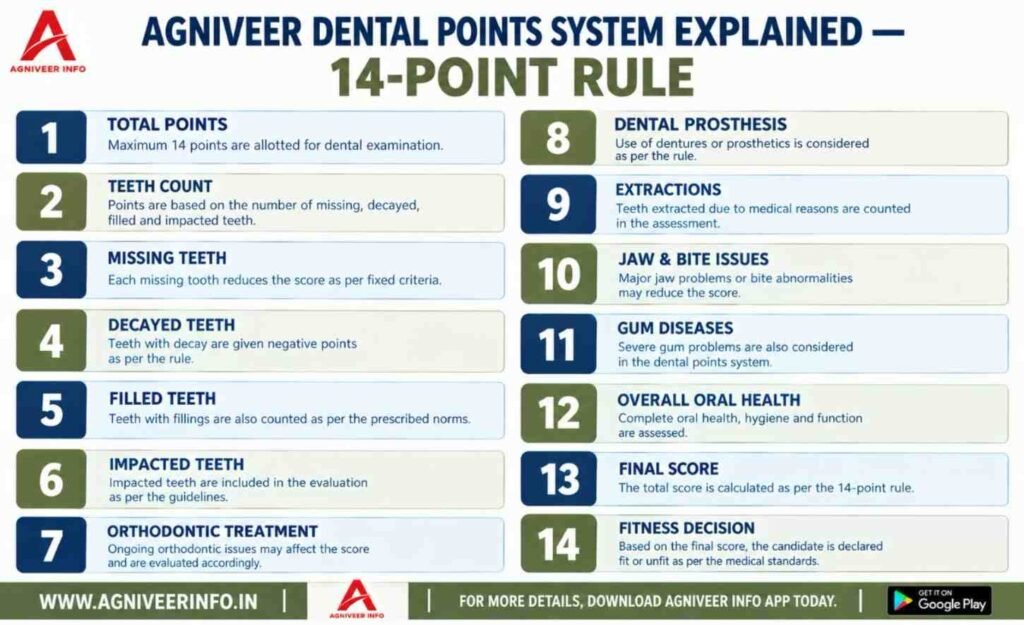
2. What Is the 14-Point Rule?
According to the official medical standards of the Indian Armed Forces, a candidate must have at least 14 dental points out of a possible 22 points to be declared medically fit. The system looks at a full set of 32 natural teeth, and different teeth are given different point values depending on how important they are for chewing and biting.
- Minimum points needed: Candidates must score at least 14 points.
- Sound natural teeth required: Points are only given for teeth that are healthy, undamaged, or properly treated, and that meet their matching tooth correctly.
- Functional opposition: A tooth only earns points if it meets the corresponding tooth on the opposite jaw properly, so that together they form a working chewing surface.
Candidates should avoid working out their own points using unofficial charts found online, since only an authorised military medical officer can give the final decision on this.
3. How Are Dental Points Counted?
The counting is based on pairs of upper and lower teeth that touch each other correctly, and in a full, normal set of natural teeth, the points are spread across different types of teeth:
- Molars (back teeth): These are the main teeth used for chewing, and each well-matched pair of molars usually carries 2 points, so if even one molar is missing, you can lose the points for both that tooth and its matching partner.
- Premolars (middle teeth): Each working pair of premolars usually carries 1 point.
- Incisors and Canines (front teeth): These teeth are used for cutting and tearing food, and each working pair usually carries 1 point.
- Wisdom teeth (third molars): Wisdom teeth only earn points if they have fully come out, are healthy, and line up properly with the opposite tooth.
If a tooth is missing, badly decayed, or does not have a matching tooth on the other jaw to bite against, it gets zero points.
4. Which Dental Problems Can Affect Agniveer Medical Fitness?
Several dental problems can bring down your total points or lead to being marked unfit, either for the time being or permanently, during the recruitment rally:
- Multiple missing teeth: Having several teeth missing can bring your total dental points below the required 14-point mark.
- Severe tooth decay (caries): Large cavities that have destroyed the structure of a tooth make it unusable for scoring points.
- Severe gum disease (Pyorrhea): Advanced gum disease that causes loose teeth, bleeding, or bad breath can lead to being marked unfit.
- Active infections or abscesses: Any swelling, pus, or untreated infection at the root needs to be treated right away before medical clearance can be given.
- Severe jaw misalignment: Major overbites, underbites, or other jaw problems that stop you from chewing properly.
Having just a small cavity or a single missing tooth does not mean you will be rejected straight away, as long as you still meet the minimum 14-point standard and have no active infection.
5. Does a Filled or Root-Canal-Treated Tooth Get Dental Points?
Yes, a treated tooth can still get dental points, as long as the treatment has been done properly and is fully complete.
- Dental fillings: A cavity that has been properly cleaned and filled with a permanent filling material by a qualified dentist is treated as a sound tooth and gets full points.
- Root Canal Treatment (RCT): A tooth that has had root canal treatment is accepted and given full points if the treatment is complete, free of infection, and fitted with a proper crown or cap.
- Artificial dentures and bridges: Removable dentures are not counted as natural teeth and get zero points, while fixed dental bridges may be checked based on how healthy the natural teeth supporting them are.
6. How Is Dental Fitness Checked During the Medical Examination?
During the medical exam, an authorised military medical officer or dental specialist carries out a full check of the mouth:
- Visual Inspection: The doctor examines the mouth with a dental mirror and probe to check the oral hygiene, gums, and tongue.
- Counting Functional Teeth: The officer counts the sound natural teeth and checks which upper and lower teeth meet each other properly.
- Point Calculation: The medical officer works out the total score based on the valid opposing pairs of teeth.
- Health Assessment: The doctor checks for active decay, gum disease, tartar build-up, or mouth ulcers.
7. Can You Prepare Your Teeth Before the Medical Examination?
Candidates can take a few safe steps ahead of time to improve their oral health before the medical rally:
- Visit a qualified dentist: Get a full check-up of your mouth at least 4 to 6 weeks before your scheduled medical exam.
- Professional cleaning: Get scaling done to remove plaque, tartar, and stains.
- Treat cavities: Get any open cavities filled with permanent filling material.
- Complete pending treatments: Make sure any ongoing root canal treatment is fully finished with the crown fitted.
- Maintain oral hygiene: Brush twice a day and use an antiseptic mouthwash.
8. Common Dental Mistakes Agniveer Candidates Make
- Ignoring minor cavities: Thinking that small cavities don’t matter, until they turn into painful infections by the time of the medical exam.
- Panicking over one missing tooth: Believing that a single missing tooth will lead to automatic rejection, even when the total points are still above 14.
- Delaying dental visits: Waiting until just two days before the medical test to see a dentist, which leaves no time for proper treatment.
- Using home remedies: Depending on unverified home tricks instead of going to a professional dentist.
- Assuming cosmetic treatments matter: Spending money on teeth whitening instead of fixing the actual structural health of the teeth.
9. Overview of Common Dental Issues
| Dental Issue | Possible Effect | What the Candidate Should Do |
| Minor Cavities | Loss of points if untreated | Visit a dentist to get permanent fillings |
| Missing Tooth | Loss of dental points for that pair | Ensure total remaining points equal 14 or more |
| Tartar / Stains | Temporary unfitness / Warning | Get professional dental scaling and cleaning |
| Completed RCT | Accepted with full points | Ensure full healing and crown placement |
10. What If You Are Declared Medically Unfit Due to Dental Reasons?
If you are declared unfit for dental reasons, you should follow the official process:
- Review the Medical Slip: Check whether the unfitness is temporary, such as tartar or a treatable cavity, or permanent.
- Apply for Appeal Medical Board (AMB): Apply for an appeal within the time limit mentioned in your official recruitment notice.
- Get Necessary Medical Treatment: Visit a certified dentist to get the required fillings, root canal treatment, or cleaning done during the allowed appeal period.
- Carry Official Treatment Records: Keep your treatment certificates and X-rays ready to show the Appeal Medical Board if they ask for them.
11. What Candidates Should Check Before the Agniveer Medical Exam
- [ ] Complete a full dental check-up with a qualified dentist.
- [ ] Make sure all cavities are properly filled.
- [ ] Complete scaling to remove tartar and plaque.
- [ ] Make sure any root-canal-treated teeth have proper crowns fitted.
- [ ] Keep your breath fresh and your gums healthy.
- [ ] Check that your total point count is above the minimum 14-point requirement.
- [ ] Carry any earlier dental treatment records or X-rays, if you have them.
12. Common Myths About Agniveer Dental Standards
- Myth 1: Every cavity leads to automatic rejection. Fact: A cavity that has been filled and properly restored is completely acceptable.
- Myth 2: One missing tooth means instant disqualification. Fact: You remain eligible as long as your total score stays at 14 points or above.
- Myth 3: Every tooth carries equal points. Fact: Molars carry higher points than the front incisors.
- Myth 4: Cosmetic whitening is compulsory. Fact: Doctors check how well your teeth function, not how white they look.
- Myth 5: A private dentist can guarantee your fitness. Fact: Only an authorised military medical board can give the final clearance.
Conclusion
Understanding the Agniveer dental points system helps candidates prepare with confidence, without worrying over false rumours or myths. The Indian Armed Forces care about functional dental health, sound natural teeth, and proper chewing ability, and not about cosmetic perfection.
Getting a professional dental check-up well in advance, treating any active cavities, completing root canal treatments, and keeping up good oral hygiene can easily help you reach the required 14-point standard. Always check the official recruitment notices for the exact medical standards, and remember that no private clinic or website can guarantee your selection, since the final clearance rests entirely with the authorised military medical board.
Get the latest Agniveer updates by joining our WhatsApp channel
Frequently Asked Questions
Q1. What is the 14-point dental rule for Agniveer?
A1. It is the official military standard that requires candidates to score at least 14 dental points out of 22, based on sound, opposing, working natural teeth.
Q2. How are dental points counted?
A2. Points are counted by checking pairs of healthy upper and lower teeth that meet correctly for biting and chewing, and molars are given higher points than other teeth.
Q3. How many dental points are required for Agniveer medical fitness?
A3. Candidates must have at least 14 acceptable dental points to be declared medically fit by the military medical board.
Q4. Does a missing tooth reduce dental points?
A4. Yes, a missing tooth stops proper contact with the matching tooth, so that particular pair gets zero points.
Q5. Can a filled tooth count for dental points?
A5. Yes, a tooth that has been properly filled and restored by a qualified dentist is counted as a sound tooth and earns points.
Q6. Can root canal treatment affect dental fitness?
A6. A completed root canal treatment, fitted with a proper cap or crown and with no underlying infection, is accepted for full dental points.
Q7. Can cavities cause rejection in the Agniveer medical exam?
A7. Untreated, severe cavities can lead to a loss of points or temporary unfitness, but cavities that have already been filled are fully accepted.
Q8. What should I do if I am declared medically unfit due to dental problems?
A8. You should apply for an Appeal Medical Board, get the necessary dental treatment done at a qualified clinic right away, and then present yourself for re-examination.
READ ALSO: AGNIVEER EAR WAX REJECTION — CAUSE & PREVENTION GUIDE FOR ARMY