

Whether an Agniveer gets a pension is one of the most talked-about questions among candidates who want to join the Indian Armed Forces through the Agnipath Scheme. Ever since the scheme started, candidates and their families have wanted to know exactly what benefits they get at the end of the four-year service period.
Understanding how the Agnipath Scheme is actually structured matters a lot for managing your financial expectations, because completing the four years does not automatically give you long-term military pension rights. The exit benefits given to Agniveers are quite different from the traditional retirement benefits given to regular, long-serving personnel. A big reason for the confusion is the one-time Seva Nidhi package, which is often wrongly described as a pension.
To make a well-informed career decision, candidates should depend on the current official recruitment notices, rather than unverified comments found online. This article gives you a fact-based explanation of the Agniveer service terms, what you get on exit, the rules for being retained in regular service, and the benefits that apply across the Indian Army, Indian Navy, and Indian Air Force.
Do Agniveers Get a Pension?
Under the official Agnipath Scheme, Agniveers who finish their four-year term do not get a regular monthly pension or a gratuity. The four-year service is a short-term military contract, governed by specific legal provisions under the respective Service Acts.
Once this period is over, Agniveers leave the service with a special, one-time payment called the Seva Nidhi package. This kind of service is designed, by its very nature, to not carry a pension. So completing four years as an Agniveer does not give you the usual military pension rights, or the status given to a former serviceman, under the existing defence service rules.
Why Agniveers Do Not Have the Same Pension Structure as Regular Personnel
The difference in pension rights comes from how military service is structured in different categories. Regular military service usually needs a minimum period of service, which is typically 15 years for personnel below officer rank, to become eligible for a lifelong monthly pension and medical cover after retirement. The Agniveer service, on the other hand, is strictly limited to four years. Since pension rights in the armed forces are linked to long-term service and being part of the regular cadre, this short-term Agniveer cadre works under a completely separate pay model, built around active monthly salary and a savings fund at the end, rather than a lifelong monthly pension.
Agniveer Seva Nidhi vs Pension
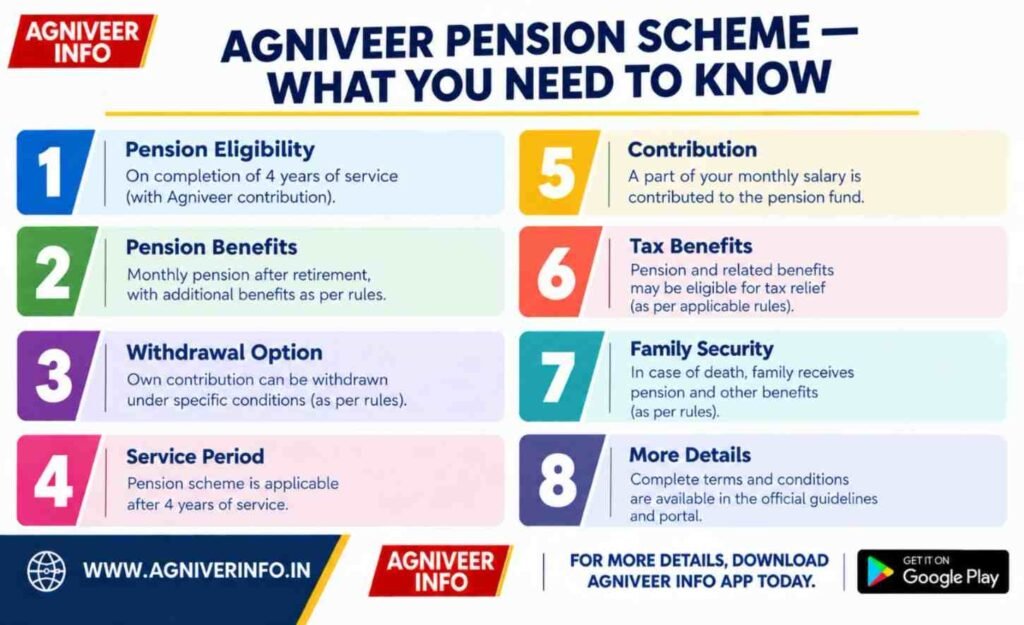
The Seva Nidhi package is a dedicated fund built up through monthly contributions made during the four years of service. Every month, 30% of an Agniveer’s customised monthly package is taken out and put into the Agniveer Corpus Fund, and the Government of India adds an equal amount every month as well. Once the four years are complete, the total amount saved up, along with the interest earned, is paid to the individual as a tax-free lump sum.
A pension, on the other hand, is a monthly payment given indefinitely by the government to personnel who have completed long-term service, and it does not depend on the person’s own contribution. Seva Nidhi is really a one-time payment made at exit, funded partly by the recruit’s own salary savings and partly by the government’s matching contribution. Getting Seva Nidhi does not count as a monthly pension, and it does not create any right to ongoing monthly payments from the government.
What Benefits Does an Agniveer Receive Instead of Pension?
While four-year Agniveers do not get pension benefits, they do get a focused package of financial and service-related benefits, both during and right after their service:
- Customized Pay Package: A monthly amount that starts at ₹30,000 in the first year and goes up to ₹40,000 by the fourth year, along with any applicable risk and hardship allowances.
- Seva Nidhi Corpus: A tax-free lump sum of about ₹11.71 lakh (which includes the government’s matching share and the interest earned) once the four years are complete.
- Insurance Cover: A life insurance cover of ₹48 lakh, which costs the soldier nothing, for the full four years of service.
- Skill Certification: An official “Agniveer Skill Certificate” that lists the technical skills and training the soldier gained during their service.
What Happens If an Agniveer Is Selected for Regular Service?
Once the four-year service is complete, up to 25% of each Agniveer batch may be taken into the regular cadre of the armed forces, based on the organisation’s needs, performance, and merit-based evaluation. Being kept on is not automatic or guaranteed for anyone. Those who are selected move out of the temporary Agniveer cadre and are formally enrolled as regular personnel, under the standard military terms. Candidates who are not selected leave the service with their Seva Nidhi package, and move on to civilian careers or other employment.
Pension Eligibility After Retention in Regular Service
For candidates who are selected for regular service, their terms of employment follow the rules that apply to the permanent cadre. Their pension eligibility is decided according to the official rules that apply to regular service personnel, at the time they formally join the regular cadre. How the four-year Agniveer period connects with the further service needed for regular retirement benefits is governed strictly by the orders of the Ministry of Defence. The benefits reserved for long-term regular personnel apply only once a soldier has been formally absorbed and has completed the required years under the regular service rules.
Army, Navy and Air Force: Does the Pension Position Differ?
The overall financial and pension structure of the Agnipath Scheme is the same across the Indian Army, Indian Navy, and Indian Air Force. All three services follow the four-year service period, the 30% monthly deduction matched by the government, the tax-free Seva Nidhi payout, and the maximum 25% cap on retention. While the trade names, specific field allowances, and training programmes are different between the Army, Navy (Agniveer SSR/MR), and Air Force (Agniveervayu), no single branch gives its own separate or automatic pension to four-year recruits.
What Happens After Four Years If an Agniveer Is Not Retained?
Agniveers who leave after four years get their full, tax-free Seva Nidhi lump sum, along with their skill certificate. To help with the move to civilian life, the central and state governments have announced preference and reservation quotas in various paramilitary forces, state police recruitment, and public sector jobs. Private companies also offer dedicated recruitment paths for certified Agniveers. But these job preferences and considerations after exit are completely separate from a government pension plan, and do not count as an ongoing military pension payment.
Common Misconceptions About Agniveer Pension
Several beliefs about the Agnipath Scheme’s financial benefits keep coming up, even though they are not correct:
- Monthly Pension Misconception: A common assumption is that Agniveers get a monthly pension after four years, but the official policy makes it clear that no monthly pension is given on exit.
- Seva Nidhi Identity: Many people mix up Seva Nidhi with a pension or gratuity, but Seva Nidhi is a savings fund built through contributions, while a pension is an ongoing service benefit.
- Automatic Retention Belief: Assuming that every recruit stays on long-term is wrong, since being taken into regular service is capped at up to 25%, and is based on merit.
- Insurance Misinterpretation: The ₹48 lakh insurance cover, which costs the soldier nothing, gives death cover during active service, and it is not a payment made after retirement.
What Candidates Should Check Before Joining
Candidates should check the exact terms in the official recruitment notices published on the Join Indian Army, Join Indian Navy, and Indian Air Force websites. Aspirants should go through the customised pay breakdown, the Seva Nidhi deduction schedule, the insurance terms, and the specific rules used to decide who is selected for regular cadre. Depending directly on the Ministry of Defence notices makes sure that candidates base their career plans on accurate legal and financial facts.
| Benefit/Status | What It Means | Pension Connection | Key Point |
| Agniveer Engagement | Four-year short-term contract in the Armed Forces | No pension attached to four-year completion | Engagement ends automatically after 4 years unless retained |
| Seva Nidhi | Contributory fund from salary savings and government match | Not a pension; it is a one-time exit corpus | Fully tax-exempt lump sum paid upon completing tenure |
| Insurance | ₹48 lakh non-contributory life cover during service | Independent of pensionary benefits | Provides financial cover during active service period |
| Regular Service | Permanent enrolment cadre for up to 25% selected recruits | Governed by regular military pension rules | Requires merit selection after initial 4-year tenure |
Conclusion
The Agnipath Scheme brings in a different financial model for short-term military service, replacing the traditional pension system with a structured monthly salary package and the Seva Nidhi fund given at exit. Four years of service as an Agniveer does not lead to a lifelong monthly pension or gratuity.
The standard retirement benefits given to regular service personnel apply only to those candidates who are later selected and absorbed into the permanent cadre, under the official selection rules. Understanding this clear difference helps aspirants judge the scheme using accurate, official information.
Get the latest Agniveer updates by joining our WhatsApp channel
Frequently Asked Questions
Q1. Do Agniveers get a monthly pension?
A1. No, Agniveers who complete their four-year service do not get a regular monthly pension, and instead they receive a one-time, tax-free Seva Nidhi package when they exit.
Q2. Is Seva Nidhi the same as pension?
A2. No, Seva Nidhi is a savings fund built through salary deductions and a matching government contribution, while a pension is an ongoing monthly payment.
Q3. What happens to pension after four years?
A3. Four years of Agniveer service does not create any pension rights, and recruits leave with their built-up Seva Nidhi package and skill certificate, instead of a pension.
Q4. Do retained Agniveers become eligible for regular-service benefits?
A4. Yes, candidates who are selected for the permanent cadre move into regular service, and become subject to the regular military terms, including the pension rules that apply to that cadre.
Q5. Do Army, Navy and Air Force follow the same Agniveer pension framework?
A5. Yes, all three services follow the same Agnipath structure, giving a monthly customised pay and the Seva Nidhi fund, without any four-year pension entitlement.
Q6. Does Agniveer service automatically count as pensionable service?
A6. No, the four-year Agniveer service is a separate, short-term engagement, and it does not automatically count as pensionable regular service for those who are not retained.
Q7. What benefits does an Agniveer receive after four years?
A7. Agniveers who exit receive the tax-free Seva Nidhi package of about ₹11.71 lakh, an official Skill Certificate, and any job preferences that apply to them after service.
Q8. Where should candidates verify the latest pension rules?
A8. Candidates should check all the recruitment conditions directly through the official notices published by the Ministry of Defence and the respective Army, Navy, or Air Force websites.
READ ALSO: AGNIVEER NAVY (SSR/MR) – ELIGIBILITY, TRADES & CAREER PATH EXPLAINED