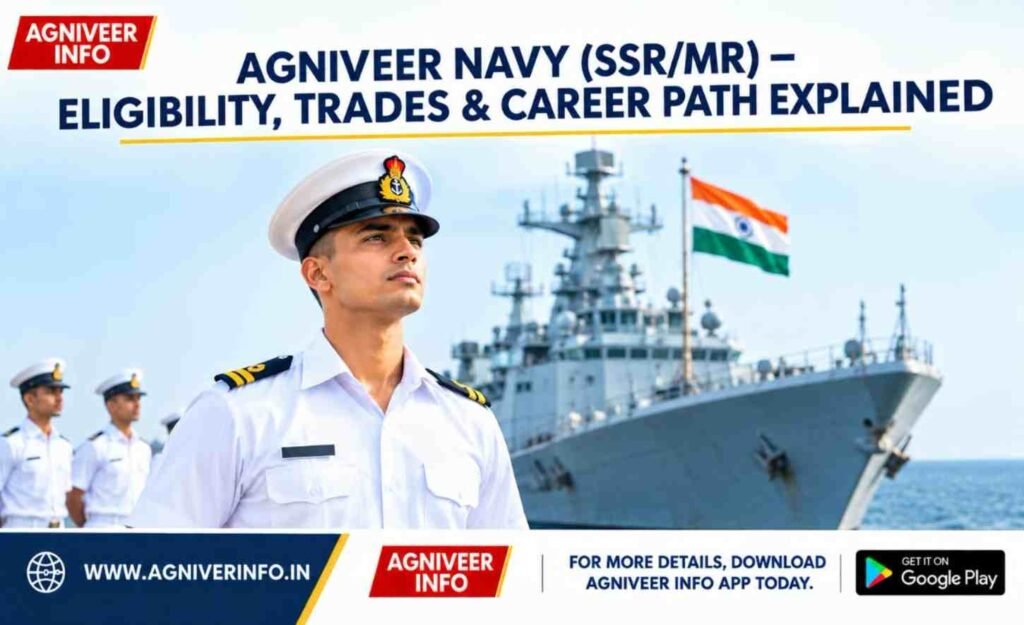
Choosing a career path in the armed forces is a big decision, and it needs a clear understanding of the roles, the responsibilities, and the eligibility rules involved. Within the Indian Navy’s Agnipath scheme, there are two main entry routes for non-commissioned personnel: Senior Secondary Recruit (SSR) and Matric Recruit (MR), and candidates often find themselves confused when choosing between these two options.
It matters to understand the core differences between SSR and MR before applying, because each entry is meant for a different educational background, a different skill set, and different duties within the naval force. Choosing an entry only because it seems more popular, or because of some perceived salary advantage, can leave you in a role that does not match your actual ability or your long-term career expectations. Candidates need to look at their own educational qualifications, physical readiness, and technical interest, and match it against what each trade actually demands.
On top of this, the selection process needs serious preparation across academic subjects, physical fitness tests, and medical checks. Since recruitment rules, age limits, and duty requirements can change from time to time, aspirants should always check the details against the latest official Indian Navy recruitment notice. This guide explains the trade profiles, eligibility rules, training structure, selection stages, pay, and long-term career options for both Agniveer SSR and Agniveer MR entries, so that candidates can make an informed choice.
What Are Navy Agniveer SSR and MR?
The Agniveer scheme in the Indian Navy is a modern way of bringing in personnel, meant to keep the naval force young, active, and up to date with technology. Under this system, candidates are recruited for a four-year period, during which they help keep operations running both at sea and at shore stations. The SSR and MR entries form the backbone of the Navy’s enlisted personnel, each serving in its own way based on the specific work they do.
Senior Secondary Recruit (SSR) personnel mainly support the technical, operational, and administrative branches, and they are trained to handle advanced naval equipment, communication systems, radar equipment, and operational logistics. Matric Recruit (MR) personnel, on the other hand, handle essential support services, upkeep, and administrative work that keeps naval bases and warships running smoothly every day. Both entries matter a great deal to how well operations work overall, and they work together aboard modern naval ships and shore facilities.
Navy Agniveer SSR Eligibility and Trade Profile
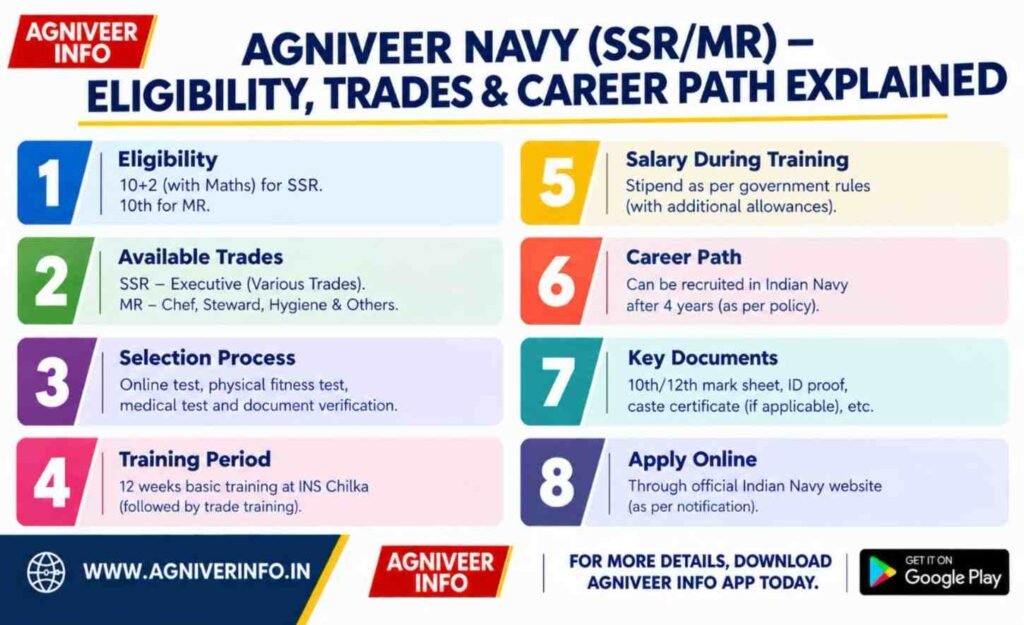
The Agniveer SSR entry is meant for candidates who have finished their higher secondary education with a good grounding in science and mathematics. To be eligible, candidates usually need to have completed 10+2 with Physics and Mathematics as compulsory subjects, along with Chemistry, Biology, or Computer Science, from a recognised education board. The exact marks needed and the subject combinations are given in each recruitment notice.
The trade profile for SSR covers different technical and non-technical operational branches, and Agniveers in this category are trained to work with advanced equipment, marine systems, electrical power networks, electronic sensors, and navigation tools. Candidates who think logically, are good at analysing things, and have an interest in technology tend to do well with the technical training and duties that come with SSR.
Navy Agniveer MR Eligibility and Trade Profile
The Agniveer MR entry gives an opportunity to candidates who have finished their secondary education. The basic education requirement here is a pass in the Class 10 (Matriculation) exam, from an education board recognised by the government, and this entry opens up naval service to a wider group of young candidates who want to serve the country.
The trade profile for MR is built around important support roles within naval establishments and on ships, and the roles under MR traditionally include Chef, Steward, and Hygienist. These roles matter a great deal for keeping the crew healthy, managing food, running shipboard hospitality, and maintaining hygiene standards on warships. Candidates who are well organised, practical, and good at working as part of a team tend to do well in these support-based trades.
SSR vs MR — Major Differences
The main difference between Agniveer SSR and MR comes down to the basic educational requirement and the kind of work each one does after training. SSR candidates come in with a senior secondary qualification, which lets them take in technical training related to weaponry, systems, and operational logistics. MR candidates come in with a matriculation qualification, and focus on the support work that keeps daily naval routines and living conditions running smoothly at sea.
The written exams for recruitment also reflect this difference in the level of study needed. The SSR written exam covers higher-level subjects, including Physics, Mathematics, English, and General Awareness, while the MR exam focuses on general science, basic mathematics, and general knowledge, matched to the Class 10 syllabus. While both groups go through tough physical training and basic naval discipline, their advanced trade training later takes a different path, based on the work they will actually do.
Navy Agniveer SSR/MR Trade and Job Responsibilities
The exact job responsibilities for Agniveer SSR personnel change depending on the specific branch they are assigned to after their initial training. Their duties can include operating communication equipment, watching radar screens, maintaining the ship’s electrical wiring, helping with navigation watches, and keeping administrative records. SSR sailors work under the direct guidance of senior petty officers and commissioned officers, to keep the ship’s systems running properly.
Agniveer MR personnel carry out duties that are essential for daily life on board and for running shore stations. Stewards handle the mess arrangements, food service, managing officer accommodation, and keeping stock of provisions. Chefs prepare meals following proper nutrition guidelines for large crews, even in tough sea conditions. Hygienists take care of sanitation, waste management, and cleanliness aboard the ship. Every one of these roles directly supports the crew’s morale and their ability to keep working under tough conditions.
SSR/MR Training and Skill Development
All selected Agniveers go through a full initial training programme at designated naval training centres, such as INS Chilka. This initial training builds naval discipline, physical endurance, precision in drills, water safety, basic seamanship, and military values. Candidates get used to a structured daily routine that focuses on teamwork, physical training, time management, and core military values.
After the initial training, Agniveers move on to specialised trade training centres. SSR recruits get technical training in theory, safety rules, and hands-on maintenance work. MR recruits get vocational training focused on cooking, hospitality management, hygiene rules, and managing supplies. This two-stage training gives recruits skills they can use both during their naval service and later, in civilian life.
Navy Agniveer SSR/MR Salary and Benefits
Agniveers get a customised monthly pay package set up over the four years of service, and this starting package includes a set base pay along with any allowances that apply. A specific part of the monthly package goes into the Seva Nidhi fund, and the Government of India adds an equal matching amount, which builds up as a financial reserve, paid out once the service period ends.
Along with the base pay, Agniveers also get free food, accommodation, uniform allowances, and medical facilities while they are in active service. This financial structure is different from the traditional permanent military pension, since it is designed only for this fixed four-year period. The exact pay figures, the yearly increase, and the details of how the Seva Nidhi builds up are clearly given in the official recruitment notices.
Navy Agniveer Selection Process for SSR/MR
The selection process for both SSR and MR entries has several stages, designed to check a candidate’s mental ability, physical fitness, and medical suitability. It usually starts with an online computer-based exam (CBE) covering the relevant academic subjects, and candidates who score above the required mark move on to the next stage of recruitment.
The second stage includes the physical fitness test (PFT), checking of documents, and an initial medical exam. The PFT checks stamina and muscular strength through a timed run, push-ups, and squats. Candidates who meet the physical standard go through a full medical exam, to make sure they are fit for service at sea. The final merit list is then prepared based on how candidates did in the written exam, along with clearing the physical and medical standards.
Career After Navy Agniveer SSR/MR
Once the four-year service period is complete, Agniveers move on to different career paths. Up to 25 percent of each batch may be chosen to join the regular cadre of the Indian Navy as permanent sailors, based on the organisation’s needs, performance, and the merit shown during their service.
For those who move into civilian life, the experience they have gained gives them a real advantage. Agniveers who leave get the Seva Nidhi amount that has built up, which can support them in starting a business or continuing their studies. On top of this, state governments, central police organisations, and private companies in the maritime sector give recruitment preference and recognise the skill certificates of former Agniveers, which helps them move smoothly into their next career.
Which Is Better — SSR or MR?
Whether SSR or MR is better for you depends on your own academic background, your personal interests, and your long-term goals. SSR suits candidates who have a science background and enjoy technical work, handling equipment, and working with complex systems, since it gives direct exposure to modern naval technology and engineering.
On the other hand, MR is a good option for candidates who want to join military service early, right after Class 10. It gives valuable vocational training, builds discipline, and offers stable financial benefits. Neither entry is better than the other, since both play an essential role in the naval fleet, and candidates should judge their own eligibility and personal preference, rather than depending on outside assumptions.
Common Mistakes While Choosing SSR or MR
- Ignoring Specific Educational Prerequisites: Applying for SSR without meeting the compulsory subject requirement in Physics and Mathematics leads to instant rejection during document verification.
- Underestimating MR Trade Importance: Seeing MR roles as less important ignores the essential operational and support work these trades provide for keeping a warship ready.
- Focusing Solely on Compensation: Choosing an entry based on small differences in pay, rather than what actually matches your skills, can lead to being unhappy with the job later during service.
- Neglecting Physical Standards Early: Putting off physical preparation, such as running and bodyweight exercises, until after the written exam often ends in disqualification at the physical test.
- Relying on Outdated Information: Depending on unverified sources instead of the official notice leads to confusion about age limits, selection stages, and how trades are given out.
- Assuming Automatic Permanent Retention: Assuming that the four-year service automatically means you will be kept on permanently stops candidates from preparing other career plans.
How to Prepare for a Navy Agniveer Career
Preparing well needs a good balance between academic study and physical training. Candidates preparing for the SSR written exam should focus on Class 11 and Class 12 concepts in Physics, Mathematics, and English grammar. Those preparing for MR should go over Class 10 Science, basic Mathematics, and current affairs. Practising mock tests regularly helps improve speed and accuracy for the computer-based exam.
Physical training needs to be built up steadily over time. Candidates should follow a structured running routine to build stamina, along with bodyweight exercises for push-ups and squats. Keeping up proper nutrition, staying hydrated, and getting enough rest helps prevent injury during preparation. Staying updated through the official Indian Navy recruitment website helps you stay correctly informed about application deadlines, syllabus changes, and medical rules.
| Comparison Area | SSR | MR | Candidate Consideration |
| Eligibility | Requires 10+2 with Physics, Math, and optional Science subjects. | Requires 10th Class (Matriculation) pass from recognized boards. | Match application strictly with verified educational credentials. |
| Work Orientation | Technical, operational, communication, and weapon system handling. | Support operations, culinary arts, stewards, and naval hygiene. | Select according to technical interest versus vocational service roles. |
| Training Focus | Technical trade theory, seamanship, equipment handling, and safety. | Service management, culinary skills, hygiene, and seamanship. | Evaluate readiness for technical study versus practical support tasks. |
| Career Consideration | Technical skill development applicable to engineering and systems. | Practical vocational expertise useful in service and logistics fields. | Plan long-term career goals based on skills gained during service. |
Conclusion
The Navy Agniveer SSR and MR entries give young people an excellent way to serve in the Indian Navy, while gaining discipline, practical skills, and financial independence. While SSR focuses on technical and operational roles that need senior secondary science qualifications, MR focuses on essential support services that are open to candidates right after matriculation.
Neither path should be seen as better than the other, since both are essential to naval operations, and candidates should think carefully about their educational background, physical ability, and trade interests, when choosing between the two. Checking the latest official Indian Navy recruitment notice will give you accurate guidance for a successful application.
For daily update join our WhatsApp channel
Frequently Asked Questions
Q1. What is the difference between Navy Agniveer SSR and MR?
A1. Agniveer SSR needs a 10+2 qualification and focuses on technical and operational trades, while Agniveer MR needs a 10th pass qualification and focuses on operational support roles.
Q2. What is the educational qualification for Navy Agniveer SSR?
A2. Candidates need to have passed 10+2 with Physics and Mathematics, along with Chemistry, Biology, or Computer Science, from a recognised education board.
Q3. What is the educational qualification for Navy Agniveer MR?
A3. Candidates need to have passed the Class 10 (Matriculation) exam, from an education board recognised by the central or state government of India.
Q4. What type of work does Navy Agniveer SSR involve?
A4. SSR personnel work with technical systems, radar equipment, electrical equipment, communication networks, navigation tools, and operational shipboard logistics during sea postings.
Q5. What type of work does Navy Agniveer MR involve?
A5. MR personnel carry out essential support duties, including preparing meals as Chefs, managing accommodation as Stewards, and looking after sanitation as shipboard Hygienists.
Q6. Is SSR better than MR in the Navy?
A6. Neither entry is better than the other, since which one suits you depends on your educational background, your career interests, your technical ability, and your personal goals within naval service.
Q7. What is the career scope after Navy Agniveer service?
A7. Agniveers can be kept on in regular service, up to 25 percent of each batch, or they can go on to further studies, or move into civilian careers using their skill certificates.
Q8. Where can candidates check the latest SSR/MR recruitment information?
A8. Candidates should regularly check the official Indian Navy recruitment website, to see the updated notices, age limits, syllabus details, and application deadlines.
READ ALSO: AGNIVEER MEDICAL TEST — COMPLETE STAGE-BY-STAGE GUIDE