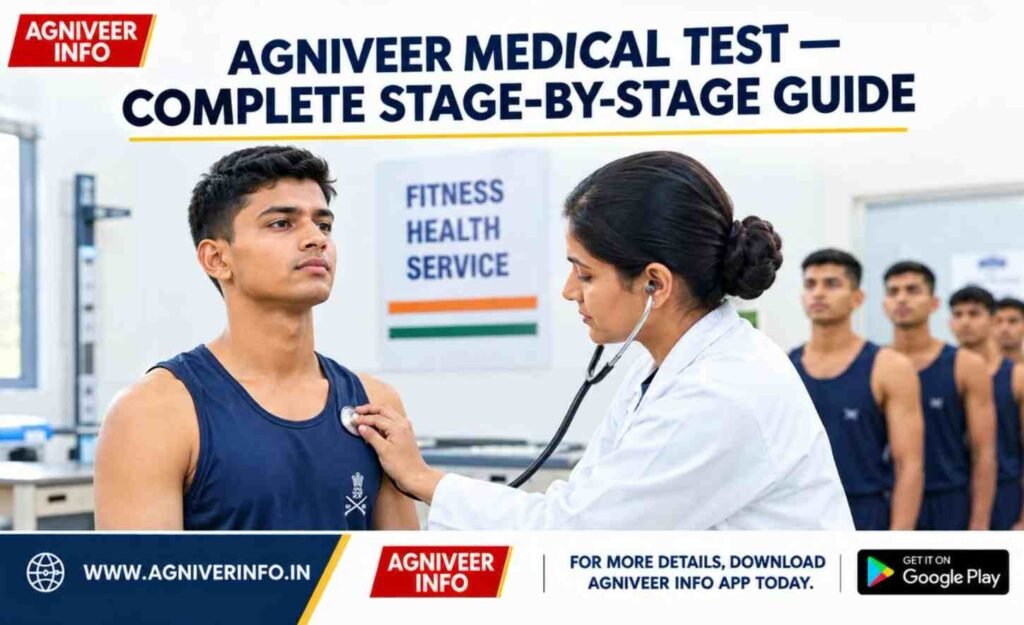
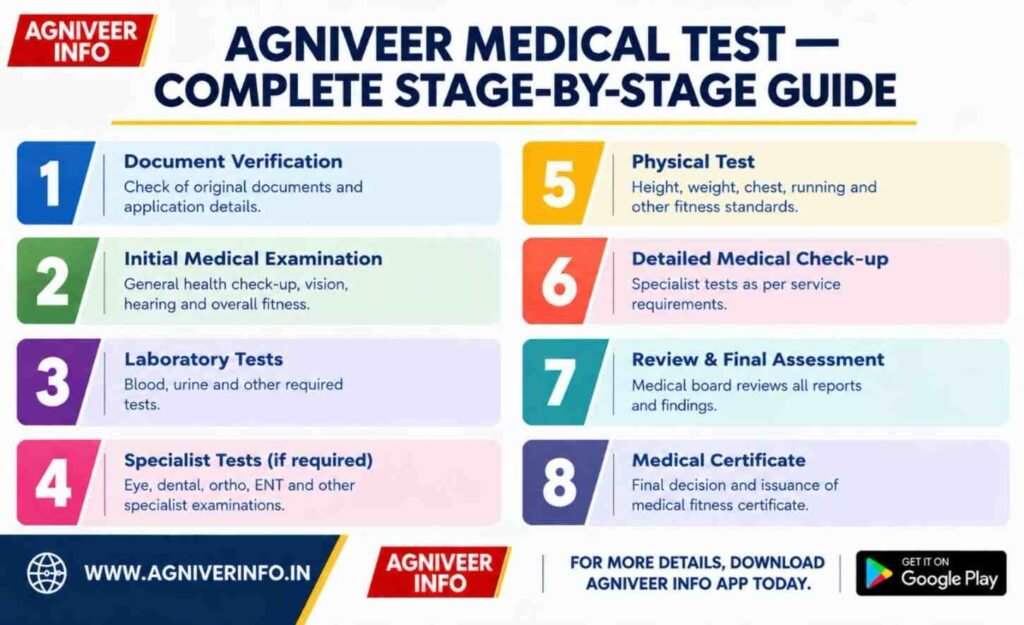
The Agniveer recruitment process across the Indian Armed Forces checks candidates through different selection stages, all designed to find people who can handle the tough demands of military life. Candidates often focus heavily on the written exam and the physical fitness test, but the Agniveer medical test is just as important a stage in the whole selection journey.
Clearing the physical efficiency test shows that you are athletic, but it does not mean you automatically meet the strict health standards that the military needs. The medical check makes sure that a person has the physical strength, sound body structure, clear vision, and long-term stamina needed to carry out duties in tough conditions, without putting their own safety or their unit’s readiness at risk.
Candidates need to understand that the Indian Army, Indian Navy, and Indian Air Force do not follow one single, universal medical standard, since each service works in a different kind of environment, ranging from high-altitude land areas to ships at sea and aviation settings. Because of this, the health requirements change quite a bit across branches, trades, and specific duties.
Understanding these service-specific requirements well before you reach the final rally or screening stage lets you deal with any correctable health issue responsibly ahead of time. Candidates should treat the latest official, service-specific recruitment notice and medical rules as the only final authority, since a guide like this one gives you helpful structure and clarity, but only an authorised military medical board can officially decide whether a candidate is fit.
What Is the Agniveer Medical Test?
The Agniveer medical examination is a full health check carried out by qualified military medical officers, to judge a candidate’s overall physical and internal fitness for service in the armed forces. Military life involves hard physical strain, irregular routines, extreme weather, and high-stress situations, so the medical test checks whether an applicant has any hidden internal disease, structural problem, sensory issue, or long-term condition that could affect their performance or get worse during service.
Physical fitness and medical fitness serve two different purposes in recruitment. A physical fitness test checks your current level of athletic stamina, such as your running speed, push-ups, and pull-ups, while the medical exam looks at your underlying physical health, how well your internal organs work, how stable your joints are, and how sharp your senses are. Doing well in the physical tests proves that you are currently in good shape, but final selection still depends strictly on getting a clean bill of health from the medical board.
When Does the Agniveer Medical Examination Take Place?
The Agniveer medical check usually happens after candidates clear the earlier screening stages, which normally include the written entrance exam and the physical fitness test. That said, the exact order of these steps can change depending on the specific service branch, the type of notice, and the entry scheme.
In many recruitment drives, candidates who pass the physical tests go straight to the medical examination location set by the recruitment authority. Document verification often happens alongside, or just before, these physical and medical checks. Candidates who clear the first medical screening move ahead toward the final merit list, while those found to have a medical issue go through the official review process laid out in the rules of that particular service.
Stage 1: Preliminary Medical Screening
The first part of the medical exam is a thorough basic physical check done by medical staff. Doctors look at the candidate’s general body build, posture, body symmetry, and overall skin condition, to spot any obvious problem or general weakness.
At this stage, medical staff note down the standard body measurements, including height, weight, and chest size along with how much it can expand, and these are checked against the official height-weight charts set for that service, which take into account age and regional differences. The staff also check for common skin infections, noticeable marks, old scars, curving of the spine, and how the limbs line up, to make sure the candidate meets the basic physical standard.
Stage 2: Eyesight and Vision Examination
How sharp a person’s eyesight is forms one of the most important parts of the Agniveer medical test, since military personnel depend a great deal on clear vision for handling weapons, navigation, staying aware in changing situations, and overall operational safety.
Medical examiners check both uncorrected and corrected vision using standard eye charts, and the exam covers distant vision, near vision, colour vision, how well both eyes work together, and the full field of view. Colour blindness, or a level of visual sharpness below the set limit, can stop a candidate from entering certain technical or combat trades. Whether glasses or corrective eye surgery are acceptable depends strictly on the rules of that particular service, its policies, and the trade being applied for.
Stage 3: Hearing, ENT and Other Sensory Checks
The Ear, Nose, and Throat (ENT) check looks at how well a candidate’s senses work and how healthy their breathing passage is. Working in noisy places, such as engine rooms, airfields, or firing ranges, needs healthy ears that can handle changes in sound and air pressure.
Examiners check the outer ear canal and the eardrum with an instrument called an otoscope, to look for any hole, ongoing discharge, or too much wax build-up. Hearing ability is checked through speech tests, or a special hearing test called audiometry, when it is needed. The nose and throat check looks for structural problems such as a badly deviated nasal septum (DNS), nasal polyps, ongoing tonsillitis, or speech problems that could affect communication while on duty.
Stage 4: Dental and Oral Examination
Dental health is looked at carefully during the military medical check, because problems in the mouth and jaw can affect a soldier’s overall health during long deployments in the field. Candidates are checked for overall cleanliness of the mouth, the health of the gums, and how sound the structure of the teeth is.
Military medical boards use a points system, specific to each service, or set oral health rules, to judge a candidate’s dental fitness. Points are given for teeth that are healthy, natural, working properly, and meeting the correct bite standards. Serious tooth decay, advanced gum disease, missing teeth that affect chewing, or a misaligned jaw can affect a candidate’s dental suitability. Keeping the mouth clean before the exam helps avoid small, avoidable delays caused by things like tartar or wax.
Stage 5: Musculoskeletal and Physical Examination
This part of the exam checks how well the bones, joints, muscles, and connective tissue actually work. Military training needs candidates to carry heavy loads, march for long stretches, run over rough ground, and move quickly, so this part of the test matters a lot.
Examiners check candidates for structural problems such as flat feet, knock knees, bow legs, hammer toes, or curved spine problems like scoliosis and lordosis. The joints in the arms and legs are checked for full movement, stability, and any sign of an old major fracture or dislocation. Scars from past surgery or injury are also checked, to see whether the tissue underneath is still weak or limited in its movement.
Stage 6: General Health and Medical Assessment
The last part of the check looks at the internal body systems, heart and blood-related measures, and overall metabolic health. Medical officers carry out a full body check to make sure the internal organs are working normally, without any disease.
Examiners measure resting blood pressure and pulse to check for high or low blood pressure, or an irregular heartbeat. Listening to the heart and lungs helps find heart murmurs, birth-related defects, or breathing conditions like asthma. Checking the stomach area helps find any enlarged organ, hernia, or tenderness. Where the service notice requires it, candidates go through basic lab tests, such as blood and urine tests, to check for any metabolic problem or infection in the body.
Army vs Navy vs Air Force Medical Standards
The medical requirements are quite different across the three services, because each one works in its own kind of environment. The Indian Army puts a lot of importance on land-based endurance, joint stability, the ability to carry heavy loads, and toughness under field conditions, so the strength of the muscles and joints, the shape of the foot arch, and the health of the spine are all checked closely, to make sure candidates can handle infantry and field duties.
The Indian Navy sets its own medical rules, matched to life at sea, ship safety, and being in water. Naval candidates need to be physically suited for the tight spaces on board, need good balance at sea, and need to handle changes in ear pressure well. The vision standards for shipboard and diving roles are quite precise, with clear rules on colour vision and night vision.
The Indian Air Force, especially for ground crew and Agniveervayu entries, sets medical standards suited to airfield safety, technical precision, and a fast-changing environment. While flying branch entries have the strictest aviation medical rules, general Agniveervayu candidates still need to meet clear standards for vision, hearing, and overall health. A candidate found medically fit for one service branch cannot assume that they will automatically be considered fit for another.
Common Medical Issues Candidates Should Know
Aspirants often ask about health conditions that come up a lot during the medical screening. Vision problems such as refractive errors, faulty colour vision, or a squint are common points that get checked. In the same way, ENT problems like a torn eardrum, ongoing ear discharge, or a badly blocked nose need medical attention before testing.
Problems with the bones and muscles, including flat feet, knock knees, over-bending elbows, and old fractures, are also checked closely to see how they affect actual function. Other common areas that get checked include skin problems, noticeable varicose veins, hydrocele, phimosis, chest wall defects, and tattoos on the body. Whether tattoos are acceptable depends strictly on that service’s rules about size, location, and any allowed exceptions. What happens with a particular medical condition depends entirely on the official service rules, and not on informal guesses.
What Happens If a Candidate Is Declared Medically Unfit?
If a candidate does not meet the required health standard during the medical exam, the medical board officially declares them medically unfit. This unfitness falls into two main types: temporary unfitness and permanent unfitness, and understanding the difference helps avoid unnecessary confusion or worry among candidates.
Temporary unfitness applies to health issues that can be fixed, such as being overweight, being underweight, having too much ear wax, minor skin infections, or other treatable minor problems. Candidates who are declared temporarily unfit are given a set amount of time to get treatment or fix the issue, before coming back for a review medical exam. Permanent unfitness applies to structural problems, long-term internal disease, serious vision problems, or other conditions that cannot be corrected. Eligible candidates can apply to an Appeal Medical Board, following the official rules and timelines printed on their medical documents.
How to Prepare for the Agniveer Medical Test
Preparing for the medical exam calls for a responsible, proactive approach, focused on staying naturally healthy. Aspirants should keep up a steady physical routine, eat a balanced diet every day, drink enough water, and get proper sleep, so that their blood pressure, body weight, and other health markers stay within a healthy range.
Candidates should keep up daily personal hygiene, including getting their ears professionally cleaned if wax builds up, taking proper care of their teeth, and keeping their skin free from infections that can be avoided. Getting a general health check-up from a qualified civil doctor a few months before recruitment helps catch easily fixable problems, like tooth decay or a change in eyesight, early on. Aspirants should stay away from dangerous practices like extreme crash diets, unverified supplements, or hiding their medical history, since being honest and genuinely fit is what protects their long-term health and safety.
Common Medical Mistakes Candidates Make
- Delaying Health Checks: Waiting until the day of the recruitment rally to discover simple, fixable problems like ear wax or minor tooth decay.
- Assuming Uniform Standards: Believing that the medical rules of the Indian Army, Navy, and Air Force are exactly the same for every trade and entry.
- Hiding Past Medical History: Trying to hide past surgery, long-term illness, or a major injury, which can put the candidate’s own safety at risk during hard training.
- Relying on Unofficial Advice: Following unverified tips from social media or private coaching centres, instead of talking to a qualified doctor.
- Neglecting Personal Hygiene: Turning up at the medical centre with dirty ears, poor dental care, or an untreated minor skin problem.
- Confusing Physical and Medical Fitness: Assuming that running fast or scoring well in the physical test automatically means you will pass the medical check.
- Using Unsafe Weight Measures: Trying extreme dehydration or sudden starvation diets to meet the weight limit right before the medical screening.
| Medical Area | Army | Navy | Air Force |
| Vision | Evaluates visual acuity and color perception based on land operational roles. | Emphasizes precise vision standards suited for shipboard and maritime environments. | Focuses on high visual clarity required for airfield operations and technical trades. |
| General Physical Fitness | Prioritizes load-bearing ability, joint stability, and endurance for field deployment. | Requires balance stability, physical agility, and adaptability to shipboard spaces. | Evaluates systemic resilience and dynamic coordination for aviation ground duties. |
| Hearing and ENT | Focuses on auditory clarity and speech perception for field communications. | Requires healthy eardrums capable of handling marine sound and pressure shifts. | Assesses hearing acuity necessary for airfield communications and technical environments. |
| Medical Assessment | Screens thoroughly for spinal soundness, foot arch integrity, and limb movement. | Evaluates marine environmental adaptability, systemic health, and physical endurance. | Tests overall metabolic balance, cardiovascular stability, and respiratory health capacity. |
Conclusion
The Agniveer medical test is a key part of the selection process across the Indian Army, Indian Navy, and Indian Air Force, and it makes sure that every recruited person has the physical stamina, sharp senses, and sound body structure needed to safely handle demanding military duties. Since each service works in its own kind of environment, the medical standards differ quite a bit, and they should never be treated as one single, universal rule.
Aspirants should focus on staying genuinely healthy, keeping up good hygiene, and talking to a qualified doctor about any health concern well in advance. Depending only on the official service recruitment notice gives the clearest guidance, so that candidates can walk into their medical exam with confidence, clarity, and full preparation.
Get the latest Agniveer updates by joining our WhatsApp channel
Frequently Asked Questions
Q1. What is the Agniveer medical test?
A1. The Agniveer medical test is an official health check carried out by military doctors, to judge whether a candidate is physically fit for service in the Indian Armed Forces.
Q2. Is the medical test the same for Army, Navy and Air Force?
A2. No, the medical standards are different across the three services, based on their own operational environment, service requirements, entry schemes, trades, and the specific duties carried out by their personnel.
Q3. What eyesight checks are performed during Agniveer medical examination?
A3. Examiners check uncorrected vision, corrected vision, colour vision, how well both eyes work together, and overall eye health, following the trade-entry rules set by that particular service.
Q4. Are dental problems checked during the medical examination?
A4. Yes, the medical board checks overall oral hygiene, gum health, how sound and functional the natural teeth are, jaw alignment, and dental fitness, using the dental points system set by that service.
Q5. Can previous surgery affect Agniveer medical eligibility?
A5. Whether you are still eligible depends on the type of surgery, how completely you have recovered, how well the area has healed, how well the joint moves, and the relevant rules set by the official military medical board.
Q6. What happens if a candidate is declared medically unfit?
A6. Candidates get an official document stating whether they are temporarily or permanently unfit, and eligible candidates are allowed to request a review board, following the official rules of that service.
Q7. How should candidates prepare for the Agniveer medical test?
A7. Candidates should keep a healthy weight, take proper care of their teeth and ears, exercise safely, stay hydrated, and get regular check-ups done by a qualified doctor.
Q8. Where can candidates verify official medical standards?
A8. Candidates should check the official medical standards only through the current recruitment notices published on the official websites of the Army, Navy, and Air Force.
READ ALSO: AGNIVEER RECRUITMENT AFTER CLASS 10: ELIGIBLE TRADES AND APPLICATION STEPS