

Getting a medical decision during the recruitment process is a crucial step for anyone who wants to serve in the Indian Armed Forces. During the Agniveer recruitment drive, candidates go through detailed physical and clinical checks, carried out by military medical boards, and it matters a lot for every applicant to understand what these checks actually mean.
When a candidate is declared unfit, the decision usually falls under one of two main types: temporary unfitness or permanent medical unfitness. It is important for candidates to understand that an Agniveer permanent rejection is a specific medical decision, and not just a general rejection of the application form.
A permanent medical unfitness finding means that an applicant has a physical, structural, eye-related, or internal condition that does not match the medical standards set for military service under the current entry scheme. Unlike temporary unfitness, which gives you time to recover or treat a short-term health issue, a permanent rejection means that this particular finding is not acceptable for the specific entry, trade, or role you applied for. The medical standards naturally change depending on the branch, whether you have applied to the Indian Army, Indian Navy, or Indian Air Force, and also based on the specific demands of the trade. Candidates need to carefully read the official medical papers given by the board, instead of depending on unverified claims online, rumours about recruitment, or unofficial advice. This detailed guide explains what a permanent medical rejection means, looks at the common areas checked across the services, explains the review process where it applies, and gives clear steps for affected candidates to follow.
What Does Permanent Rejection Mean in Agniveer Recruitment?
Permanent rejection, in the context of the Agniveer medical check, means that an official military medical board has examined a candidate and found a medical condition that makes them unfit for service under the current standards. This is completely different from a rejection over paperwork, such as submitting an incomplete application form, or not meeting the age limit.
The medical finding is officially recorded, following standard clinical steps, and the exact medical reason written on the candidate’s medical sheet decides what kind of unfitness it is. Since the working conditions differ a lot across branches, a condition that stops someone from getting into one specific role might be judged differently for another service branch or trade. Understanding the exact wording used by the medical board is the first step in knowing where you actually stand.
Permanent Rejection vs Temporary Unfit
The difference between temporary unfitness and permanent medical unfitness comes down to the nature of the medical finding, and whether it can be fixed within the time allowed during recruitment. Temporary unfitness is given for conditions that can be corrected, or are expected to get better within a set period, such as skin infections, being slightly underweight or overweight, or a mild illness that can be treated. In such cases, candidates are given a set amount of time to get proper treatment and come back for a re-check.
On the other hand, permanent medical unfitness is recorded when the condition is structural, long-term, or simply does not fit with active military duty. While a permanent rejection reflects how things stand under the current active rules, candidates should know that there may be an official option to apply for an Appeal Medical Board or Review Medical Board, depending on the specific service’s own guidelines. Even so, a permanent finding is treated as final, unless it is formally changed through the proper official channel.
Common Reasons for Agniveer Permanent Medical Rejection
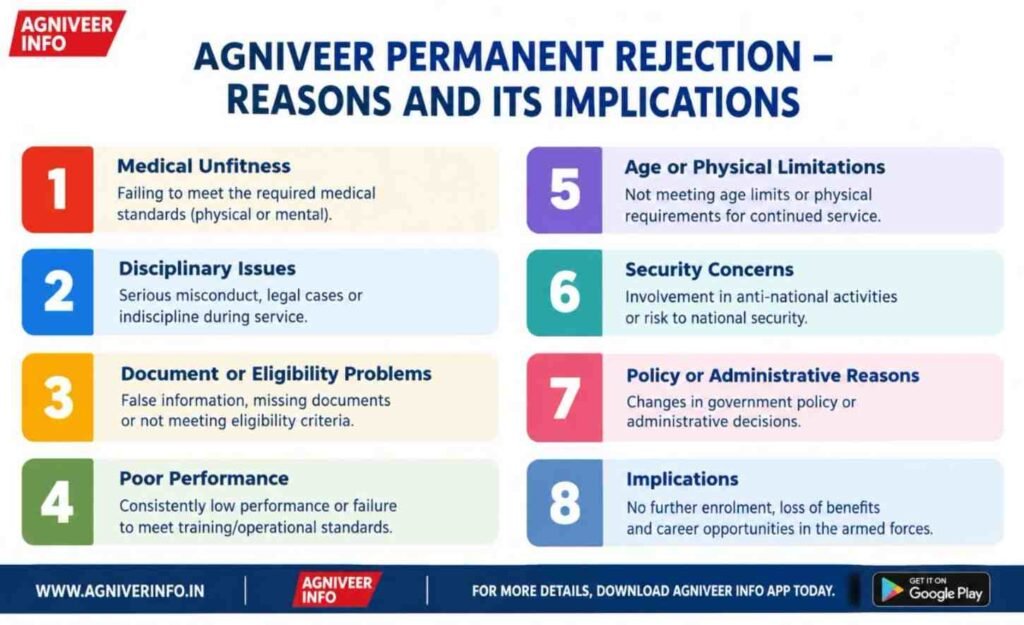
Military medical boards check candidates across several body systems, to make sure they are ready for operational duty. Conditions that may lead to permanent unfitness usually fall under a few broad categories:
- Ocular Conditions: Severe refractive errors, colour vision problems that do not match the trade’s standard, or structural problems with the eye.
- Musculoskeletal Abnormalities: Serious spine deformities, ongoing joint instability, chest wall deformities, or limited movement in the limbs.
- Cardiovascular and Respiratory Issues: Birth-related heart problems, ongoing high blood pressure, or long-term breathing conditions.
- ENT and Dental Findings: Permanent hearing loss, structural damage to the ear, or not enough valid dental points.
- Systemic and Chronic Illnesses: Metabolic disorders, ongoing chronic infections, or nerve-related conditions that do not fit with military duties.
Whether a specific condition leads to permanent unfitness depends entirely on the official service standards, and on the medical board’s own clinical judgement.
Can Eyesight Problems Lead to Permanent Rejection?
Vision standards in the Armed Forces are quite strict, given how demanding military duties can be. The eye check looks at visual sharpness, refractive errors, colour vision, and the general health of the eye. Certain vision conditions can indeed lead to permanent medical unfitness, if they fall outside the limits set for a specific branch or trade.
It is wrong to assume that wearing glasses automatically means permanent rejection for every single Agniveer entry. Some non-technical or specific roles allow corrective lenses, as long as they stay within a clearly set limit. That said, severe refractive errors, serious colour blindness for operational trades, or an underlying disease of the retina, will lead to permanent unfitness under the standard military medical rules.
Can Physical or Musculoskeletal Conditions Cause Permanent Rejection?
Physical readiness matters a great deal for military service, which is why the health of your bones, joints, and muscles is a key part of the medical check. Conditions such as severe flat feet (pes planus), noticeable knock knees (genu valgum), or a serious curve in the spine, called scoliosis, can affect how well you can carry weight, move, and keep up your stamina during hard training.
When a structural or functional problem is found, the medical board checks whether the condition affects how the body actually performs, or whether it raises the risk of injury. While a small, mild variation in posture might be acceptable depending on how serious it is, a noticeable structural deformity or an ongoing joint problem often leads to permanent rejection, to protect the person’s own health and keep the military ready for duty.
Can Medical History or Previous Surgery Cause Permanent Rejection?
A candidate’s past medical history and any surgery they have had are looked at carefully during the medical exam. Having had a surgery in the past does not automatically disqualify an applicant. The medical board looks at the type of surgery, how well the body has recovered its structure, how stable it is functionally, and whether any metal implant is still inside the body.
Major surgeries involving important organs, complex joint repairs, or conditions that need long-term medicine, are more likely to lead to permanent unfitness. On the other hand, a small surgery that has fully healed, with no lasting effect on function, may still meet the fitness standard. Each case is judged on its own medical details, according to the rules of that service.
Army Agniveer Permanent Medical Rejection
The Indian Army sets full medical standards, matched to land-based combat and operational conditions. Candidates who are declared permanently unfit during Army Agniveer rallies or medical screening are given an official medical document, explaining the exact medical reason behind the unfitness.
The Army has its own set process for candidates who want to appeal against a medical board’s decision, and applicants need to strictly follow the instructions given on their medical forms, including the given timeline and the specific military hospital location for any allowed re-check.
Navy Agniveer Permanent Rejection
The Indian Navy sets its own physical and medical standards, built specifically for maritime service, shipboard life, and duties at sea. The standards for vision, ENT health, and overall stamina are matched to what naval work actually needs.
When a candidate gets a permanent unfit decision during Navy Agniveer recruitment, this finding reflects the Navy’s own medical standard. Any review, where it is officially allowed, must be followed strictly, according to the official Navy recruitment guidelines and documents.
Air Force Agniveervayu Permanent Medical Rejection
Recruitment for Indian Air Force Agniveervayu includes special medical checks that cover both ground duties and technical trades. Precision in eyesight, spatial sense, and lung health matter a great deal during these checks.
A permanent medical rejection in Agniveervayu recruitment means that the candidate’s physical measurements do not meet the Air Force’s medical instructions. Any request for a medical review must follow the exact process laid down by the Air Force’s medical authorities.
Can Permanent Medical Rejection Be Challenged or Reviewed?
Candidates often ask whether a permanent medical rejection can be appealed. Whether an Appeal Medical Board (AMB) or Review Medical Board (RMB) is available depends entirely on the rules set by the specific service branch and that recruitment cycle.
If an appeal option is allowed, the candidate needs to complete the required paperwork at the medical location within the given time. A private medical certificate from a civil doctor cannot automatically overturn a military medical decision, though the official process may allow such documents to be used as supporting evidence during a formal appeal. Candidates should stay cautious of unauthorised agents who claim they can guarantee a medical clearance.
What Documents Should Candidates Keep After Permanent Rejection?
Candidates who get a permanent medical unfitness decision should carefully keep all the official documents given to them by the medical authorities. Important papers include the official medical examination sheet, the rejection slip, the recruitment admit card, and any written instructions that explain the appeal process.
Keeping the diagnostic reports, imaging results, and any official communication safe makes sure the candidate has a complete record of their check-up, and these papers matter a lot if a formal appeal is filed, or if the candidate later applies for another opportunity with different eligibility rules.
Common Mistakes Candidates Make After Permanent Rejection
- Ignoring Written Appeal Instructions: Not reading the exact process and deadline printed on the official rejection document.
- Relying on Unofficial Promises: Believing touts or third-party agents who claim they can illegally change a medical board’s decision.
- Submitting Civil Medical Reports Directly: Assuming that a certificate from a private hospital automatically cancels out a military medical board’s ruling.
- Concealing Medical History: Trying to hide a past surgery or a chronic condition during re-examination, which can lead to disqualification.
- Undergoing Unnecessary Surgeries: Rushing into a corrective surgery without first confirming whether it will actually meet the military medical standard.
- Assuming Uniform Rules Across Services: Expecting the Army, Navy, and Air Force to follow the exact same standards and review timelines.
What Should Candidates Do After Permanent Medical Rejection?
After getting a permanent medical rejection, a candidate should first read the written medical opinion carefully, to understand the exact medical reason behind the unfitness. If the official document gives the option to apply for an Appeal Medical Board, the candidate must follow the exact process right away, within the given deadline.
If no further review is allowed, or if an appeal confirms the original finding, the candidate should accept the medical decision responsibly. Applicants should stay away from unverified treatments, and should think about looking at other career options in civil sectors, government jobs, or other defence roles where their profile matches the required standard.
| Factor | Army | Navy | Air Force |
| Medical Decision | Issued by Army Medical Board | Issued by Navy Medical Board | Issued by IAF Medical Board |
| Common Considerations | Land combat, endurance, physical structure | Maritime environment, hearing, visual standards | Technical aptitude, vision, respiratory fitness |
| Review/Re-Medical | Per official Army appeal guidelines | Per official Navy appeal guidelines | Per official IAF appeal guidelines |
| Candidate Action | Follow rally medical instructions | Follow naval recruitment portal notices | Follow Agniveervayu medical instructions |
Conclusion
A permanent medical rejection in Agniveer recruitment is an official clinical finding, showing that a candidate’s current physical or medical condition does not match the required military standards. This is very different from temporary unfitness, which gives time for a short-term health issue to get better.
Since the physical requirements differ between the Indian Army, Indian Navy, and Indian Air Force, candidates need to understand the specific instructions of their own branch. Anyone affected should carefully go through their official papers, follow the official appeal process where it is allowed, stay away from unauthorised agents, and make informed choices about their future career.
For daily update join our WhatsApp channel
Frequently Asked Questions
Q1. What does permanent rejection mean in Agniveer recruitment?
A1. Permanent rejection means that an official military medical board has found a medical condition that does not meet the required standard for the specific entry.
Q2. Is permanent medical rejection the same as temporary unfitness?
A2. No, temporary unfitness gives time for a correctable condition to get better, while permanent unfitness means the condition is not acceptable under the current active military recruitment rules.
Q3. What are common reasons for Agniveer permanent medical rejection?
A3. Common reasons include long-term internal diseases, severe eyesight problems, major bone and joint deformities, serious hearing loss, or heart and blood vessel conditions, as judged by the medical board.
Q4. Can eyesight problems cause permanent medical rejection?
A4. Yes, eyesight problems that go beyond the set limit, serious colour vision defects, or structural eye diseases can result in permanent medical unfitness for service.
Q5. Can a permanent medical rejection be reviewed?
A5. Whether a review is possible depends on the rules of that service; if it is allowed, candidates need to apply for an Appeal Medical Board, following the official process within the given deadline.
Q6. Do Army, Navy and Air Force follow the same medical standards?
A6. No, while the basic health requirements are similar, the exact medical and physical standards change according to the operational conditions of each service branch.
Q7. What documents should candidates keep after rejection?
A7. Candidates should keep the official medical examination form, the rejection sheet, the admit card, the diagnostic reports, and any written instructions about the official appeal or review process.
Q8. What should a candidate do after permanent medical rejection?
A8. A candidate should carefully check the stated medical reason, follow the official appeal process if they are eligible and it is allowed, and look into other suitable career options.
READ ALSO: AGNIVEER PERMANENT COMMISSION — SELECTION CRITERIA EXPLAINED