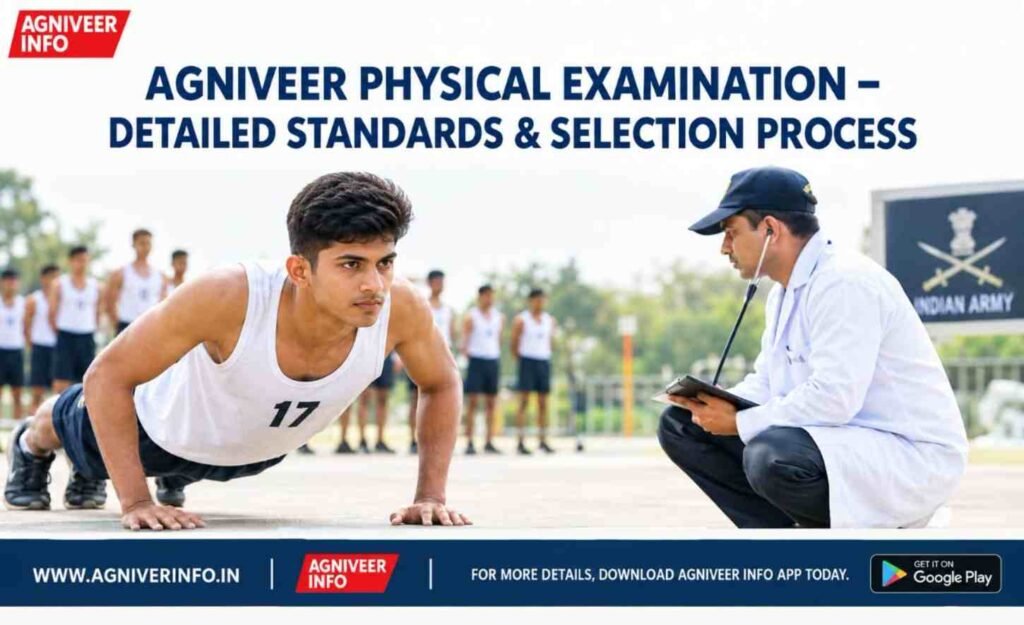
The Agniveer Physical Test works as a basic benchmark to check how physically ready, how strong, and how much stamina an aspirant has, before they can join the Indian Armed Forces. Getting recruited into the Army, Navy, and Air Force needs a high level of physical ability, so that candidates can handle the tough demands of operational life.
Physical testing and medical examination stay as two separate stages in recruitment, since the physical test checks your stamina and muscle strength, while the medical board checks your internal health, how well your organs work, and your overall body standards. It matters to know that the physical standards are not the same across the three services, since each branch sets its own rules to match its own operational needs.
Candidates should know that depending on unofficial advice found online, or old recruitment blogs, often leads to real mistakes in preparation, because the test distances, qualifying times, number of repetitions, and obstacle details can change across recruitment cycles, branches, trades, and gender categories.
Depending only on the current official recruitment notice is essential for correct preparation. This guide explains the Agniveer Physical Fitness Test across the branches, covering the test stages, the differences by gender, how scoring works, and safe, effective training strategies to help candidates succeed.
What Is the Agniveer Physical Test?
The main purpose of the physical test is to check candidates based on their stamina, their short-burst strength, and their bodyweight strength. Military life demands a lot of toughness, which is why physical screening works as an important tool, both to filter out candidates and to rank them by merit. Passing this stage confirms that a candidate has the basic ability needed for basic military training.
Unlike a medical check, which looks at how the internal organs work and checks for any structural problem, the physical test measures how the body actually performs under a set time limit. Because the demands are different between land operations, life on a ship, and flying-related work, each service has its own set of rules and its own way of judging fitness.
Agniveer Physical Test — Army, Navy and Air Force Differences
Indian Army
Army recruitment has traditionally put a lot of weight on long field endurance, explosive leg power, and upper-body pulling strength, because of the reality of combat terrain. The physical test often carries merit value, or has strict qualifying limits, during the recruitment rallies.
Indian Navy
The Navy’s requirements focus on balanced physical fitness, core stability, and the kind of stamina suited to shipboard duties. The tests generally check stamina, along with upper-body and lower-body bodyweight endurance.
Indian Air Force
The Air Force Agniveervayu test checks basic fitness through set running tests and bodyweight exercises. The screening mainly checks whether an applicant meets the basic fitness level needed for both technical and non-technical Air Force roles.
Running Test — Distance, Timing and Standards
The running test checks stamina and how much operational endurance a candidate has. The standard distance used in Army rally testing has traditionally been 1.6 kilometres, while the other services use their own set timed runs, matched to their own recruitment rules. Candidates should not assume that the timing is fixed the same way across every category, since the target time changes based on gender, altitude, trade, and the specific entry stream, which is why it is important to check the exact numbers directly from the active recruitment notice.
Push-Ups, Sit-Ups and Other Physical Exercises
Bodyweight exercises test the strength and endurance of specific muscle groups, along with core stability. Push-ups check the strength of the chest, shoulders, and triceps, while sit-ups and bent-knee stomach exercises check core control. Doing these with the correct form, going through the full movement, and keeping a controlled pace matter a lot, since a movement that does not follow the standard form is regularly disqualified by the physical instructors.
Army Rally Physical Tests and Obstacles
Indian Army rally tests often include specific physical efficiency tasks, along with the main running test. These traditionally include pull-ups on a beam, to check upper-body pulling strength, a 9-foot ditch jump, to check landing skill and explosive power, and a zig-zag balance beam, to check agility and spatial sense. The exact requirements depend on the trade classification and the specific rally notice.
Navy Agniveer Physical Fitness Test
The Navy’s physical screening checks overall physical ability, using a standard timed run and bodyweight movements. Candidates run, and then follow it up with squats (called Uthak Baithak), push-ups, and sit-ups. The Navy standards do not include the land-based Army rally obstacles, like balance beams or ditch jumps, and instead focus on a uniform way of checking physical fitness.
Air Force Agniveervayu Physical Fitness Test
Air Force physical testing uses a precise process, made up of a timed run followed by structured bodyweight exercises like push-ups, sit-ups, and squats. Candidates get a set rest period between each event. The rules here strictly focus on correct posture and a controlled pace of movement, rather than just speed alone.
How the Physical Test Is Conducted
Candidates report to the assigned recruitment venue for document verification and an initial biometric check, and the instructions about the order of the tests, safety rules, and qualifying standards are formally announced there. The tests happen one after another, usually starting with the running test to screen the large group of candidates, followed by the strength exercises and any special obstacles. The results are recorded right away, and this decides whether a candidate moves ahead to the medical examination.
Physical Test Standards for Male and Female Candidates
The physical standards are quite different between male and female candidates, to reflect natural physical differences, while still keeping a high standard of fitness. The rules for female candidates include an adjusted time for completing the run, a changed number of repetitions, or a different bodyweight task, depending on the service branch. Candidates should check the gender-specific table given in the notice, to prepare correctly.
How the Physical Test Is Scored or Qualified
The physical test either works on a simple pass-or-fail basis, or on a marks-based scoring system. Some Army entries give different marks based on the running time and the number of pull-ups, and this directly affects the final rally merit list. On the other hand, the Air Force and Navy physical tests usually work as a qualifying stage, where candidates just need to meet the minimum standard, without getting a numerical score added to their overall merit.
Common Reasons Candidates Fail the Physical Test
- Getting the pace of the run wrong, by sprinting too early and then getting tired quickly.
- Using poor exercise form, which leads to push-ups or pull-ups being rejected for not being done properly.
- Not having enough stamina, because of an inconsistent training routine.
- Not being ready for the actual conditions on the day, such as the weather, the heat, or an early-morning test schedule.
- Not resting enough, and ending up with an overtraining injury or shin splints right before the test.
- Depending on outdated advice found online, instead of the official service notice.
How to Prepare for the Agniveer Physical Test
Good preparation needs a training plan that builds up gradually over weeks or months. Start by building your basic stamina with long, easy-paced runs, before moving on to interval training, to improve your pace and speed endurance. Your strength training should focus on bodyweight exercises, with full, correct movement, rather than fast, sloppy repetitions.
Make sure you get enough sleep, do some light recovery activity, and keep up daily stretching, to avoid injuries to your muscles and tendons. Staying hydrated and eating a balanced diet is essential to support your training and let your muscles repair. Candidates should avoid extreme weight-loss methods, dehydration tricks, or unproven supplements, since these can harm your health and your physical performance.
How to Practice the Test at Home or on a Ground
Practise on a measured 400-metre track, or an open field, so that you can judge your running distance correctly. Use a stopwatch to note your split times, and track your pace every week. Do your bodyweight exercises with strict form, pausing briefly at the top of each movement, to match the official testing standard. From time to time, practise the whole sequence of tests together, to build the stamina needed to do one exercise right after another, while always keeping safety as the top priority during any practice at home.

Common Mistakes During Physical Test Preparation
- Increasing your running distance too quickly, which can cause stress fractures or joint swelling.
- Practising only running, while completely ignoring your core and upper-body strength.
- Ignoring correct form during push-ups and pull-ups, which gives you false confidence about how many valid reps you can actually do.
- Not including any recovery days, which can lead to burning out physically before the actual test.
- Preparing using generic charts found online, instead of the notice specific to your branch.
| Physical Test Area | Army | Navy | Air Force |
| Running/Endurance | 1.6 km run evaluated on time and group standards | Timed run adjusted for male and female parameters | Timed run with specific completion time limits |
| Strength Exercises | Pull-ups on beam to test upper-body strength | Push-ups, squats, and sit-ups with strict technique | Push-ups, sit-ups, and squats with defined rest |
| Obstacles/Additional Tests | 9-foot ditch jump and zig-zag balance beam | Not applicable; assessment focuses on core fitness | Not applicable; evaluation centers on standard exercises |
| Qualification/Assessment | Marks-based or qualifying depending on trade category | Qualifying entry stage for subsequent recruitment rounds | Qualifying assessment stage prior to adaptability tests |
Conclusion
The Agniveer Physical Test is an important stage in recruitment, since it confirms whether an applicant is capable of taking on military training. Because the physical standards, the scoring method, and the exercises required are quite different between the Army, Navy, and Air Force, candidates need to base their preparation on the current official notice.
Building your endurance, strength, and technique through a safe, structured, and gradual training plan helps you stay physically ready, without risking injury. Clearing the physical test opens the way toward the medical check and final selection into the armed forces.
Get the latest Agniveer updates by joining our WhatsApp channel
Frequently Asked Questions
Q1. What is the Agniveer physical test?
A1. It is a full physical screening that checks stamina, strength, and agility, to decide whether a candidate is suited for military service and basic training.
Q2. Is the Agniveer physical test the same for Army, Navy and Air Force?
A2. No, the physical standards, the test details, the exercise format, and the scoring method are quite different across the Indian Army, Indian Navy, and Indian Air Force.
Q3. What running test is required for Agniveer recruitment?
A3. The running test usually involves a timed run over a set distance, such as 1.6 kilometres, with a qualifying time that is decided by the service branch, the trade, and the gender.
Q4. Are physical standards different for male and female candidates?
A4. Yes, the physical standards, including the running time, the number of repetitions, and specific physical tasks, are set separately for male and female candidates across every entry.
Q5. Does every Agniveer candidate perform pull-ups and obstacles?
A5. No, pull-ups, ditch jumps, and balance obstacles are specific to the Army rally tests, and are not usually part of the Navy or Air Force tests.
Q6. How should candidates prepare for the physical test?
A6. Candidates should follow a training plan that builds up gradually, combining stamina-building runs, correct bodyweight exercise practice, mobility work, proper nutrition, and enough rest.
Q7. Is the physical test qualifying or marks-based?
A7. It depends on the service; some Army rally entries give competitive marks for physical performance, while the Navy and Air Force tests are purely a pass-or-fail stage.
Q8. Where should candidates verify the latest physical standards?
A8. Candidates should check the standards only through the official recruitment websites and official notices published by the Indian Army, Navy, and Air Force.
READ ALSO: AGNIVEER PERMANENT REJECTION – REASONS AND ITS IMPLICATIONS