
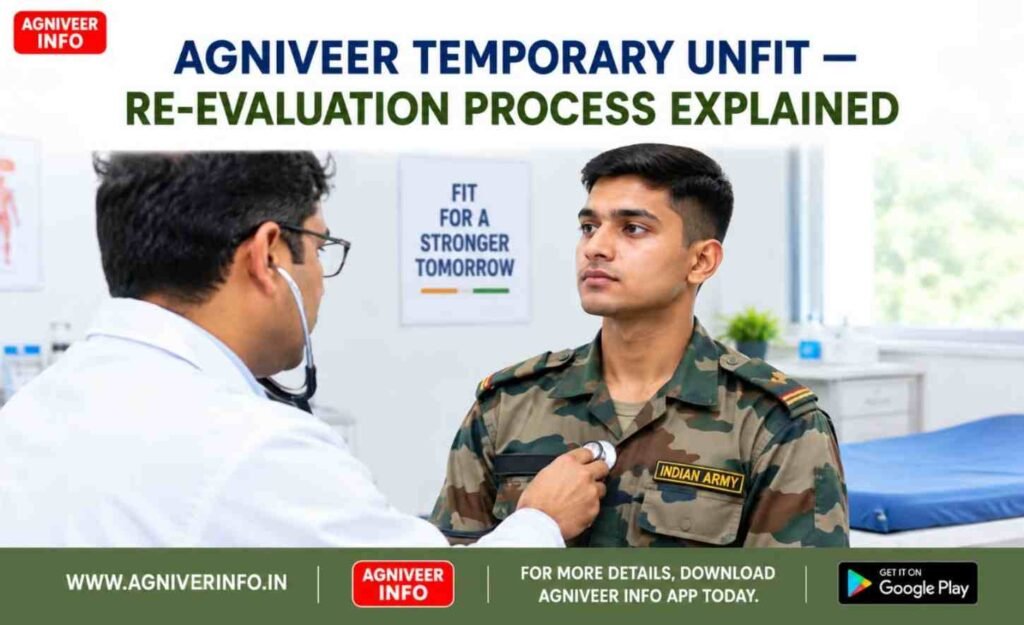
The medical examination stage of Agniveer recruitment is a crucial milestone for candidates hoping to join the Armed Forces. During this thorough check, the medical authorities look at each candidate against set physical and clinical standards, to decide whether they are suitable for service.
Getting an official finding of “Temporary Unfit” often causes needless worry among applicants, who wrongly read it as a final rejection. In reality, temporary unfitness simply means that a candidate has a specific medical finding or condition that needs a bit more observation, recovery time, treatment, or a special re-check, before a final decision can be made.
The reason behind giving a temporary unfitness finding comes from balancing the tough demands of military service with a fair check on the candidate, because certain physical conditions, minor injuries, or test results can get better within a short time, so military medical boards give a set window for re-checking. That said, the exact timelines,
the steps to follow, and the paperwork needed are not the same across the military branches, since the Indian Army, Indian Navy, and Indian Air Force each have their own administrative system, medical manuals, and re-check rules. Aspirants should carefully read the official medical slip given to them by their examining board, check the official recruitment notice, and depend only on official military healthcare channels, rather than unverified advice from others.
What Does Temporary Unfit Mean in Agniveer Recruitment?
An Agniveer Temporary Unfit finding is a kind of “in-between” medical status given during the recruitment exam. It means that the candidate currently has a physical measurement, clinical finding, or curable condition that does not meet the immediate standard needed for the Armed Forces, but has a real chance of being corrected or recovered within an officially allowed period.
Unlike a permanent rejection, this status pauses the final selection decision, to allow for proper medical follow-up or re-checking. Medical officers give this finding, to make sure that a temporary or fixable physical issue does not permanently block a candidate who is otherwise qualified, while still strictly keeping to the basic medical standard needed for military duty.
Why Can an Agniveer Candidate Be Declared Temporarily Unfit?
Candidates may be marked temporarily unfit for a wide range of fixable physical conditions, minor clinical issues, or natural body variations. Broad reasons often include being underweight or overweight compared to the standard body measurements, a temporary skin condition, a sports injury that can heal, mild physical strain, or the need to recover from a minor surgery.
On top of this, short-term clinical findings, such as a temporary rise in blood pressure due to stress, a small build-up of ear wax, a vision reading that can be fixed, or a mild infection that can be treated, can lead the examining doctors to put off a final decision. Medical boards give this status specifically when the condition is judged to be treatable, temporary, or needing a set period of medical observation.
What Happens After Being Declared Temporary Unfit?
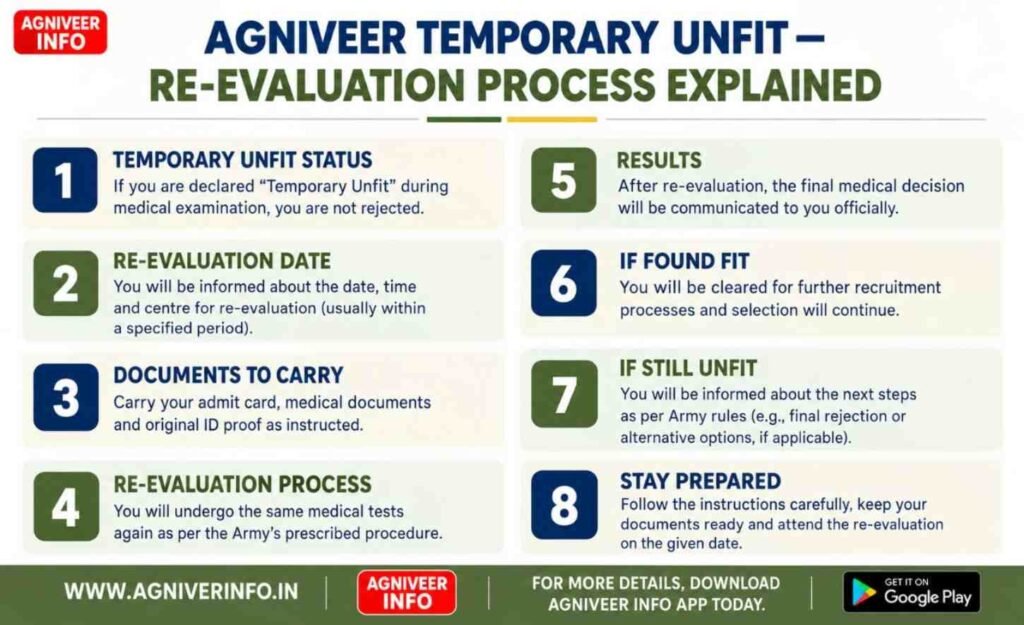
Once a candidate is declared temporarily unfit, they are officially given a medical document, or unfit slip, by the medical board that examined them. This document explains the exact clinical reason for the temporary status, and gives clear instructions about the reporting facility, the venue for re-checking, and the time allowed.
After this notice, the candidate needs to strictly follow the advice of qualified medical professionals, to fix the issue that was noted. Once the given period is over, or the condition is fixed, the candidate needs to report back to the specified military hospital or medical centre, for a formal re-check by authorised military specialists.
Agniveer Re-Evaluation Process — Step by Step
- Review Official Documentation: Read the official medical slip carefully, to understand the exact clinical finding and the specific instructions given by the medical board.
- Consult Medical Professionals: Get proper advice from qualified civilian or government doctors, to go through the right treatment or recovery process.
- Maintain Detailed Records: Keep all the relevant clinical papers, prescriptions, and reports related to your medical recovery.
- Follow Official Reporting Timelines: Check the official date, time, and military hospital venue given for your re-medical examination.
- Report for Re-Evaluation: Present yourself at the given military medical centre, with all the required recruitment and medical documents.
- Undergo Final Medical Assessment: Go through the full re-check done by the authorised military specialists, to get your updated medical status.
What Documents May Be Required for Re-Evaluation?
Candidates going for an Agniveer medical re-evaluation need to bring specific administrative and medical documents, to confirm their identity and clinical history. The authorised military medical boards need complete paperwork, to process the re-check smoothly, without administrative delays.
- The official Temporary Unfit medical slip, or document given by the first medical board.
- The original recruitment admit card, and official identity proof, such as an Aadhaar card or PAN card.
- Any relevant clinical reports, diagnostic summaries, or treatment records from registered doctors, if specifically asked for by the authority.
Army Agniveer Temporary Unfit and Re-Evaluation
The Indian Army carries out its initial medical checks at designated recruitment rally sites, or primary medical centres. Candidates who are declared temporarily unfit are given official documents, explaining the exact medical reason, and directing them to a designated Military Hospital (MH) or Command Hospital for re-evaluation.
The re-check process in the Army strictly follows the established military medical manuals. Candidates need to report exactly within the time given on their medical slip. Specialists at the designated military hospital carry out a thorough clinical examination, before sending their final finding back to the concerned Army Recruiting Office (ARO).
Navy Agniveer Temporary Unfit and Re-Evaluation
The Indian Navy follows its own medical guidelines, suited to the tough demands of life at sea. Candidates going through Navy Agniveer medical checks, who get a temporary unfit finding, are directed to designated naval hospitals or specific military medical establishments, for a full review.
The naval re-check process focuses on confirming that the identified condition has fully cleared up, without leaving any lasting physical effect. Candidates need to carefully follow the naval recruitment instructions given on their official papers, since the reporting steps and administrative process strictly follow naval medical recruitment rules.
Air Force Agniveervayu Temporary Unfit and Re-Evaluation
The Indian Air Force follows its own medical standards, designed for aviation and support duties under the Agniveervayu entry scheme. The medical exams and any later re-checks are handled by designated Air Force Medical Establishments (AFME) and authorised military hospitals.
When an Agniveervayu candidate is given a temporary unfit status, the medical authority gives the exact medical board location and the reporting period. Air Force medical specialists check the candidate, to confirm complete physical and clinical recovery, according to Air Force medical publications, before giving a final fit or unfit certificate.
What Can Happen After Re-Evaluation?
After the re-evaluation exam, the authorised military medical board reaches a final clinical decision, based on the set service standards. The possible outcomes directly reflect the candidate’s physical condition at the time of the re-check:
- Declared Medically Fit: The candidate successfully meets all the required physical and clinical standards, and their recruitment process moves ahead.
- Declared Medically Unfit: The condition that was noted has not cleared up, or does not meet the set service standard, which leads to a permanent rejection for that particular cycle.
- Referred for Further Review: In more complex cases, the medical board may send the candidate for an additional, specialised check, as per the service rules.
Common Mistakes Candidates Make After Temporary Unfitness
- Ignoring Official Medical Slips: Not reading the exact instructions, clinical finding, and venue details written on the official medical document.
- Missing Mandatory Reporting Dates: Arriving late at the designated military hospital, which usually leads to the re-evaluation being cancelled automatically.
- Assuming Guaranteed Selection: Believing that getting a temporary status automatically guarantees an eventual fit certificate, without proper recovery.
- Relying on Unofficial Remedies: Trying unverified, unsafe, or non-prescribed treatments, to force quick physical changes before the medical board.
- Forgetting Essential Documents: Turning up at the re-evaluation venue without the original identity papers, recruitment slips, or the prescribed medical records.
- Attempting to Conceal History: Hiding your medical history, or giving false documents to the examining military specialists during the re-check.
How Should Candidates Prepare for Re-Evaluation?
Preparing for an Agniveer medical re-evaluation needs a structured, disciplined, and responsible approach. Candidates should put their health first, by consulting qualified doctors who can guide their recovery or treatment safely. Following professional advice strictly makes sure that physical recovery happens naturally and properly, without risking further problems.
Candidates need to keep up a level of physical fitness suited to their own situation, while staying away from extreme, unscientific practices, such as excessive dehydration, unauthorised supplements, or extreme fasting. Organise all your official recruitment papers and medical documents well in advance, arrange your travel to the designated military hospital in good time, and present yourself calmly and professionally before the military medical board.
Can a Candidate Challenge or Appeal a Medical Decision?
The Armed Forces have specific administrative rules on medical decisions, but these rights are governed strictly by the service-specific recruitment rules and medical manuals. A candidate does not have an automatic or unlimited right to challenge every medical finding, outside the official channels.
If the official rules allow an appeal or review medical board for a specific condition, the candidate needs to apply within the exact time and format given on their official medical document. Decisions given by an authorised Appeal Medical Board, or the final military medical authority, are final, and a private doctor’s certificate cannot override an official military board’s decision.
| Stage | Army | Navy | Air Force |
| Temporary Unfit | Issued at recruitment rally or primary board for recoverable conditions. | Granted during naval medical screening for remediable clinical findings. | Assigned during Agniveervayu medicals for temporary physical issues. |
| Re-Evaluation | Conducted at designated Military Hospitals by specialized army doctors. | Carried out at specified Naval or Military Hospitals by medical officers. | Executed at authorized Air Force Medical Establishments or hospitals. |
| Documents | Requires original unfit slip, rally admit card, and identity documents. | Requires official Navy medical paperwork, admit card, and valid ID. | Requires Agniveervayu medical documentation, admit card, and ID. |
| Possible Outcome | Candidate declared fit, permanently unfit, or referred per regulations. | Candidate cleared as medically fit or declared unfit for entry. | Candidate certified fit or unfit based on aviation medical standards. |
Conclusion
Understanding the Agniveer Temporary Unfit status matters a lot for candidates going through the Indian Armed Forces recruitment process. Getting a temporary unfitness finding is not an instant rejection, but rather a structured chance to fix a recoverable medical condition, under the military’s own guidelines.
Since the Indian Army, Indian Navy, and Indian Air Force each work under their own administrative system and medical standards, candidates need to strictly follow the specific instructions written on their own official medical document.
Following qualified medical advice, avoiding unverified remedies, and reporting on time to the designated military hospital, are all critical steps. In the end, only the authorised military medical boards have the final say on medical fitness, making sure every Agniveer taken in can handle the physical demands of national service.
For daily update join our WhatsApp channel
Frequently Asked Questions
Q1. What does Temporary Unfit mean in Agniveer recruitment?
A1. Temporary Unfit means a candidate has a recoverable medical condition, which needs observation, treatment, or recovery, before a final military medical decision is made.
Q2. Does Temporary Unfit mean permanent rejection?
A2. No, it is not a permanent rejection. Candidates are given a specific chance to go through re-evaluation, once they have dealt with the temporary medical condition noted.
Q3. How does Agniveer medical re-evaluation work?
A3. Candidates follow the official instructions, get the right medical care, and report to the designated military hospital on the given date, for a full specialist assessment.
Q4. What documents are required for re-evaluation?
A4. Candidates need to present their official temporary unfit slip, the original recruitment admit card, valid government ID, and any requested clinical treatment records or reports.
Q5. Can a candidate become medically fit after re-evaluation?
A5. Yes, if the military medical board confirms that the condition has fully resolved, and the candidate meets all the set physical and clinical entry standards.
Q6. Do Army, Navy and Air Force follow identical procedures?
A6. No, each service branch has its own separate medical rules, administrative steps, designated reporting facilities, and re-evaluation process, matched to its own operational recruitment needs.
Q7. Can a candidate appeal a medical decision?
A7. An appeal or review board is only allowed if it is clearly given under the official service rules, and it must be requested within the exact time given for that process.
Q8. What should candidates do after receiving Temporary Unfit status?
A8. Candidates should carefully go through their official medical slip, seek proper medical treatment, get all the necessary documents ready, and report on time for their re-evaluation.
READ ALSO: AGNIVEER SWEATY HANDS REJECTION EXPLAINED — INDIAN ARMY