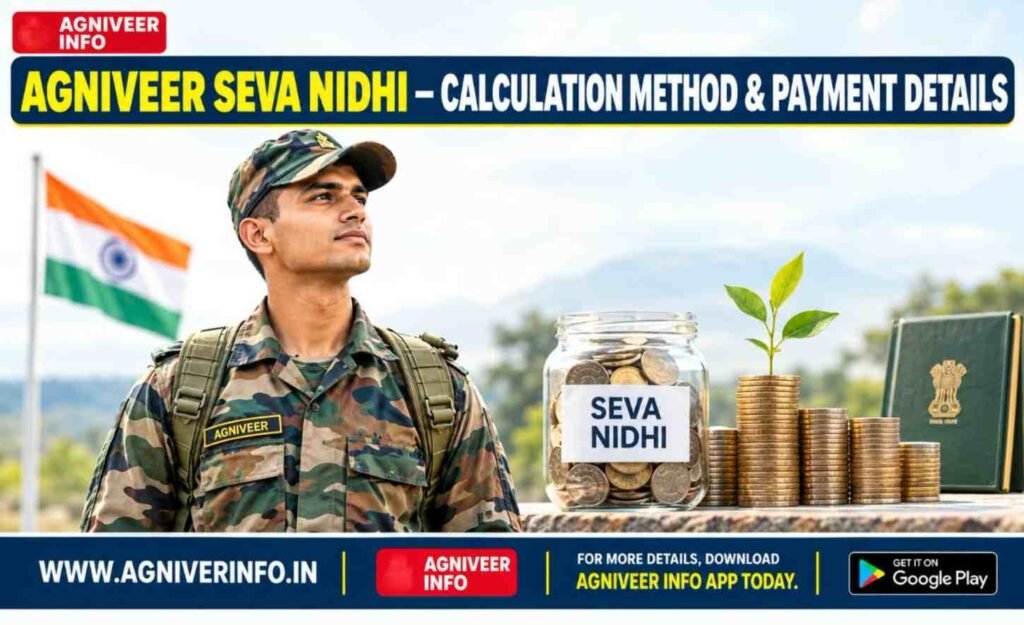
The Agnipath scheme brings a big change to Indian military recruitment, bringing in a modern way of hiring personnel below officer rank, across the Indian Army, Indian Navy, and Indian Air Force. At the centre of this financial system is the Agniveer Seva Nidhi, a dedicated fund built up over time,
designed to give financial independence to individuals once they finish their four years of service. Many prospective candidates often confuse this saved-up fund with their monthly take-home pay, or with a standard military pension. Understanding this difference matters a lot for aspirants who are weighing their career choices and thinking about their long-term financial stability.
The Seva Nidhi is not a regular cash amount paid out during active monthly duty, and instead it works as a structured, savings-based financial cushion, built through matched monthly savings over the four years of service. Both the recruit and the Government of India put in a fixed percentage of the set monthly pay package into a dedicated fund.
Once the soldier is discharged, this fund, along with the interest it has earned, is given out as a one-time financial benefit. Understanding clearly how it is calculated, who is eligible, and how it is paid out, helps recruits plan properly for further education, starting a business, or moving into a private career, after their military service ends.
What Is Agniveer Seva Nidhi?
Agniveer Seva Nidhi is a customised, compulsory exit package set up under the Agnipath framework. Unlike traditional military pension schemes, which give a lifelong monthly payment to retired personnel, Seva Nidhi works as a one-time financial safety net for recruits who exit after four years. Its main purpose is to give young people the money needed to start a second career,
continue their studies, or set up a business. Candidates need to understand that this fund is completely separate from their regular pay earned during service. It keeps building up in a central account throughout the four years of service, and stays locked until the soldier is formally discharged.
How Is Agniveer Seva Nidhi Calculated?
The way the Seva Nidhi fund is calculated depends on a compulsory 30% monthly deduction from an Agniveer’s gross package, matched equally by the Government of India. Every month, 30% of the candidate’s customised package goes into the Agniveer Corpus Fund, and at the same time,
the government puts in an identical amount into the candidate’s account. Over the 48 months of service, both sides build up an equal balance. On top of this, the fund earns interest, based on the rate applicable to the Public Provident Fund (PPF), as decided by the government’s own rules. The total amount, once everything is added up, forms the final amount paid out.
Agniveer Seva Nidhi Year-Wise Contribution
The contributions go up steadily over the four years, in line with the yearly increase in pay. In the first year, from a gross package of ₹30,000, the monthly contribution is ₹9,000 from the candidate, and ₹9,000 from the government. In year two, the gross package goes up to ₹33,000, giving a monthly deduction of ₹9,900, matched equally by the government.
Year three has a package of ₹36,500, giving monthly contributions of ₹10,950 from both sides. In the final year, with a package of ₹40,000, the monthly deposit reaches ₹12,000 from each side. Over the four years, the candidate’s own contribution totals about ₹5.02 lakh, matched equally by the government, giving a base amount of ₹10.04 lakh, before adding the interest.
Government Contribution to Seva Nidhi
The government’s matching contribution is one of the main pillars of the Agnipath scheme’s financial system. Rather than being an extra cash amount added straight to the monthly salary, the government matches every rupee that is deducted from the recruit’s pay. This government share is credited directly into the dedicated Agniveer Corpus Fund every month. This arrangement makes sure the candidate’s savings double over the four years of service, without the recruit having to manage any investment themselves, or take on any market risk.
How Much Seva Nidhi Does an Agniveer Receive?
Once an Agniveer successfully completes the four years of service, they receive a lump sum of about ₹11.71 lakh. This total amount is made up of the candidate’s own savings of ₹5.02 lakh, the government’s matching share of ₹5.02 lakh, and the interest that has built up over the four years. The exact final amount may vary slightly, depending on the interest rate that the government declares over those four years. This lump-sum exit benefit is designed to support the soldier once they move on from military life, without creating any ongoing pension liability for the government.
When Is Agniveer Seva Nidhi Paid?
The Seva Nidhi fund becomes due once the four years of service officially come to an end. The discharging authorities process the total saved amount as part of the final release paperwork. The full amount is credited directly into the individual’s registered bank account, once the official discharge process is complete. If a candidate leaves the service early, either by resigning or because of disciplinary action, the payment rules are decided strictly by official military guidelines, which may reduce or take away the government’s matching share, depending on the individual case.
Who Is Eligible to Receive Seva Nidhi?
To be eligible for the full Seva Nidhi package, you need to complete the full four-year service contract under the Agnipath scheme. Recruits who complete their service and move into civilian life are fully entitled to receive the complete saved-up fund, including the government’s contribution and the interest earned.
In cases where a soldier is discharged early because of a medical condition connected to their military service, specific compensation rules apply, as laid out in the official recruitment policy. Candidates who are dismissed for disciplinary reasons, or who choose to leave early without permission, may lose the government’s matching share.
Is Seva Nidhi Different From Agniveer Salary?
Agniveer Seva Nidhi and the monthly salary are two separate things. The monthly salary, specifically the in-hand pay, is the actual cash paid directly into a recruit’s bank account every month, to cover their living costs, and this is 70% of the gross customised package. Allowances for risk, hardship, dress, and travel are paid separately, along with this monthly pay. Seva Nidhi, on the other hand, is a fund that is kept locked and held in trust, until the soldier is discharged. Treating Seva Nidhi as regular monthly income leads to a wrong idea of how much take-home pay you actually get during service.
What Happens If an Agniveer Is Selected for Regular Service?
Up to 25% of each Agniveer batch may be taken into the regular cadre of the Armed Forces, based on merit, the organisation’s needs, and performance evaluation. Candidates who are selected for regular service do not receive the government’s matching share of the Seva Nidhi as a lump-sum exit payout. Instead, their own saved contribution, which is about ₹5.02 lakh plus the interest earned, is either given back to them, or moved into their standard pension and provident fund account, as per the official rules that govern permanent personnel.
Is Agniveer Seva Nidhi Taxable?

Under the current tax rules set by the Government of India, the Agniveer Seva Nidhi fund is clearly exempt from Income Tax. The monthly contributions made by the candidates, the government’s matching contribution, and the interest earned within the Agniveer Corpus Fund all qualify for this tax-free status. On top of this, the final lump sum received once the four years of service are complete does not attract any income tax, which means the recruit gets to keep the full amount of money available to them on exit.
| Service Year | Candidate Contribution | Government Contribution | Seva Nidhi Calculation Note |
| Year 1 | ₹9,000 per month (₹1.08 lakh annual) | ₹9,000 per month (₹1.08 lakh annual) | Calculated as 30% of ₹30,000 monthly gross package. |
| Year 2 | ₹9,900 per month (₹1.188 lakh annual) | ₹9,900 per month (₹1.188 lakh annual) | Calculated as 30% of ₹33,000 monthly gross package. |
| Year 3 | ₹10,950 per month (₹1.314 lakh annual) | ₹10,950 per month (₹1.314 lakh annual) | Calculated as 30% of ₹36,500 monthly gross package. |
| Year 4 | ₹12,000 per month (₹1.44 lakh annual) | ₹12,000 per month (₹1.44 lakh annual) | Calculated as 30% of ₹40,000 monthly gross package. |
Conclusion
The Agniveer Seva Nidhi is a key financial part of the Agnipath recruitment system, built to give financial security to recruits once they leave military service. Through a disciplined, month-by-month deduction, matched by an equal government contribution over four years, candidates build up a solid amount of money, along with the interest earned on it.
Understanding that Seva Nidhi is a benefit given after service ends, and not part of your active take-home salary, matters a lot for planning your finances properly. By understanding how it is calculated, who is eligible, and the tax exemptions that apply, prospective candidates can look at their military service clearly, and plan well for their life after service.
Get the latest Agniveer updates by joining our WhatsApp channel
Frequently Asked Questions
Q1. What is Agniveer Seva Nidhi?
A1. Agniveer Seva Nidhi is a customised, tax-free exit benefit, built up through equal contributions from the candidate and the government, and paid out as a lump sum once service ends.
Q2. How is Seva Nidhi calculated?
A2. It is calculated by deducting 30% every month from the candidate’s package, adding an equal government match, and letting this amount build up along with the applicable interest rate.
Q3. Does the government contribute to Seva Nidhi?
A3. Yes, the Government of India matches 100% of the candidate’s monthly Seva Nidhi contribution, throughout the full four-year service period, across all defence branches.
Q4. When is Seva Nidhi paid?
A4. The full Seva Nidhi fund is paid directly into the candidate’s bank account, once the four-year Agnipath service is formally complete.
Q5. Is Seva Nidhi different from Agniveer salary?
A5. Yes, Seva Nidhi is a fund that stays locked until service ends, while the salary is the net cash paid to recruits every month during active military service.
Q6. Does every Agniveer receive Seva Nidhi?
A6. Every Agniveer who successfully completes the four years of service receives the Seva Nidhi exit package, subject to the official scheme terms and discharge rules.
Q7. What happens to Seva Nidhi if an Agniveer enters regular service?
A7. Selected recruits get back their own saved contribution, plus the interest earned, while the rules for regular service govern their transition, without them receiving the full lump-sum exit package.
Q8. Is Agniveer Seva Nidhi taxable?
A8. No, the entire Seva Nidhi package, including the candidate’s own contribution, the government’s matching amount, and the interest earned, is fully exempt from income tax under the current laws.
READ ALSO: AGNIVEER SELECTION PROCESS — COMPLETE STEP-BY-STEP GUIDE