

Many defence aspirants hear that flat feet can lead to rejection in the medical examination, and they immediately start worrying about whether they are medically fit for the Army. This worry is easy to understand, because serving the country is a big dream, but the matter is not as simple as just looking at the shape of a foot. Medical fitness is decided by the official rules that the Indian Armed Forces use, and not by casual looking or by things people say on the internet.
Many people wrongly believe that a flat arch ends a defence career at once. In reality, medical fitness depends on how serious the condition is and on how it affects your overall physical performance. This article explains what flat feet mean, how they are checked, why testing yourself at home is not reliable, and what you can realistically do if you are worried. Please remember that this information is only for learning, and it does not take the place of an official Army medical examination done by authorised medical officers.
1. WHAT IS FLAT FOOT?
In simple words, a “flat foot” (called pes planus in medical language) means that the arch on the inner side of the foot is low or is not there at all. Normally, when you stand, the arch of your foot rises a little off the ground, but if the whole sole touches the floor when you stand, you have flat feet.
This condition often runs in families, which means it is passed on from parents to children. Many people are born with naturally flat feet and never feel any pain or trouble because of it. There are two main types:
- Flexible Flat Feet: The arch can be seen when you sit, but it disappears when you stand. This is very common and usually does not cause any problem.
- Rigid Flat Feet: The foot stays flat whether you are standing or sitting. This type is less common, and it can sometimes come with stiffness or pain.
2. DOES FLAT FOOT AUTOMATICALLY MEAN ARMY REJECTION?
Flat feet should not be called an instant rejection. The Indian Army medical standards check whether your feet can handle the hard work of military training, such as long marches, running and carrying heavy loads, so if your feet are flexible, painless and working well, you may still be found medically fit.
The authorised medical board judges your foot posture by how well your foot works. If you can do physical activities without pain, swelling or a defect in the structure of the foot, the condition may not be a reason for permanent rejection. Do not depend on random online forums or social media, because they often spread myths about instant disqualification, while the official standards are applied by doctors who look at your whole physical health.
3. GRADES OR SEVERITY OF FLAT FOOT
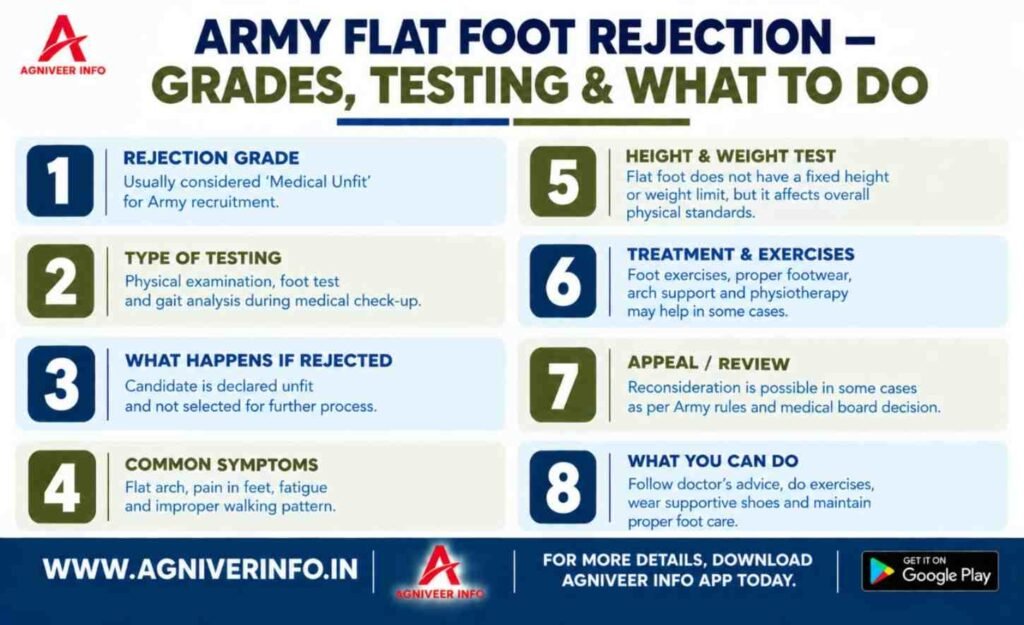
You may see many websites that talk about “Grade 1, Grade 2 or Grade 3” rejection rules. It is important to know that the official medical rules of the Indian Armed Forces do not use a fixed “Grade 1/2/3” system for rejecting flat feet. These labels are often made up by coaching centres or by bloggers who are not doctors, so that a hard medical check can look simple.
Medical officers look at the “navicular drop” (which means how much the arch drops down) and at how flexible the whole foot is. A foot that is stiff, painful or bent out of shape is more likely to be marked than a foot that is flexible and painless. There is no shortcut or secret grading scale, and the final decision is only with the medical board during your recruitment rally or your service selection board (SSB) medicals.
4. HOW IS FLAT FOOT TESTED?
In the Army medical examination, doctors use the standard clinical methods to check your feet. They do not depend on one single test, and they look at how your feet work when you move. The common methods are:
- Weight-Bearing Examination: You are asked to stand in a natural way so that the doctor can see how your sole touches the floor.
- Foot Posture Assessment: The doctor checks the line of your ankle and heel to see whether the foot rolls too much towards the inside (overpronation).
- The Tiptoe Test: You may be asked to stand on your tiptoes. If an arch shows up while you are on your toes, it means your flat feet are flexible, which is usually a good sign.
- Functional Movement: You may be asked to walk or do simple movements so that the doctor can check for pain or any problem in how the foot works.
5. COMMON HOME TESTS — WHAT THEY CAN AND CANNOT TELL YOU
Many candidates try the “wet footprint test” at home, where they wet their feet and step on a paper to see the mark. This shows the shape of your arch, but it cannot tell you whether you are medically fit for the Army.
A home test is only a look with the eyes, and it does not measure:
- Flexibility: Whether your foot can adjust to stress.
- Pain Levels: Whether the structure of your foot makes you tired.
- Alignment: Whether your ankles are steady.
Do not use home tests to decide on your own that you are unfit, and do not lose hope because of them. These tests are not exact enough to judge whether a candidate is physically able to serve.
6. SYMPTOMS THAT MAY NEED MEDICAL ATTENTION
Many people with flat feet experience no symptoms at all. But if the shape of your foot puts stress on the body, you may feel:
- Pain in the heel, the arch or the middle of the foot.
- Discomfort that gets worse when you run or stand for long hours.
- Swelling along the inner side of the ankle.
- Pain in the leg or knee because of a wrong way of walking (gait).
If you have pain that does not go away, please meet an orthopaedic doctor, who can tell you whether your symptoms come from your arch or from some other problem.
7. CAN FLAT FEET BE IMPROVED?
You cannot “cure” the basic shape of a foot, but you can make the muscles that support your arch stronger and steadier. If your flat feet are flexible, the following may help:
- Strengthening Exercises: Toe curls and picking up small things with your toes can make the foot muscles stronger.
- Stretching: Stretching your calf muscles regularly reduces the tension on your foot.
- Footwear: Wear supportive shoes with good arch support in your daily life.
- Weight Management: Keeping a healthy weight reduces the pressure on your feet.
These steps help you feel better and work better, but they are not a sure way to “pass” a medical test.
| Concern | What It Means | What the Candidate Should Do |
| Visible Flat Arch | Normal variation or mild condition | Maintain foot health and stay active. |
| Foot/Ankle Pain | Potential functional limitation | Consult a doctor for professional advice. |
| Rigid Foot Structure | Potential medical disqualification | Get an expert opinion before applying. |
8. WHAT SHOULD A DEFENCE ASPIRANT DO IF WORRIED?
If you are worried about your feet, follow these practical steps:
- Stay Calm: Do not decide that you are unfit just because of an online test.
- Professional Advice: See an orthopaedic doctor if you have pain.
- Check Official Rules: Always read the medical standards in the official notice for your own entry (for example NDA, Agniveer or CDS).
- Be Honest: During the medical exam, do not try to hide your condition or use tricks to make an artificial arch.
- Focus on Fitness: Keep yourself physically active so that your legs stay strong.
9. IF DECLARED MEDICALLY UNFIT
If a medical officer declares you unfit because of flat feet, please do not panic. The system gives you a legal way to challenge the decision, which is called a Medical Appeal. You will be given a fixed period of time to appeal at a designated military hospital, so read your medical report carefully, understand the exact reason for the rejection, and if a specialist gives you a report saying that you are fit, show it to the board during the appeal.
10. MYTHS ABOUT FLAT FEET AND ARMY MEDICALS
- Myth: Everyone with flat feet is rejected. Fact: Only the cases that affect physical performance are usually rejected.
- Myth: You can hide flat feet with surgery or insoles. Fact: Doctors can easily find surgical scars or artificial corrections.
- Myth: Running barefoot “cures” flat feet. Fact: Walking barefoot can make the feet stronger, but it will not change the structure of your bones.
Get the latest Agniveer updates by joining our WhatsApp channel
FREQUENTLY ASKED QUESTIONS
Q1. Does flat foot cause rejection in the Indian Army?
A1. Not necessarily. Rejection happens only if the flat feet are stiff, painful or limit how you work, so that you cannot do the physical tasks that the Army needs.
Q2. What is the Army test for flat feet?
A2. Medical officers do a clinical examination, in which they check the structure of your foot while you stand and walk, and they also use a tiptoe test to check how flexible the foot is and how the arch works.
Q3. Are there different grades of flat feet?
A3. There are no official “Grade 1, 2 or 3” rejection rules in the Indian Army medical standards. Doctors check whether your feet are flexible or stiff, and whether they work well.
Q4. Can flat feet be corrected with exercises?
A4. Exercises can make the muscles around the arch stronger and can improve the steadiness of flexible flat feet, but they cannot change the bone structure of your foot.
Q5. Can running cure flat feet?
A5. No. Running is a great exercise for general fitness, but it will not permanently turn a flat foot into a high-arched foot.
Q6. Can a wet footprint test confirm flat feet?
A6. No. A wet footprint only shows the shape of your sole, and it cannot measure how flexible your foot is, whether it pains, or whether you can do military duties.
Q7. What should I do if I am worried about flat feet before my medical exam?
A7. Do not panic. Visit an orthopaedic specialist to check whether your feet are flexible and painless, and stay physically active while you focus on your overall fitness.
Q8. What happens if I am declared medically unfit?
A8. You can apply for a formal medical appeal within the time given in your rejection notice, and then a specialist board will examine your case again
CONCLUSION
Flat feet are a common physical trait, and they are not an automatic barrier to serving in the Indian Army. The medical board looks at what your feet can do, which means whether you can run, march and train without pain or the risk of injury.
Do not depend on home tests or on advice that is based on fear. If you have any worry, take the opinion of a qualified doctor to be sure that your feet are healthy and working well. In the end, the authorised medical board takes the final decision on the basis of the set standards,
and not on the basis of home experiments. So focus on your overall physical fitness, prepare for your written exams, and go to the medical examination with confidence and honesty.
READ ALSO: ARMY AGNIVEER GD ELIGIBILITY — FULL CRITERIA GUIDE