

Many defence aspirants work hard for months to clear their written exams and physical tests, but many of them forget that the hearing test in the Army medical examination is a very important part of the final selection.
Aspirants are often confused about how earwax, ear infections, tinnitus (a ringing sound in the ear), a perforated eardrum (a hole in the eardrum) or a small hearing loss can affect their medical result. Some candidates worry without any need, while others ignore serious ear problems until the last moment.
It is important to remember that a small ear problem does not automatically mean permanent rejection, because the final decision always rests with the official Armed Forces medical board, which follows the medical standards fixed for it. This guide explains how the Army hearing test works, what the official requirements are, what commonly makes a candidate unfit, and what practical steps you can take to protect your hearing eligibility.
1. WHY IS HEARING TESTED IN THE ARMY MEDICAL EXAMINATION?
Good hearing is a must for every soldier, officer and specialist in the Armed Forces. On the battlefield or during training, personnel have to hear radio commands, faint footsteps, the sound of weapons and warning signals clearly, and if someone is late in hearing a command, a whole unit can be put in serious danger. This is why the defence medical boards test both of your ears very carefully during recruitment.
A candidate cannot simply say that his hearing is fine, because the medical officers use exact testing methods to check the real health of the ear and how well the candidate can hear.
2. WHAT IS THE ARMY HEARING TEST?
The Army ENT Medical Test (ENT means ear, nose and throat) checks the structure of your ears and also how well you can hear. In the medical exam, an ENT specialist first looks at your outer ear, ear canal and eardrum with an instrument called an otoscope, so that he can find physical problems like a block of earwax, fluid or a hole in the eardrum.
After that, simple voice and whisper tests are usually done to see whether you can hear clear speech from a fixed distance in a quiet room. For entries that need an exact check, such as NDA, CDS, AFCAT or the technical branches, candidates may also go through Pure Tone Audiometry (PTA), which measures the softest sounds you can hear at different pitches, so that your ears can be matched with the official criteria of the Armed Forces.
3. ARMY HEARING STANDARDS — WHAT IS CONSIDERED NORMAL?
The official Indian Army hearing standards need a candidate to have normal hearing in both ears, without any active disease or defect in the structure of the ear. Under the standard recruitment rules, a candidate should be able to hear a forced whisper from a distance of 610 cm (6 metres) with each ear separately in a quiet place.
When audiometry is done, the hearing levels are measured in decibels (dB) across the speech pitches (usually 250 Hz to 4000 Hz). In general, a hearing loss of more than 20 dB in the speech pitches, or a big loss in the high pitches, can lead to temporary or permanent unfitness, depending on the entry category. Officer entries and aviation branches usually keep stricter hearing limits than the general recruitment entries.
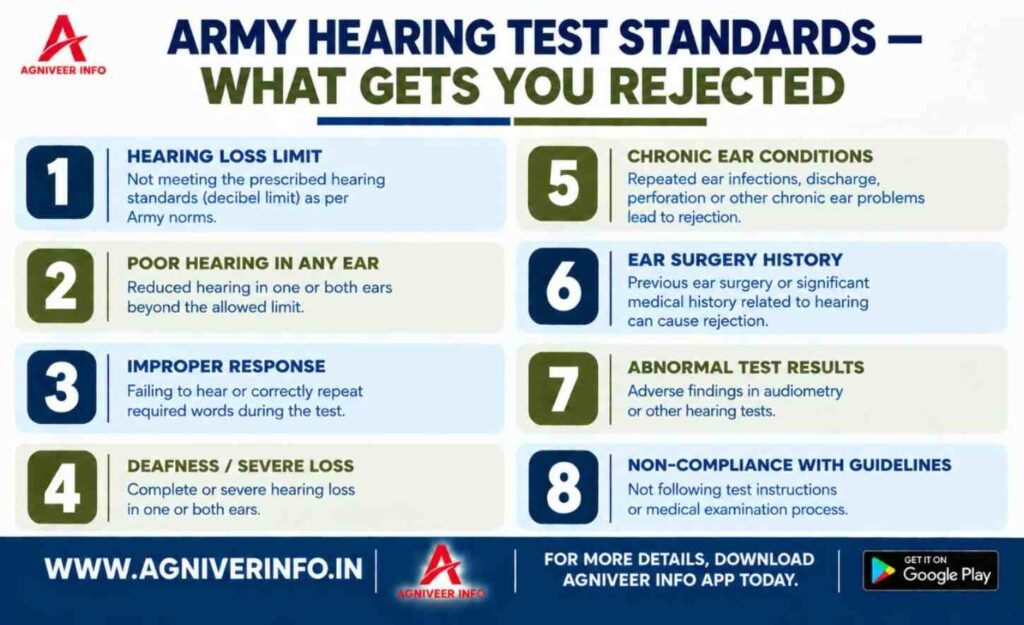
4. WHAT HEARING PROBLEMS CAN LEAD TO REJECTION?
Some ear conditions often lead to rejection in the hearing test at medical boards, because the medical officers carefully screen candidates for conditions that could get worse during military training or service.
- Significant Hearing Loss: A lasting loss of hearing in one or both ears, either from nerve damage (sensorineural) or from a block in carrying sound (conductive), that falls below the fixed limits.
- Perforated Eardrum: Any visible hole or tear in the eardrum, whether it is old or new.
- Chronic Otitis Media: Ear infections that last for a long time and cause constant discharge or damage to the middle ear.
- Active Ear Infections: Serious swelling, fungal infections or fluid collected behind the eardrum.
- Tinnitus: A constant ringing or buzzing sound in the ears, especially when it goes along with nerve damage inside.
5. DOES EARWAX AFFECT THE ARMY HEARING TEST?
Too much earwax is one of the most common reasons why candidates get temporary unfitness in the Agniveer hearing test and the officer entry medicals. Heavy earwax blocks the ear canal, so sound cannot reach the eardrum and the normal hearing tests fail.
The medical officers also cannot see the eardrum properly when wax covers it. Candidates must never use safety pins, matchsticks or hard cotton buds to take out wax, because this can easily make a hole in the delicate eardrum. If you think that wax has built up in your ear, please visit a qualified ENT doctor well before your medical exam, so that the ear can be cleaned safely by a professional.
6. WHAT ABOUT TINNITUS, EAR INFECTIONS OR A PERFORATED EARDRUM?
Knowing about each ear condition clears up the confusion that many defence aspirants have:
- Tinnitus: A ringing in the ears can be temporary because of loud noise, or it can be lasting because of nerve damage inside the ear. If the tinnitus does not go away, it usually leads to a detailed check, and it can lead to rejection if it is linked to hearing loss.
- Ear Infections: Sudden infections of the outer or middle ear cause a temporary drop in hearing and swelling. Most simple infections can be treated, but infections that come again and again or that last long cause permanent unfitness.
- Perforated Eardrum: A hole in the eardrum affects how sound travels, and it lets water and germs enter the middle ear. Candidates with an active hole are declared unfit, although a successful repair by surgery (tympanoplasty) with complete healing may be looked at again as per the rules of the entry.
7. QUICK GUIDE TO COMMON EAR ISSUES
| Hearing Issue | What It Means | What the Candidate Should Do |
| Impacted Earwax | Sound blocked by hard wax | Get ears professionally cleaned by an ENT doctor before the medical test. |
| Eardrum Perforation | Hole or tear in eardrum | Consult an ENT surgeon for evaluation and necessary medical treatment. |
| Active Infection | Swelling, pain, or fluid | Complete prescribed medical treatment and ensure total healing before testing. |
| Noise-Induced Hearing Loss | Inner ear damage from loud sound | Protect ears from loud music, firearms, and machinery immediately. |
8. CAN HEARING IMPROVE BEFORE THE MEDICAL EXAMINATION?
Whether your hearing can get better depends fully on the root cause of the problem. If you did badly in the test because of temporary reasons like earwax, fluid in the middle ear after a common cold, or a mild infection in the outer ear, proper medical treatment can bring your hearing back to normal.
But a lasting hearing loss from nerve damage inside the ear, or from loud noise, cannot be cured or reversed. Candidates who have ear problems should meet a qualified ENT specialist, get a proper hearing test report (audiogram), follow the medical advice strictly, and keep all the official medical papers safe for later use.
9. COMMON MISTAKES CANDIDATES MAKE
Many aspirants harm their hearing eligibility by making mistakes that could have been avoided, either before or during the medicals.
- Using sharp objects or cotton swabs roughly to clean the ear canals at home.
- Listening to music on earphones or headphones at a high volume for long hours.
- Hiding past ear surgeries, a history of ear discharge or known hearing problems from the medical officers.
- Depending on online smartphone hearing tests that nobody has verified, instead of visiting a certified audiologist.
- Waiting to meet an ENT doctor until just a few days before the official medical board.
- Thinking that being able to talk normally in daily life means that you will pass the strict military audiometry tests.
10. HOW TO PREPARE FOR THE ARMY HEARING MEDICAL EXAMINATION
To get ready for the Army hearing medical, you need to take a few simple and practical steps to protect the health of your ears. In the weeks before your medical exam, stay away from very loud places, music concerts and the noise of heavy machines. Do not put oil, drops that no doctor has prescribed, or homemade liquids into your ear canals.
Get a routine ENT check-up at least one month before your medical board, so that hidden wax or a mild infection can be found early. Most of all, follow only the official recruitment notices and the guidance of the authorised military medical authorities, and not advice from the internet that nobody has verified.
11. CAN YOU PASS THE ARMY MEDICAL IF YOU HAVE A MINOR EAR PROBLEM?
Having a small ear problem does not automatically end your dream of joining the Armed Forces. Temporary conditions like a little wax or dirt on the outer ear that can be cleaned are easy to correct, and they usually lead only to temporary unfitness, which gives you time to fix the problem.
But damage to the structure of the ear, active discharge that keeps coming, or a real hearing loss from nerve damage cannot be ignored by the medical officers. The medical board judges every candidate strictly by the published official standards, and you cannot decide your fitness by yourself or by home remedies, because only the authorised military medical officers can take the final decision that binds everyone.
12. COMMON MYTHS ABOUT ARMY HEARING TESTS
- Myth 1: Any minor ear issue causes permanent rejection.
Fact: Temporary issues like earwax or minor outer infections are easy to treat and correct. - Myth 2: If I hear normal speech at home, I will pass audiometry.
Fact: Audiometry tests specific high and low pitches that normal daily talk may not show. - Myth 3: I can trick the tester during whisper or tone tests.
Fact: Experienced medical officers use standard methods of checking, so they can easily find fake or wrong answers. - Myth 4: Using a hearing aid will make me eligible for selection.
Fact: Hearing aids are strictly not allowed for military recruitment eligibility. - Myth 5: Cleaning ears roughly with buds a day before the test helps.
Fact: Rough cleaning often pushes the wax deeper or causes painful injuries to the canal and bleeding of the eardrum.
13. WHAT IF YOU ARE DECLARED MEDICALLY UNFIT?
If you are declared medically unfit because of an ear condition, stay calm and read your medical fit/unfit papers carefully. The official recruitment rules give a clear way to apply for an Appeal Medical Board (AMB) or a Review Medical Board (RMB) within a fixed period of time.
Make sure that you follow the exact steps given in your official recruitment notice, pay any fee that is asked for, and go to the designated military hospital on the date that is fixed for you. If your problem was temporary, such as earwax or a mild infection that has been treated, getting it properly cleared by an ENT specialist will help you show clean ears at your medical review.
CONCLUSION
Passing the hearing test in the Army medical examination is an important step on your way to joining the Indian Armed Forces. Protecting your ears from loud noise, staying away from dangerous cleaning methods at home, and getting early advice from an ENT doctor for symptoms that do not go away are all smart steps for every aspirant.
Always check the medical guidelines directly from the current official recruitment notices, and not from internet rumours that nobody has verified or from old posts. Most of all, remember that an online article or a self-test cannot decide your eligibility, because the authorised Armed Forces medical board has the final power to judge your hearing fitness as per the official military standards.
Get the latest Agniveer updates by joining our WhatsApp channel
FREQUENTLY ASKED QUESTIONS
Q1. What is the Army hearing test?
A1. The Army hearing test is a full medical examination done by military medical officers to check the health of a candidate’s ear canal, the structure of the eardrum and how well he can hear, using whisper tests, otoscopy (looking inside the ear with an instrument) and audiometry.
Q2. What are the current Army hearing standards?
A2. In general, the standards need normal hearing in both ears, with the ability to hear a forced whisper at 610 cm (6 metres) with each ear separately, along with normal audiometry levels across the important speech pitches.
Q3. Can hearing loss cause Army medical rejection?
A3. Yes, a significant hearing loss in either ear, whether from a block in carrying sound (conductive) or from nerve damage (sensorineural), that falls below the official fixed limits will lead to temporary or permanent medical rejection by the military medical board.
Q4. Can earwax affect the hearing test?
A4. Yes, too much or stuck earwax blocks sound and stops the doctor from checking the eardrum properly, and this often leads to temporary unfitness. Your ears should be cleaned by an ENT doctor before the test.
Q5. Can an ear infection affect Army medical fitness?
A5. Active infections of the outer or middle ear cause temporary unfitness until they are fully cured. But long-lasting ear infections that come with constant discharge or damage to the structure lead to permanent medical unfitness for military service.
Q6. Does tinnitus affect Army eligibility?
A6. Tinnitus that does not go away, especially when it comes with nerve damage inside the ear or a measurable hearing loss, can lead to a detailed medical check and possible rejection as per the official medical guidelines of the Armed Forces.
Q7. What happens if I fail the Army hearing medical examination?
A7. If you fail the first medical exam, you will get an official medical paper that states the reason for unfitness and tells you how to apply for an Appeal Medical Board within the official time limit.
Q8. Can I appeal an Army medical rejection?
A8. Yes, candidates who are declared unfit have the right to ask for an Appeal Medical Board as per the rules in the official recruitment notice, and this allows senior medical specialists to examine them again at a designated military hospital.
READ ALSO: ARMY FLAT FOOT REJECTION — GRADES, TESTING & WHAT TO DO