When people see an Indian Army officer wearing bright medals, colourful ribbons or silver decorations on a green uniform, they often wonder what these impressive symbols mean. Many beginners think that every medal is an award for bravery, or that a big cluster of medals simply shows a higher officer rank.
In reality, military decorations are not decorative items or fashion pieces that are given out for basic duty. Each medal stands for a particular chapter in a soldier’s military life, and it is earned through selfless bravery, exceptional leadership, distinguished service or by taking part in dangerous military operations.
Military awards have strict official rules about who can earn them, how they are given and where they are worn on the chest. Different medals have completely different purposes, which range from the greatest courage in war to long years of clean and dedicated service to the nation.
This guide explains Indian Army medals and decorations in simple language. We will look at the major gallantry awards (awards for bravery), the distinguished service decorations, the operation medals, the cloth ribbons, and how to understand the honour behind each military award.
WHAT ARE INDIAN ARMY MEDALS AND DECORATIONS?
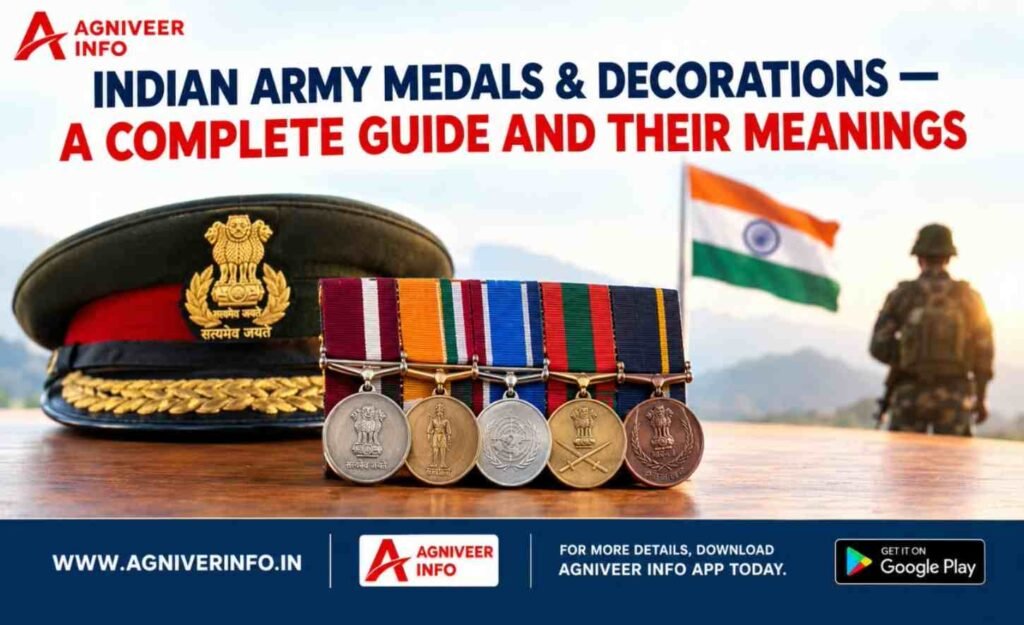
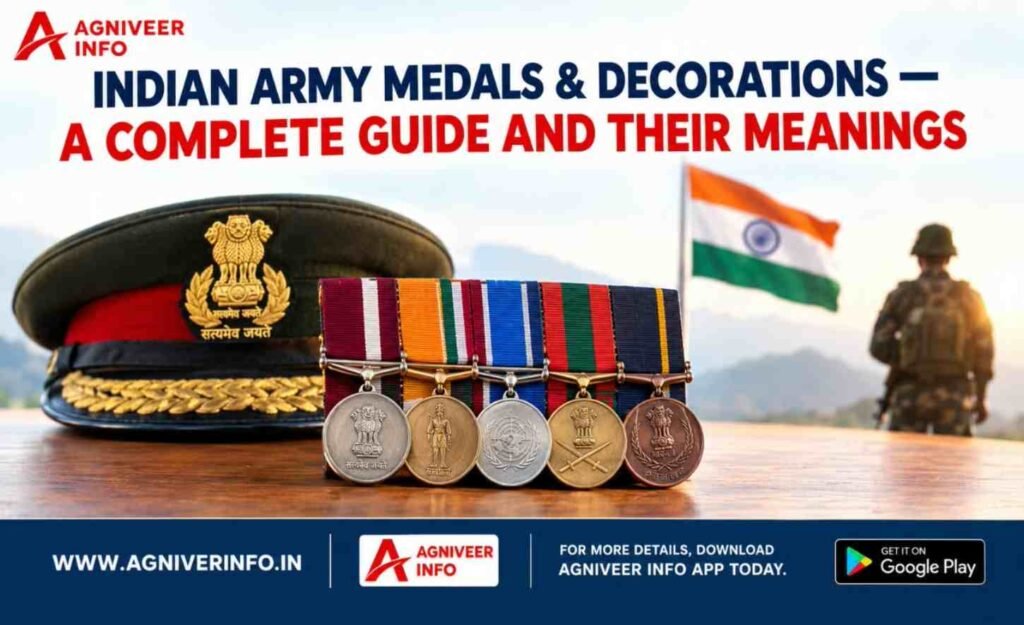
A military medal is an official metal disc or cross that is attached to a coloured cloth ribbon. It is given by the President of India to honour a soldier or a unit for a particular achievement. A military decoration is a wider term, and it includes medals, stars and special crosses that are given for exceptional personal service or courage. The government gives these items so that the nation can officially recognise and remember the extraordinary acts of its soldiers.
The words “medal” and “decoration” are often used in the same way, but there is a small difference between them. A standard medal usually celebrates a particular event, a military operation or the completion of a fixed number of years of service. A decoration usually highlights personal bravery or exceptional leadership in very stressful situations. Both kinds of recognition raise the morale of the military, keep its historic achievements alive, and inspire future generations of soldiers to serve the country with pride.
MAIN CATEGORIES OF INDIAN MILITARY AWARDS
Indian military awards are arranged in clear categories so that every kind of military contribution gets the right recognition. When you understand these categories, it becomes easy for a beginner to see why a soldier received a particular honour.
- Gallantry Awards: These honours recognise extraordinary bravery, courage and self-sacrifice during battle or during security operations in peacetime.
- Distinguished Service Awards: These decorations honour exceptional duty, outstanding leadership and high-level administrative service in peace or in war.
- Campaign and Operation Medals: These awards are given to soldiers who take an active part in particular military missions, border conflicts or relief work for people in need.
- Long Service and Commemorative Medals: These medals honour soldiers who complete long periods of honourable service, or they mark important milestones in the history of the nation.
GALLANTRY AWARDS: HONOURING EXTRAORDINARY BRAVERY
Gallantry awards stand for the highest level of human courage in the Indian Armed Forces. India divides its bravery honours into wartime awards and peacetime awards, depending on the situation in which the act took place.
Wartime Gallantry Awards
Wartime gallantry awards are given for exceptional courage that is shown directly in front of the enemy during a war or in combat operations.
- Param Vir Chakra (PVC): This is India’s highest wartime military award. It recognises the greatest acts of bravery and self-sacrifice in front of the enemy.
- Maha Vir Chakra (MVC): This is the second-highest wartime gallantry award, and it is given for very clear bravery on the battlefield.
- Vir Chakra (VrC): This is the third-highest wartime award, and it is given for acts of gallantry against enemy forces on land, in the air or at sea.
Peacetime Gallantry Awards
Peacetime gallantry awards recognise remarkable bravery that is shown away from the formal battlefield, such as in counter-terrorism missions, border security actions or the rescue of civilians.
- Ashoka Chakra: This is India’s highest peacetime gallantry award, and it is equal in honour to the Param Vir Chakra.
- Kirti Chakra: This is the second-highest peacetime bravery award, and it is given for very clear courage away from active war zones.
- Shaurya Chakra: This is the third-highest peacetime gallantry medal, and it is given for exceptional devotion and bravery during dangerous security operations.
DISTINGUISHED SERVICE AWARDS: HONOURING LEADERSHIP AND DUTY
Distinguished service awards do not need direct fighting on the battlefield. Instead, they honour military officers and soldiers who show exceptional dedication, a strong vision for strategy and high-level leadership over many years.
- Param Vishisht Seva Medal (PVSM): It honours the most exceptional service of the highest order to the nation.
- Ati Vishisht Seva Medal (AVSM): It is given for extraordinary distinguished service of an exceptional order.
- Yudh Seva Medal (YSM): It recognises distinguished service specially during war or in combat conditions.
- Vishisht Seva Medal (VSM): It is given to military personnel for distinguished service of a high order.
WAR, OPERATION AND SERVICE MEDALS
Apart from the honours for bravery and leadership, soldiers also get operation and campaign medals for serving in difficult areas or in particular military missions. For example, soldiers who are posted to the freezing heights of Kashmir may receive the Siachen Glacier Medal. In the same way, personnel who take part in major border defence operations earn particular operation medals like the Sainya Seva Medal or the High Altitude Medal. Medals are also given to mark 9, 20 or 30 years of clean service in the Armed Forces.
OVERVIEW OF MAJOR INDIAN MILITARY HONOUR CATEGORIES
| Award/Category | What It Recognises | Broad Type | Simple Meaning |
| Param Vir Chakra | Supreme bravery in wartime | Gallantry | Highest war bravery award |
| Ashoka Chakra | Supreme courage in peacetime | Gallantry | Highest peace bravery award |
| PVSM | Exceptional high-level duty | Service | Outstanding leadership award |
| Operation Medals | Participation in specific missions | Campaign | Special operational service |
HOW ARE MEDALS WORN ON THE UNIFORM?
Medals and ribbons are not put on a shirt in any random way. The Indian Army has strict official dress rules that decide their order and their line-up. Full-size metal medals are worn mainly during ceremonial parades, national celebrations and formal state dinners.
Ribbon bars are worn on the daily working uniform above the left shirt pocket. They are arranged strictly in the order of precedence, which means that the highest awards, such as the Param Vir Chakra or the Ashoka Chakra, are placed in the top left position, and after them come the other gallantry awards, the distinguished service honours and the long-service medals.
WHO CAN RECEIVE THESE AWARDS?
Who can get a military award depends fully on the rules fixed by the Ministry of Defence. Gallantry awards can be earned by all ranks, which include Officers, Junior Commissioned Officers (JCOs) and Other Ranks (Jawans). Peacetime gallantry awards like the Ashoka Chakra can even be given to civilians who show exceptional bravery during terror attacks or natural disasters. But distinguished service honours like the PVSM are generally given to senior officers who handle major command responsibilities.
MEDAL VS RIBBON VS BADGE
Beginners often mix up the basic military items that are worn on a uniform. Here is a clear breakdown:
- Medal: The real metal disc, star or cross that is given for bravery, service or campaigns.
- Ribbon: A small strip of cloth that stands for a medal, and it is worn on regular working uniforms.
- Badge/Insignia: Special symbols that are worn on the sleeves or pockets to show special qualifications (like Para Wings), trade skills or unit appointments, and they are not earned awards.
WHY MILITARY MEDALS MATTER
Military medals mean much more than polished metal or coloured cloth. They stand for deep personal sacrifice, calm bravery under fire, steady discipline and complete loyalty to the nation. When a soldier steps forward to receive a medal, it honours not only that one person, but also the shared spirit, strength and sacrifice of his whole unit and family.
COMMON MISCONCEPTIONS ABOUT MILITARY AWARDS
It is common for beginners to hold wrong beliefs about military decorations. Here are a few corrections:
- Not every medal is for bravery: Most of the medals on a uniform recognise taking part in a campaign, long service or leadership in administration.
- Medals do not decide rank: A young Captain can earn a Param Vir Chakra, while a senior General may hold only distinguished service medals.
- Badges are not medals: Qualification patches show particular skills, while medals stand for official recognition by the President of India.
- Military awards are different from civilian honours: The Bharat Ratna and the Padma awards are civilian honours, while military awards follow separate defence rules.
CONCLUSION
Indian military medals and decorations are the formal records of the nation for courage, leadership and dedicated duty. When readers can tell apart the gallantry awards, the distinguished service honours, the operation medals and the daily ribbon bars, they can better understand the achievements that are shown on an officer’s chest. Every award carries a deep personal story of sacrifice and of devotion to duty for India. If we understand these symbols, we can better honour the men and women who serve in the Indian Armed Forces.
Get the latest Agniveer updates by joining our WhatsApp channel
FREQUENTLY ASKED QUESTIONS
Q1. What is the highest gallantry award in India?
A1. The Param Vir Chakra is India’s highest wartime gallantry award. It is given for the greatest bravery and self-sacrifice in front of the enemy.
Q2. What is the difference between a medal and a decoration?
A2. A medal is usually a metal disc that is given for service or operations. A decoration is a wider group that includes the bravery crosses and stars that are given for personal gallantry.
Q3. What is Param Vir Chakra awarded for?
A3. It is given for the most clear bravery, a daring act or an act of the highest valour and self-sacrifice in the face of the enemy during war.
Q4. What are Maha Vir Chakra and Vir Chakra?
A4. They are the second-highest and the third-highest wartime bravery awards in India. They honour outstanding courage against enemy forces on land, at sea or in the air.
Q5. What is the difference between gallantry and service medals?
A5. Gallantry medals recognise single acts of bravery in dangerous conditions. Service medals recognise long service, leadership, duty in operations or achievements in administration.
Q6. What is the difference between a medal and a ribbon?
A6. A medal is the full metal award that is worn during formal ceremonies. A ribbon is a small coloured bar of cloth that is worn on daily uniforms to stand for that medal.
Q7. Who can receive Indian military medals?
A7. Depending on the award, officers, Junior Commissioned Officers, Jawans and personnel of the Army, the Navy and the Air Force can receive these medals.
Q8. How are medals and ribbons displayed on Army uniforms?
A8. They are worn above the left chest pocket. They follow a strict order of precedence, and the highest bravery awards are placed in the top position.
READ ALSO: FLAT FOOT AND AGNIVEER SELECTION — THE DEFINITIVE GUIDE