Source: Official sites: Join Indian Army | Join Indian Navy | Indian Air Force
Getting ready for the Agniveer recruitment needs hard physical training, study for the exams, and a good understanding of how the whole selection works. One of the last stages of this selection is the official medical examination.
Doing a pre-medical self-check lets candidates look at their general health, arrange their health papers, and deal with any small health worries well before they meet the official military medical board. This self-check is only a tool to help you prepare, and it is meant to build awareness and stop delays that come from small hygiene or paperwork problems that could easily be avoided. It is not a formal diagnosis, and it cannot certify that you are medically fit.
The final decision about a candidate’s fitness rests only with the authorised Armed Forces medical officers, who carry out the exam according to the official service standards. The medical rules can be different for the Indian Army, the Indian Navy, and the Indian Air Force, because each one has a different kind of work and different trades.
So candidates should depend only on the latest official recruitment notifications, and not on charts found online, advice from coaching centres, or rumours on the internet. This guide explains how candidates can do a practical and sensible self-check, so that they are well prepared for the official Agniveer medical test.
What Is a Pre-Medical Self-Checklist?
A pre-medical self-check is a step-by-step personal review that a candidate does before going for the official military medical examination. It means looking at your basic body measurements, going through your medical history, checking your general personal hygiene, and gathering the health papers that you may need.
This process is very different from an official military medical board. A self-check has no power to give a diagnosis, and it cannot tell you what the official result will be. It works only as a way of learning about yourself, so that you understand the general health rules and, if needed, get proper advice from a civilian doctor.
Why Should Agniveer Candidates Do a Pre-Medical Check?
Doing a personal review gives candidates an early idea of any physical or hygiene problem that can be fixed beforehand. Simple things, like too much earwax or a little plaque on the teeth, can be taken care of by visiting a qualified doctor before the exam.
Arranging your medical papers in advance stops last-minute worry. A proper self-check helps candidates go through the recruitment process with a clear mind, instead of depending on wrong or misleading claims about military medical standards that you find online.
General Health Self-Check
Candidates should pay attention to their overall daily health, their energy levels, and their physical stamina. Watching out for a cough that does not go away, digestive problems that keep coming back, unusual tiredness, or physical discomfort that you cannot explain can point to areas that need a regular medical check-up.
It is very important to be honest about any past hospital stays, long-term conditions, or ongoing treatment. Candidates should never try to guess a complex condition on their own or take supplements that are not prescribed, just to change their basic body readings.
Height, Weight and Body Measurements
Basic body measurements are a part of the first check. Candidates can measure their own height and weight at home or at a local clinic, to know their own starting point.
The official rules for height, weight, and chest expansion are quite different depending on the service, the trade, the age, and the regional recruitment rules, so candidates should look at the current official notification charts and not at general tables found online. Unsafe habits such as extreme fasting, severe dehydration (not drinking enough water), or a sudden crash diet to change your weight are dangerous, and they are strongly advised against.
Eyesight and Vision Self-Check
Candidates can think about whether they see things blurred, feel strain in their eyes, or find it hard to read signs that are far away. Those who already wear glasses or lenses should keep their prescription papers updated and organised.
Online vision tests or phone apps cannot copy the official eye check-up done in a clinic. If candidates feel that their vision has changed, they should see a registered optometrist or an eye doctor for a proper check-up. Glasses or other vision corrections are judged strictly according to the rules for each trade that are given in the official recruitment notifications.
Colour Vision Self-Check
Being able to tell colours apart is important for safety and for special duties in the defence services. Candidates can notice, in their daily life, how well they can tell shades apart, but online colour vision tests are not the same as an official check-up.
The formal check-up uses standard clinical tools that are used by military medical officers. The final grading of colour vision depends completely on the trade requirements that each service branch sets.
Hearing and ENT Self-Check
Candidates should watch out for signs of trouble hearing, discharge from the ear that keeps happening, a ringing sound in the ear that does not go away, or long-lasting sinus problems. Any past ear, nose or throat surgery or ear condition should be backed up with clear medical papers.
Tests done at home or through mobile apps cannot decide whether you are fit for military service as far as hearing is concerned. Candidates should never put cotton buds or sharp objects into the ear canal, and if there is wax build-up, they should get it cleaned by a trained professional.
Dental Self-Check
Keeping good oral hygiene is a simple part of getting ready for the medical exam. Candidates should look for cavities they can see, gums that bleed, a lot of tartar (hard plaque), or broken teeth.
Getting dental problems fixed through proper cleaning or the needed treatment at a registered dental clinic keeps your mouth in the best health. General rules about the number of teeth needed, or claims of automatic rejection found online, are often wrong, so candidates should check the official guidelines for the exact rules of their trade.
Physical and Musculoskeletal Self-Check
Candidates can watch their own posture, how well their joints move, and how smoothly they move during their daily exercise. Noticing joint pain that does not go away, swelling, or discomfort in the body’s structure after physical activity is important for your overall physical condition.
Small differences in body structure, or old injuries that have fully healed, do not automatically mean that you are unfit. Candidates should never do risky movements just to “test” their joints, and they should not depend on diagnoses found online that are not checked.
Skin, Scars, Tattoos and Visible Abnormalities
Looking after your skin means noticing rashes that keep coming back, active infections, or big surgical scars. Surgical scars are judged based on how well they have healed, how they affect the body’s working, and the medical history behind them.
The rules on tattoos are different for each service branch, for each category of candidate, and for the part of the body where the tattoo is. Candidates should read the current official Agniveer recruitment notification carefully to see the allowed size and place for tattoos, and not assume that a general rule applies to everyone.
Medical History and Previous Surgery Checklist
It is very important to arrange genuine papers of any past surgery, broken bones, hospital stays, or long medical treatment. Clear medical documents help the military medical board understand the full history of how you have healed.
Hiding your medical history is wrong and works against you. A past surgery or injury does not automatically mean you will be rejected; the official decision depends on whether you have fully recovered, how your body works now, and the medical standards of the service.
Documents to Keep Ready Before Medical Examination
- The official recruitment admit card and call-up letters.
- A valid government photo ID.
- Original medical papers about any past surgery or hospital stay.
- Genuine prescriptions for any medicine you are currently taking legally.
- Recent eye or dental check-up reports, if you have any.
What Candidates Should NOT Do Before the Medical Exam
- Do not go on an extreme diet, starve yourself, or follow an unsafe weight-loss plan.
- Do not try to dehydrate yourself on purpose to change your weight or body measurements.
- Do not take medicines that are not prescribed, or any chemicals, to change your test results.
- Do not show fake medical certificates or health documents that have been changed.
- Do not hide any past surgery, long-term illness, or major medical treatment.
- Do not try to memorise the vision chart or tamper with the clinical testing equipment.
- Do not depend on advice from unauthorised agents, internet forums, or social media.
Army, Navy and Air Force — Why the Checklist Can Differ
Indian Army
Army Agniveer candidates are checked against the needs of work on land. Physical stamina, the strength of the bones and joints, and the physical standards for each trade form the main part of the Army medical check-up.
Indian Navy
Navy Agniveer medical check-ups take into account life and work on a ship and conditions at sea. The standards for vision, ear-nose-throat health, and overall physical stamina match the needs of naval service.
Indian Air Force
Air Force Agniveervayu candidates go through a medical check-up made for the conditions of flying and aviation work. Eyesight, colour vision, and certain body standards are matched to the roles of the Air Force.
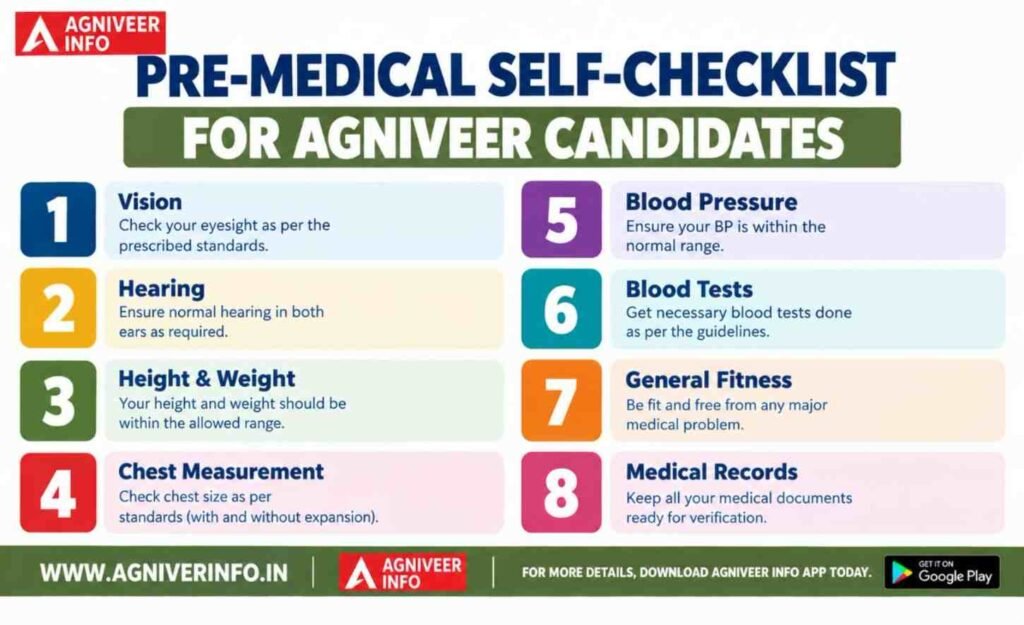
What If Your Self-Check Shows a Possible Problem?
Finding a possible health worry during your self-check should not make you panic. Candidates should not try to diagnose themselves, and they should not assume right away that they will be rejected.
The right thing to do is to see a qualified civilian doctor for a proper, honest check-up. Keep all your real clinical reports organised, and show them openly during the official examination. A private doctor’s opinion gives you medical clarity, but it cannot change the final decision of the official military medical board.
| Self-Check Area | What Candidate Can Review | What Requires Professional Assessment | Important Note |
| Vision | General clarity, daily eye strain, current use of lenses. | Exact visual sharpness, refraction, health of the cornea. | Official vision standards depend strictly on the trade notifications. |
| Hearing/ENT | Wax build-up, history of discharge, basic hearing. | Audiometry, tympanometry, check-up of the inner ear structure. | Avoid cleaning your own ear canal with tools that are not sterile. |
| Dental Health | Oral hygiene, cavities you can see, tartar, swollen gums. | Filling of cavities, professional cleaning, checking the alignment of teeth. | Clean oral hygiene stops temporary delays during the exam. |
| Medical History | Past surgery, hospital records, ongoing treatment. | Checking how well the surgery healed and how the body works now. | Honest disclosure, backed by real medical papers, is compulsory. |
Conclusion
A pre-medical self-check is a practical way for Agniveer candidates to look at their general health, deal with basic hygiene needs, and arrange their medical papers. It gives you a better understanding of yourself, but it never takes the place of the formal military medical examination.
Since the standards are different for the Army, the Navy, and the Air Force, candidates should always look at the official recruitment notifications. Keeping honest medical papers and staying away from unsafe shortcuts makes sure that you approach the recruitment process in a smooth and responsible way.
Get the latest Agniveer updates by joining our WhatsApp channel
Frequently Asked Questions
Q1. What is a pre-medical self-check for Agniveer candidates?
A1. It is a first personal review of general health, personal hygiene, and medical papers that candidates do before going for the official military examination.
Q2. Can candidates check their eyesight before the medical exam?
A2. Candidates can notice if their eyes feel strained, but a proper check of visual sharpness and refraction needs to be done by a qualified optometrist or an eye doctor.
Q3. Can an online colour vision test confirm military fitness?
A3. No, online tests are not checked and cannot be trusted. The official grading of colour vision is done only by authorised military medical officers, using standard clinical testing charts.
Q4. Should candidates check their dental health beforehand?
A4. Yes, looking after your oral hygiene and visiting a dentist for routine cleaning or treatment of cavities helps deal with dental problems that could otherwise cause trouble before the medical exam.
Q5. Should previous medical records be carried to the examination?
A5. Yes, candidates should carry genuine papers of any past surgery or major treatment, to give the medical board clear proof that they have fully recovered.
Q6. Can a private doctor guarantee Agniveer medical fitness?
A6. No, a private doctor can give you clinical advice, but the final power to declare medical fitness rests only with the official military medical board.
Q7. What should candidates do if they find a possible health problem?
A7. Candidates should see a registered medical specialist for a proper check-up, keep their genuine medical reports ready, and show them during the official medical screening.
Q8. Are Army, Navy and Air Force medical standards identical?
A8. No, the medical standards are different for each service branch and each trade, because of their different roles, working conditions, and the official notifications of each branch.
REAS ALSO: REVIEW MEDICAL BOARD (RMB) — COMPLETE APPEAL PROCESS GUIDE