To get ready for the physical tests of the defence forces, you need discipline, steady progress and enough time to recover.
A plan of 60 days gives you a practical way to build your stamina, improve the way you run and grow your bodyweight strength, without suddenly injuring the soft parts of your body such as muscles, tendons and ligaments. Short, last-minute training often leaves people with very sore muscles and tired joints, but an organised plan lets your body adjust naturally over two full months.
When you begin at the fitness level you really have, your performance improves steadily, and the risk of overtraining, which means doing more than your body can handle, goes down a great deal.
Physical preparation should never mean giving your maximum effort every single day. Hard, high-impact strain every day spoils the way you move and raises the risk of stress fractures, which are small cracks in the bone from too much strain.
Fitness that lasts depends on proper sleep, regular drinking of water, balanced food every day and planned rest days. The physical rules are also not the same in the Indian Army, the Indian Navy and the Indian Air Force, so you must check the current official recruitment notice for your own service, trade and gender, and not assume that one test standard fits everyone.
This general guide explains a planned way of building basic stamina, strength for everyday movements, speed and recovery over eight weeks.
Why Choose a 60-Day Agniveer Training Plan?
A period of 60 days gives you enough time to help your heart and lungs, your tendons (the cords that join muscle to bone) and your muscle stamina get used to the work step by step. Crash training over a short time often leads to shin splints,
which are painful strain along the front of the lower leg, and to tendonitis, which is swelling of a tendon, and also to physical burnout. Eight weeks, on the other hand, allows you to raise the amount and the effort of your training slowly, and then lower it a little so that your body can recover fully.
When you divide the 60 days into training blocks, there is a clear difference between simply testing how much you can do and truly building the fitness you need for duty. If you watch your progress week after week, you do not train at random, and you get steady improvement and balanced fitness.
Before Starting: Assess Your Current Fitness
A realistic starting point keeps you from getting hurt early in training. Begin by checking your stamina, your bodyweight strength, any stiffness or limits in your movement and how active you have been recently. Run a comfortable distance and time it, so that you know your current pace, and watch how your body reacts without pushing yourself until you are completely exhausted.
Check how many push-ups and squats you can do and how strong your core is, but do them with control and not in a fast, careless way. A beginner needs less running each week and longer rest between sessions, while a candidate who is already active can safely handle more training.
60-Day Training Structure
Days 1–15: Foundation Phase
Put all your attention on getting your heart and lungs used to the work, on your running style, on light bodyweight exercises and on loosening your joints. Build regular habits of sleeping and drinking water, and give your tendons time to get used to the regular impact of the ground.
Days 16–30: Development Phase
Slowly increase the distance you run at an easy pace and add tempo running, which is running at a steady, moderate effort. Do more repetitions of your strength exercises every day, give extra attention to a steady core, and keep to your routine strictly without adding all-out sprints.
Days 31–45: Performance Phase
Add interval work, which means faster running in short bursts, and practise controlling your pace. Focus on bodyweight stamina that fits your service, so that your muscles can keep working and you become more efficient even when you are a little tired.
Days 46–55: Test-Specific Phase
Do full practice sessions that copy the movements the test will ask for, and keep them controlled. Work on running at the right pace, keep up your strength stamina and make sure you know well the basic movements that the tests demand.
Days 56–60: Taper and Final Preparation
A taper means cutting down your training before the test, so lower the total amount of work by a good margin while keeping your movements correct. Put rest first, drink enough water, eat balanced meals and do light exercises that keep the joints moving, so that any leftover tiredness in your muscles goes away.
60-Day Running Training Plan
A good Agniveer running plan gives more importance to building stamina than to sprinting every day. The amount you run each week should grow in a planned way, and it should include easy runs at a pace where you could talk, recovery sessions and planned practice of your pace. Beginners should feel free to add short walking breaks, because these help them build the distance they can handle safely.
Keep the hard interval training under control and limit it to certain days only. Running rules are not the same in every service, so you should aim to build a reliable pace and an efficient running style and not chase random speed targets when your legs are already tired.
Strength Training for Agniveer Preparation
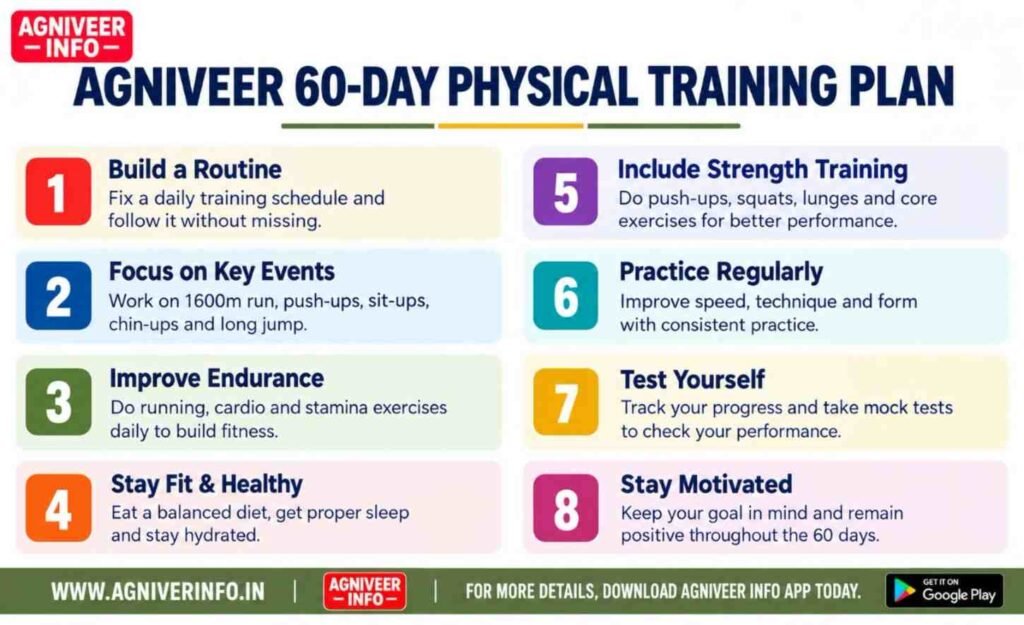
Strength in everyday bodyweight movements is important if you want to get through the physical fitness tests smoothly. Your daily exercises should include push-ups, bodyweight squats, lunges, different kinds of planks, calf raises and pull-ups where they are needed. Always give more importance to keeping your joints in the right position and controlling the whole movement than to a high number of repetitions.
Raise the load slowly by adding a few more repetitions or by controlling your speed better. Enough rest between strength workouts gives your muscles time to repair, which makes your body stronger and protects your shoulders and core from getting overtired.
Mobility, Warm-Up and Recovery
Every workout should start with a warm-up that keeps you moving, so that your muscles and joints are ready for the strain. After the workout, holding stretches still for a while, which is called static stretching, helps to keep your muscles flexible and your joints healthy. Drinking enough water and eating balanced food every day give your body the energy it needs to perform.
Never use dangerous methods such as keeping yourself short of water, eating far too little or taking supplements that nobody has checked. When you rest fully on the days meant for recovery, your body tissue gets time to adjust, and this lowers the chance of injury by a large amount.
Army, Navy and Air Force Preparation Differences
Army
Army preparation usually puts great weight on stamina, on an efficient running style and on the ability to do pull-ups for the recruitment rally, so candidates should work hard on the stamina of the legs and the strength of the core.
Navy
Navy Agniveer preparation is centred on meeting the official rules for squats, push-ups and running, and candidates should make sure that their stamina and bodyweight fitness are balanced and match the current official instructions.
Air Force
Agniveervayu candidates, who are the Air Force Agniveers, must match their workouts to the current Air Force fitness test standards, balancing their timed running with steady performance in push-ups, sit-ups and squats.
Weekly Training Pattern During the 60 Days
A balanced week mixes running, bodyweight exercises and rest. Two to three days are for running to build stamina, two days are for bodyweight strength and a steady core, one day includes controlled interval work, and one or two days are kept fully for rest and light movement of the joints.
| Training Phase | Running Focus | Strength Focus | Recovery Focus |
| Days 1–15 | Continuous runs to build stamina | Basic control of bodyweight | Movement work to loosen the joints |
| Days 16–30 | Longer distance and tempo runs | Sets with more repetitions | Active recovery |
| Days 31–45 | Interval runs at a controlled pace | Circuits that build strength and stamina | Sleep and drinking water |
| Days 46–60 | Cutting down and easy runs | Light, good-quality repetitions | Full rest |
Common Mistakes in a 60-Day Training Plan
- Increasing the distance you run each week too fast: This causes bad shin splints and puts needless strain on your joints.
- Doing all-out sprint workouts every day: This leads straight to early tiredness and injury.
- Skipping strength exercises: This limits the strength of your upper body and your overall toughness.
- Ignoring rest days: This stops your body tissue from adjusting and lowers your performance over a long time.
- Using bad form in push-ups or squats: This builds bad habits and makes your repetitions invalid.
- Following old blogs or social media posts that nobody has checked: This gives you wrong ideas about how to train.
How to Track Progress Over 60 Days
You can judge your training by watching for three signs, which are that your effort feels lighter when you are at rest, that you keep your pace under control and that your breathing settles faster after a workout. When the number of strict bodyweight repetitions you can do keeps rising, it shows that your muscles have more stamina and that your body can do more.
Keeping track of your performance week after week gives you useful feedback on how well you move and how much stamina you have. But remember that progress in training is your own improvement, and it does not guarantee that you will pass the official recruitment test.
Final 5 Days Before the Physical Test
In the last five days, cut down the amount of training by a great deal. Do not start any hard new exercise routines, and keep to light exercises that keep the joints moving, good food and good sleep every night. Keep drinking water regularly, and check well in advance that you have all the official documents, rally papers and reporting details you need.
Conclusion
A 60-day training plan gives you a balanced way to build your running stamina, your bodyweight strength and the free movement of your joints, step by step. When you mix a growing running load with controlled strength training and enough rest, you build real toughness for sport.
If you adjust the amount of work to the fitness you start with and respect the tapering period at the end, you will have your best energy on the day of the test. Always confirm the official standards for your service from the main defence sources, because general training guides can give you a plan for your fitness but cannot guarantee that you will be selected.
Get the latest Agniveer updates by joining our WhatsApp channel
Frequently Asked Questions
Q1. Is 60 days enough to prepare for the Agniveer physical test?
Sixty days is enough time for candidates with a basic level of fitness to build stamina, gain strength for everyday movements and improve their running safely.
Q2. How should beginners start the 60-day training plan?
Beginners should first find their fitness level by running slowly and continuously, walking in between, doing light bodyweight exercises, warming up with movement and taking enough rest between workouts.
Q3. How often should Agniveer candidates run during preparation?
Candidates should run three to four days a week, mixing easy runs that build stamina with controlled practice of pace, and leaving rest days so that the soft parts of the body can recover.
Q4. Should strength training be included in the 60-day plan?
Yes, bodyweight exercises such as push-ups, squats, pull-ups and core work should be done two to three times a week to support your overall fitness.
Q5. Are Army, Navy and Air Force training requirements identical?
No, the physical standards, the parts of the test and the mix of exercises are different for each service, trade and gender, so candidates must check the official rules of their service before planning their preparation.
Q6. How important are rest and recovery during preparation?
Rest and recovery are very important, because they help muscles repair, prevent injuries from overuse such as shin splints, keep the body’s hormone system healthy and let the body adjust over a long time.
Q7. Should candidates train hard during the final days?
No, candidates should cut down their training in the last five days and focus on light movement, enough sleep, proper drinking of water and rest for tired muscles.
Q8. Can this 60-day plan guarantee Agniveer physical-test qualification?
No training plan can guarantee that you will qualify, because success depends on the fitness you start with, how strictly you follow the plan, the official test rules, the weather and your own effort.