

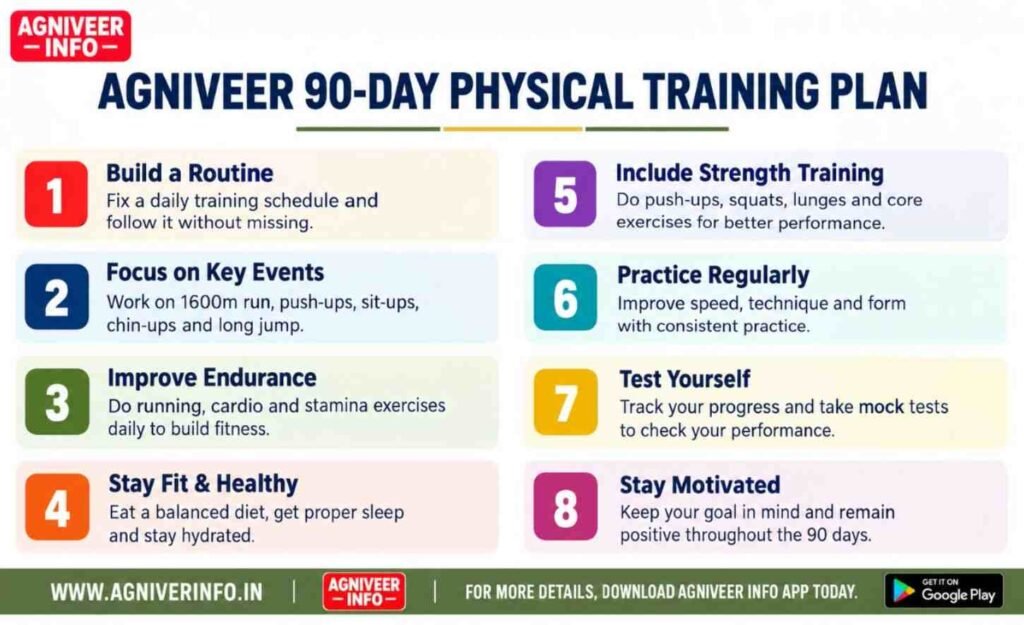
If you want to join the Indian Armed Forces through the Agniveer scheme, you need a very fit body, a strong mind and a lot of discipline.
A planned period of preparation gives you enough time to build real physical strength without overtraining, which means doing more than your body can handle, and without injuries that come from doing the same strain again and again. When people try to squeeze all their preparation into a few panicked weeks,
they often end up with shin splints, which are painful strain along the front of the lower leg, along with pulled muscles and early tiredness. A longer preparation period that is divided into steps works better, because it lets your body get used to heavier work bit by bit. With this kind of training, you slowly improve your stamina, your strength for everyday movements, your running speed and your body’s ability to recover.
It is important that you begin at the fitness level you actually have. Beginners should not start by copying the heavy training of experienced athletes, because muscles and joints that are not yet conditioned need time to get used to the shock of each step. Good rest, regular sleep, enough water and balanced food are the base of all improvement, and none of them can be skipped.
The physical test rules are also not the same in the Indian Army, the Indian Navy and the Indian Air Force, so every candidate must carefully check the latest official recruitment notice for their own service, trade and category. This complete Agniveer 90-Day Physical Training Plan gives you a realistic, safe and step-by-step way to get your body ready.
Why Follow a 90-Day Agniveer Training Plan?
A 90-day plan helps you move step by step from basic fitness to being fully ready for duty. Because the work is spread over a longer time, there is less sudden strain on your joints, tendons (the cords that join muscle to bone) and heart and lungs. Building fitness that lasts is very different from just testing your limits, since giving your maximum effort every day brings smaller and smaller gains and makes injury more likely.
A 90-day plan also has rest days built into it, which means your body gets time to repair itself and build more stamina. Candidates who write down their workouts, watch their progress and change the amount of training when needed stay more regular all the way through. Planned preparation also builds the mental toughness and the sense of pace that you need at the real recruitment rally. Regular training improves your fitness a great deal, but you should remember that fitness is only one part of the selection process, and it does not promise that you will be selected.
Assess Your Fitness Before Day 1
Before you start any routine, find out your starting level in a safe way. A casual, comfortable run shows how ready your heart and lungs are, and you should not push yourself to complete exhaustion while doing it. Count the most push-ups and squats you can do with control, and check how steady your core is, and you will see how much strength you have now. Notice too how freely your hips, ankles and shoulders move, because any stiffness you find is something that needs attention.
Your first workload should match your own history. Beginners need to begin with less work and progress more slowly than candidates who are already active or who have run before. Giving your maximum effort on the first day raises the chance of injury and tells you very little. When you write down your starting numbers, you can plan the right starting point for yourself and make safe, steady progress over the full 90 days.
90-Day Training Structure
Days 1–21: Foundation Phase
In this first block, you build your basic stamina, learn the right running style and get the technique of bodyweight exercises correct. You keep the amount of work modest so that your joints can adjust, and you settle into a routine of daily loosening exercises and proper sleep.
Days 22–45: Development Phase
Now you slowly add more work as your stamina gets stronger. The workouts bring in short, controlled stretches of faster running along with harder strength exercises, and you learn to keep a steady pace, to build the stamina of your muscles and to handle more work without losing your form.
Days 46–70: Performance Phase
The focus now moves to fitness that is close to what the test needs. This means interval training, which is faster running in short bursts with rests in between, tempo runs, which are runs at a steady, hard effort, and strength circuits with less rest. You improve your control of pace, you build mental toughness when you are tired and you increase your ability to keep up speed for longer.
Days 71–84: Test-Specific Phase
Your training now copies what the official fitness test asks for, through controlled practice tests and sessions at your target pace. You find the weak points that are left, practise the movements needed for your own service and learn to manage your effort.
Days 85–90: Taper and Final Preparation
A taper means cutting down your training before the test, so the total amount of work drops a great deal while your movements stay of high quality. Short, sharp and light sessions keep your muscles active while your body recovers fully, so that you have your best energy on the day of the test.
90-Day Running Training Plan
To run really well, you need to mix runs of different effort and not sprint every day. In the early part of your preparation, the main work is easy long runs at a pace where you could still talk, and these make your heart stronger and increase the tiny blood vessels that carry blood to your muscles. Every week should also include easy recovery runs or active walking, which keep your blood flowing without adding more strain to your body.
As your fitness grows, you move on to interval sessions and controlled tempo runs, which build your ability to keep up speed and to use oxygen well. Increase the total distance you run each week very carefully, and only in small steps. There is no single target that fits every candidate, because the official requirements depend on the service, the trade and the category, so you should plan your running to match the distance and the time given in your own official notice.
Strength Training for Agniveer Preparation
Exercises that use your own body weight are the main base of Agniveer physical preparation. The key exercises are push-ups for the pushing strength of your upper body, bodyweight squats and lunges for the driving power of your legs, pull-ups for the pulling power of your upper body and core exercises to keep your middle body strong and steady. Exercises for the calves and the lower legs strengthen the muscles that take in the shock of running.
Doing fewer repetitions with strict form gives you far more benefit than rushing through a high count with poor movement. You can make your strength workouts harder by slowly adding repetitions, by shortening the rest between sets or by using tougher versions of the exercises. Enough rest for your muscles between hard strength sessions prevents long-lasting strain, so that your power stays steady through the whole training period.
Speed, Endurance and Stamina Development
To perform at your best, it helps to know that your body uses different kinds of energy. Aerobic endurance, which is stamina that uses oxygen, works like an engine for long activity, while running speed depends on the fast-acting muscle fibres and on how well your nerves and muscles work together. Speed endurance lets you keep a fast pace even when lactic acid, a substance that builds up in tired muscles, starts to collect, and muscular endurance lets your muscles repeat a movement again and again without giving way.
The Agniveer 90-Day Workout Plan builds all these qualities step by step by giving your body different kinds of work. If you try all-out sprints every day, your nervous system gets tired quickly and you are more likely to strain your hamstrings, which are the muscles at the back of your thighs, or your groin. It is better to rotate easy base runs, planned intervals, bodyweight circuits and rest days, because this builds balanced stamina in a safe and effective way.
Mobility, Warm-Up and Recovery
To prevent injury, you need a proper warm-up with movement before every session. Movements such as leg swings, lunges with a twist and arm circles raise your body temperature and get your joints ready for hard effort. After the workout, a cool-down with light jogging and holding stretches still for a while, which is called static stretching, helps your muscles return to their normal length and helps clear waste from them faster.
Sleep, water and food are three big parts of recovery. Keep a regular sleep routine, eat balanced meals with enough protein and whole, unrefined carbohydrates, and keep drinking water through the day. Dangerous habits such as keeping yourself very short of water, crash dieting, taking drugs that boost performance or training through sharp joint pain ruin your health and work against you. If you have pain that does not go away, you should get advice from a qualified doctor.
Army, Navy and Air Force Preparation Differences
Army
In Army recruitment, candidates are tested on hard running courses, pull-ups, ditch jumps and balance obstacles. So your preparation should stress running stamina, pulling strength in the upper body and the ability to change direction quickly under tough conditions.
Navy
The Navy Agniveer physical tests check overall fitness and usually include timed runs, bodyweight squats and push-ups. Navy candidates should work on balanced muscle stamina, a steady running pace and smooth, continuous movement with strict form.
Air Force
Agniveervayu candidates, who are the Air Force Agniveers, take physical fitness tests that stress running along with set targets for push-ups, sit-ups and squats within fixed times. Their preparation should put the most weight on clean technique, control of the core and running efficiently at the target pace.
How to Structure a Typical Training Week
A balanced week spreads the training strain sensibly across six days and keeps one whole day for complete rest. Early in the week, you can pair an easy stamina run with core work and loosening exercises for the lower body. In the middle of the week, you can do bodyweight strength circuits, followed by controlled interval running or pace work.
Later in the week, the workouts go back to easy recovery runs, strength sessions for the upper body and loosening drills. A longer, steady cardio session on Saturday builds both mental and physical stamina, while Sunday is kept fully for rest, drinking water and eating well to refill your energy. This balanced rhythm keeps your tiredness manageable and slowly raises what your body can do.
| Training Phase | Running Focus | Strength Focus | Recovery Focus |
| Days 1–21 | Building an easy stamina base with light runs at a talking pace. | Learning correct form, and squats, push-ups and core control. | Setting up an 8-hour sleep routine and daily loosening movements. |
| Days 22–45 | Slowly adding distance and controlled tempo efforts. | More repetitions and pulling strength for the upper body. | Active recovery, planned drinking of water and food after workouts. |
| Days 46–70 | Planned interval training and practice at target pace. | Bodyweight circuits with less rest, and core stability when tired. | Targeted muscle release, contrast showers and strict rest days. |
| Days 71–90 | Test practice runs, lower volume and light speed drills. | Keeping good form, low-volume sets and joint readiness. | Mental relaxation, rest for the joints and food before the test. |
How to Track Progress During 90 Days
If you watch realistic signs, you can check that your fitness is truly improving. A lower heart rate during easy runs, or faster times over set distances, is clear proof that your stamina is growing. Better control of movement and more completed repetitions in push-up or squat workouts show that you are getting stronger.
If you recover faster after workouts and feel less sore, it shows that your whole body is in better condition. Still, you must remember that your own progress does not automatically mean that you will pass the official test, because the conditions of recruitment, the weather and the official marking rules decide the final result.
Common Mistakes During 90-Day Preparation
- Increasing training volume too quickly: Sudden jumps in distance cause shin splints, tendonitis, which is swelling of a tendon, and stress fractures, which are small cracks in a bone, and these can stop your progress completely.
- Running hard every single day: Maximum effort every day tires out your nervous system, raises the risk of injury and lowers your running speed.
- Ignoring bodyweight strength work: If you only run, you neglect the strength of your upper body and core, which is needed for complete military fitness.
- Neglecting rest and sleep: Without enough recovery, your muscles cannot repair, which leads to long-lasting overtraining and a big drop in performance.
- Copying advanced training programs: Workouts made for top athletes put too much strain on developing candidates and make them burn out early.
- Practising outdated physical standards: If you depend on information from other sources that nobody has checked, you may train for the wrong distances or exercise targets.
Final 7 Days Before the Physical Test
In the last week before the test, the whole focus is on cutting down your training and saving your energy. You should reduce the amount of work a great deal while keeping your movements light, sharp and quick. If you do heavy workouts or try to gain fitness at the last minute in this period, your muscles stay tired and you will perform worse on the day.
Put your attention on good sleep, drinking enough water and eating familiar meals that are full of nutrition. Get your official papers ready, confirm the official reporting instructions and keep comfortable sports gear ready in advance. When you reach the test ground rested, well hydrated and mentally focused, your 90 days of hard preparation can turn into your best performance.
Conclusion
A planned 90-day training programme gives Agniveer candidates a good length of time to build overall fitness safely. When you build your stamina, running speed and bodyweight strength step by step, together with active recovery, you gain real physical ability without injuries from overuse.
Rest and a taper in the last week make sure that your muscles are fully restored and ready to give their best on the day of the test. You should keep checking the official recruitment notices so that your preparation matches the exact rules of your service, and you should remember that steady preparation improves your fitness but does not guarantee final selection.
Get the latest Agniveer updates by joining our WhatsApp channel
Frequently Asked Questions
Q1. Is 90 days enough to prepare for the Agniveer physical test?
A1. Yes, 90 days gives you enough time to build stamina, bodyweight strength and speed step by step, as long as you train regularly and recover properly all through.
Q2. How should beginners start a 90-day Agniveer training plan?
Beginners should first find their starting fitness level, work on correct movement, run at an easy pace where they can talk and raise the amount of work slowly so that they avoid injuries.
Q3. How many days per week should candidates run?
Candidates usually gain the most from running three to four days a week, mixing easy base runs, interval sessions and rest days so that the body recovers well.
Q4. Should strength training be included throughout the 90 days?
Yes, bodyweight strength work such as push-ups, squats, pull-ups and core exercises should be part of every week so that you build complete ability and a strong body.
Q5. Are Army, Navy and Air Force physical requirements identical?
No, the fitness standards, the test events, the way marks are given and the time limits are different for each service and trade, so candidates must check the official notice of their own branch.
Q6. How important are rest and recovery during 90-day preparation
They are very important, because muscles repair and fitness grows during rest, and enough rest also prevents long-lasting overtraining, tiredness and injuries.
7. What should candidates do during the final week?
Candidates should cut down their training, do only light movement, sleep deeply, keep drinking water, eat familiar and nourishing food and get their official papers ready.
8. Can this 90-day plan guarantee physical-test qualification?
No, this plan is only a general guide to physical preparation, and it cannot promise that you will pass the official recruitment tests or be selected in the end.
READ ALSO: NAVY AGNIVEER SALARY — COMPLETE BREAKDOWN