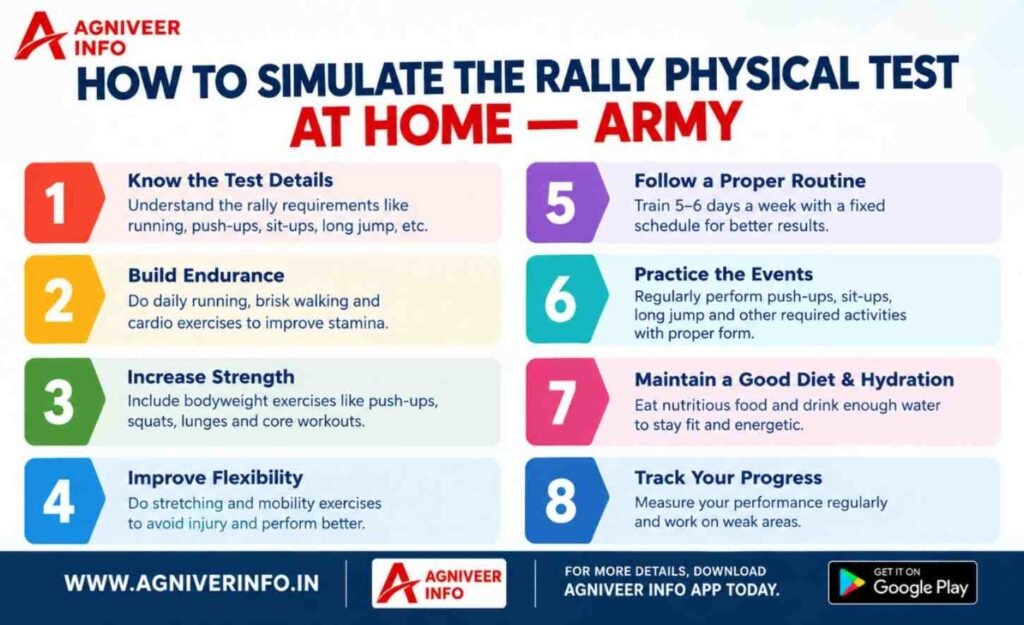
HOW TO SIMULATE THE RALLY PHYSICAL TEST AT HOME — ARMY
Source: Indian Army Official Website
Last updated: 18 November 2026
In this guide on rally physical test at home, you will learn about understand the actual Army physical test first, how to simulate pull-up and upper-body demands and how to simulate test-day fatigue safely. Preparing for an Indian Army recruitment rally requires rigorous physical preparation, yet thousands of aspirants face a common challenge: limited access to official grounds, specialized obstacle tracks, or local coaching academies. Many candidates must begin their physical conditioning from home, utilizing local roads, open spaces, and minimal equipment. While a home environment can never fully recreate the specific pressure, crowd dynamics, or exact environmental factors of an official recruitment rally, candidates can systematically develop the physical capacities required to pass the selection process.
Home training must be approached with a strategic mindset. Attempting to build crude, dangerous physical obstacles using household items often leads to serious injuries that can permanently derail a candidate’s military aspirations. Instead, effective home preparation focuses on targeting the foundational physical qualities—cardiovascular endurance, muscular stamina, leg power, grip strength, and core stability—that the official recruitment test evaluates.
By understanding how to simulate these physiological demands safely, candidates can build an exceptionally strong athletic foundation. This comprehensive rally physical test at home guide outlines how to structure home conditioning intelligently, safely develop event-specific physical capacities, monitor progress, and transition effectively to real-world testing environments while strictly adhering to safety standards.
Rally Physical Test at Home: Can You Really Simulate the Army Rally at Home?
A direct evaluation of home preparation requires distinguishing between physical conditioning and exact event replication. When it comes to rally physical test at home guide, candidates can successfully develop high levels of aerobic capacity, explosive leg power, upper-body muscular endurance, and dynamic balance within a home or local neighborhood setting. However, home preparation cannot perfectly reproduce the exact physical layout, official scoring environment, or mental pressure of an Army recruitment rally. Running endurance can be trained effectively on safe local roads or open paths.
Strength can be built using bodyweight exercises or simple implements, and balance can be developed through controlled movement drills. What candidates must strictly avoid is attempting to build makeshift replicas of official recruitment obstacles using unsafe household materials. Inprovised structures, unstable elevated surfaces, and homemade ditches carry high risks of acute joint injuries and fractures. Therefore, home preparation should be viewed as a powerful method for building the underlying athletic capacities required by the Army, rather than a literal construction of an obstacle course.
Understand the Actual Army Physical Test First
Looking at rally physical test at home, before designing any home-training program, candidates must thoroughly review the current official Indian Army or Agniveer recruitment notification applicable to their specific category. Physical fitness test requirements, including running distances, target time brackets, pull-up scoring criteria, ditch-jump specifications, and balance requirements, are governed by official regulations and may vary depending on the specific trade, region, or recruitment cycle.
Candidates must never rely on outdated rumors, unverified internet advice, or assumed standards. Official notifications outline the precise sequence of physical events, minimum qualifying marks, and scoring deductions. Understanding these criteria allows candidates to align their home preparation with actual performance expectations. Differentiating between official standards and home simulation methods ensures that candidates train with clear intent, focusing their energy on meeting verifiable benchmarks rather than unstandardized general fitness goals.
📍 For more details on this topic, read this: Women Agniveer Physical Preparation: Army Recruitment
Rally Physical Test at Home: How to Simulate the Running Test at Home
For rally physical test at home, developing cardiovascular endurance and sustained running speed is the cornerstone of Army physical preparation. While continuous running should be performed on safe, flat outside surfaces such as local tracks, quiet roads, or open grounds rather than inside a house, candidates can structure their running workouts to simulate the physiological stress of the rally. A balanced home-running protocol incorporates distinct training modes to target different energy systems:
Easy Aerobic Runs: Continuous, moderate-pacing runs conducted over longer durations to build foundational cardiovascular stamina and promote recovery.
Interval Training: Alternating between short bursts of high-intensity running and brief recovery periods to enhance aerobic capacity and speed endurance.
Tempo Pacing Sessions: Sustained runs held at a challenging, controlled pace to teach body management and mental discipline under fatigue.
In rally physical test at home guide, tracking progress using a reliable stopwatch or basic mobile tracking app helps candidates monitor improvements without relying on arbitrary guesses.
How to Simulate Pull-Up and Upper-Body Demands
While preparing for rally physical test at home, upper-body pulling strength and grip endurance are critical components of recruitment testing. Candidates who have access to a professionally installed, secure pull-up bar can practice standard pull-ups directly. When specialized equipment is unavailable, candidates can develop the necessary muscle groups through safe bodyweight progressions. Incline push-ups, flat push-ups, and door-frame bodyweight rows target the lats, shoulders, chest, and core muscles essential for vertical pulling power.
Grip strength can be enhanced by performing static hangs from a safe bar or carrying weighted household items with controlled form. Candidates must strictly refrain from hanging on unreinforced doors, plastic pipes, weak tree branches, or unstable furniture. While push-ups and rows build foundational strength, they serve as supportive conditioning tools rather than direct substitutes for strict pull-ups.
📍 For more details on pull-ups, read this: Pull-Ups for Agniveer: Army Beam Test Standards & Guide
How to Simulate Test-Day Fatigue Safely
As far as rally physical test at home is concerned, managing physical exertion while fatigued is a crucial aspect of physical preparation, but candidates must never confuse smart fatigue management with unsafe overexertion. True athletic adaptation occurs when the body recovers from controlled stress. Candidates can simulate fatigue by scheduling core stability or balance drills immediately following a running interval or circuit set, forcing the nervous system to maintain focus while tired.
However, training strategies involving deliberate dehydration, extreme calorie restriction, sleep deprivation, or daily maximal effort testing are highly dangerous and counterproductive. Safe fatigue training relies on maintaining strict exercise technique despite elevated heart rates, allowing the body to adapt progressively without risking systemic burnout or acute strain.
📍 For more details on this topic, read this: Army Hearing Test Standards: What Gets You Rejected?
Rally Physical Test at Home: What You Should Never Try at Home
Building homemade ditches: Digging pits or jumping over improvised trenches creates severe risks of ankle fractures and ligament tears due to unstable landing surfaces.
Using furniture for pull-ups: Hanging from door frames, chairs, or unanchored pipes frequently leads to structural failure and sudden falling accidents.
Jumping from elevated heights: Executing high-impact drop jumps off walls or roofs places excessive stress on joints, causing shin splints and tendonitis.
Excessive daily plyometrics: Performing maximum jumps every day without adequate rest leads to chronic joint inflammation and overtraining syndrome.
Training through sharp pain: Ignoring persistent joint or muscle pain turns minor strain into long-term injuries that prevent rally participation.
Replicating extreme fatigue artificially: Restricting water intake or food prior to training causes severe dehydration, heat illness, and metabolic dysfunction.
How to Track Your Progress
Under rally physical test at home, systematic tracking provides objective evidence of physical improvement over time and prevents training plateaus. Candidates should maintain a dedicated notebook or digital log to record key metrics every week. Track specific data points such as timed running durations over known distances, total strict push-up and pull-up repetitions, plank hold durations, and perceived exertion levels during circuits. Evaluating trends over four-to-six-week blocks allows candidates to identify weaknesses and adjust volume accordingly. Progress should be evaluated through consistent, incremental gains rather than dramatic day-to-day jumps, ensuring steady physiological adaptation while reducing injury risks.
Overview of Home Simulation Methods
| Physical Demand | Home Simulation | Main Benefit | Important Limitation |
|---|---|---|---|
| Running | Road intervals and pacing runs | Builds cardiovascular stamina and running economy | Traffic and hard road surfaces require careful management |
| Upper-Body Strength | Push-ups, bodyweight rows, and bar hangs | Develops shoulder, back, and grip muscular endurance | Cannot fully replace standard strict pull-up mechanics |
| Jumping Power | Squats, lunges, and soft-ground broad jumps | Increases explosive leg power and joint stability | Lacks the exact psychological context of obstacle jumps |
| Balance | Line walking and single-leg balance drills | Enhances dynamic stability and spatial awareness | Ground-level drills do not simulate elevated track conditions |
Conclusion: Rally Physical Test at Home
Preparing for an Indian Army recruitment rally from home requires a disciplined, intelligent approach that prioritizes physical conditioning over risky obstacle replication. By systematically developing cardiovascular endurance, upper-body strength, leg power, and balance through safe bodyweight exercises and structured running protocols, candidates can build an athletic foundation capable of meeting rigorous military standards. Success relies on absolute consistency, progressive workload management, adequate recovery, and continuous tracking against official recruitment guidelines. Home preparation empowers aspirants to take control of their physical readiness safely, ensuring they arrive at the recruitment ground fit, resilient, and fully prepared to perform.
For more details and daily updates, join our WhatsApp channel.
Frequently Asked Questions About Rally Physical Test at Home
Can I prepare for the Army physical test at home?
Yes, candidates can build excellent cardiovascular stamina, upper-body strength, and core endurance at home using structured bodyweight workouts and local running routes safely.
How can I practise Army running at home?
Run on safe local roads or open paths using structured interval sessions, tempo runs, and easy aerobic workouts to develop sustained speed and endurance.
Can I safely practise ditch-jump exercises at home?
You can safely build explosive leg power using bodyweight squats, lunges, and broad jumps on soft grass rather than constructing dangerous improvised physical ditches.
How can I improve balance without Army obstacles?
Practice single-leg holds, heel-to-toe line walking, and controlled agility drills on flat ground marked with tape or chalk to develop dynamic stability safely.
Can home workouts replace actual rally practice?
Home workouts build necessary physical conditioning, but candidates should eventually practice on actual running tracks and open grounds to adapt to real testing conditions.
How often should I train for Army physical preparation?
Train five to six days per week, alternating between running, strength conditioning, and agility, while reserving at least one full day for total rest.
What equipment is useful for home Army preparation?
A secure pull-up bar, proper running shoes, a stopwatch, and simple markers like chalk or cones are sufficient for effective home physical preparation.
Where should I check the latest Army physical-test requirements?
Always verify physical testing standards, event sequences, and scoring criteria directly from the current official Indian Army recruitment notification published for your category.
Disclaimer: This information is for general guidance only. Rules, dates and figures can change, so please check the official source linked above before taking any final decision.