
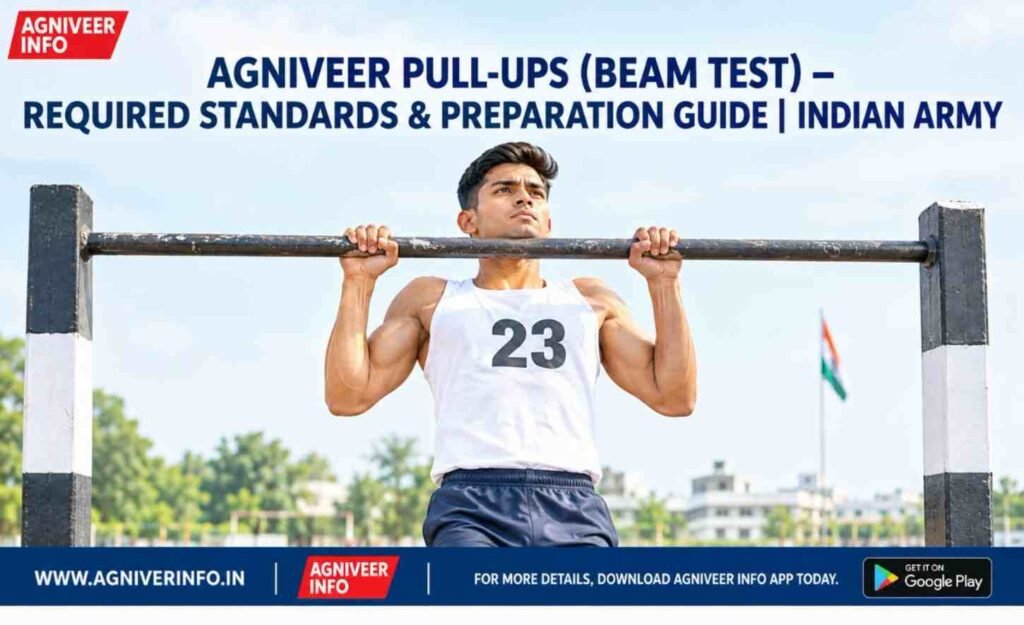
Many young Agniveer aspirants feel confident about the 1.6 km running test, but they suddenly get nervous when they reach the pull-up bar, which is officially called the beam test. Running builds good lower-body stamina, but pulling your whole body weight upward off the ground needs a completely different kind of fitness.
Candidates often fail the Agniveer Beam Test simply because they ignore their upper body, or assume that running stamina automatically gives them upper-body strength. Doing smooth, clean pull-ups needs strong grip, back strength, arm power, a stable core, a properly managed body weight, and strict technique. Just hanging from a metal bar every day, without a proper plan, will not magically increase how many you can do.
This practical guide covers the verified Army Pull Up Standards, how the marks work, the exact way to do the movement, common physical mistakes, a step-by-step plan for beginners, tips for grip strength, and proper rest. Always remember that the latest official Indian Army recruitment notice remains the final word on the physical test rules.
What Is the Agniveer Pull-Up / Beam Test?
The Indian Army Pull Up Test is a core part of the Agniveer Physical Test, designed to check upper-body muscle strength and endurance. Military life demands real physical power, to climb ropes, get over vertical obstacle walls, carry heavy ammunition boxes, and move through rough terrain during operations. Bodyweight exercises like pull-ups quickly show physical instructors whether a candidate can control their own body weight properly under pressure.
Many young candidates confuse a relaxed gym chin-up, or a half-hanging swing, with a proper military pull-up. During the official selection rally, physical instructors look for continuous movement, control, and strict form, without depending on any momentum.
Agniveer Pull-Up Standards — How Many Are Required?
Under the current recruitment system for Agniveer General Duty (GD) and Tradesmen categories, the Agniveer Physical Fitness Test carries a total of 100 marks, split between the 1.6 km run (60 marks at most) and the beam test (40 marks at most). Candidates need to pull themselves up using either an underhand or overhand grip, whichever is instructed by the rally staff.
To qualify for Agniveer GD and Tradesmen roles, a candidate must complete at least 6 clear pull-ups. Doing fewer than 6 pull-ups leads to instant physical disqualification from the selection process. Candidates who do more repetitions get higher marks, which directly helps their final merit ranking. For technical roles like Agniveer Tech or Office Assistant (Clerk), the physical fitness test is only a pass-or-fail stage, which means candidates just need to meet the minimum standard, though the official notice clearly lays out the exact requirement for each category.
Agniveer Beam Test Scoring Structure
| Pull-Ups / Repetitions | Marks / Category | What It Means |
| 10 Repetitions | 40 Marks | Maximum Score (Group I) |
| 9 Repetitions | 33 Marks | Excellent Performance |
| 8 Repetitions | 27 Marks | Good Performance |
| 7 Repetitions | 21 Marks | Satisfactory Performance |
| 6 Repetitions | 16 Marks | Minimum Pass / Qualifying Limit |
| Less than 6 | Fail / 0 Marks | Immediate Disqualification |
Pull-Up Test: Qualifying vs Scoring
Understanding how the marks actually work helps candidates plan their preparation better. Passing the test with 6 repetitions gives you 16 marks, but doing 10 full repetitions gives you all 40 marks. That gap of 24 marks makes a big difference to your final combined merit score. This is why your goal should never simply be to reach the minimum pass mark. Aiming for 10 strict repetitions makes sure you get the maximum physical marks possible.
How Is a Proper Pull-Up Performed?
Doing pull-ups at an Army rally means following the physical commands exactly. Physical instructors only count the repetitions that are done cleanly and meet the exact standard.
- Proper Grip: Step up and hold the bar firmly with an overhand grip (palms facing away), shoulder-width apart, or however the testing officer instructs you.
- Starting Position: Hang with your arms fully straight, keeping your legs straight or slightly crossed at the ankles, without touching the ground.
- Controlled Movement: Pull your body straight up in a smooth motion, using your back and arm muscles, while keeping your body steady.
- Correct Finishing Position: Lift yourself up until your chin clearly goes over the top edge of the horizontal beam, and pause briefly, without resting your chin on the bar.
- Controlled Descent: Lower your whole body smoothly, until your arms come back to a full hanging position, before starting the next repetition.
- Zero Cheating: Do not swing your hips, kick your legs, or bounce up from the bottom. A partial repetition will not be counted by the rally instructors.
Common Reasons Candidates Cannot Do Pull-Ups
- Weak Grip Strength: The forearms get tired quickly, so the hands slip off the beam before the main muscles are even properly tired.
- Underdeveloped Back Muscles: Candidates depend completely on their small arm muscles, instead of using their strong back muscles.
- Excess Body Weight: Carrying extra body fat adds more total load on the muscles that do the pulling.
- Lack of Core Stability: A weak core causes the lower body to swing uncontrollably during the effort.
- Inconsistent Training: Practising only now and then, instead of sticking to a proper Agniveer Pull Up Training routine.
How to Start If You Cannot Do Even One Pull-Up
If you currently cannot do even a single pull-up, start building your basic pulling strength with these practical exercises for beginners:
- Dead Hangs: Hold the bar and hang with straight arms for 30–60 seconds, to build your basic grip endurance.
- Scapular Pulls: While hanging, pull your shoulder blades down and together, without bending your elbows, to work your upper back.
- Negative Pull-Ups: Stand on a box, jump up so your chin is over the beam, and then lower your body down slowly over 4–5 seconds.
- Inverted Bodyweight Rows: Set a bar at waist height, lean back with your feet on the ground, and pull your chest up to the bar.
- Band-Assisted Pull-Ups: Loop a strong resistance band over the bar, and put your foot inside it, to reduce how much of your body weight you are lifting.
How to Increase Your Pull-Up Repetitions
To build strength step by step and learn how to increase pull-ups for Army rallies, follow this structured plan:
- Train with Sub-Maximal Sets: Do not train to complete failure on every set. If your maximum is 5 repetitions, do several sets of 3 clean repetitions instead.
- Increase Total Weekly Volume: Focus on building up your total number of repetitions across the whole week, rather than forcing one huge workout.
- Grease the Groove Method: Do 2 to 3 easy, good-quality pull-ups several times through the day, with full rest in between each set.
- Focus on Form Quality: Always practise every single repetition with strict, rally-style form, so that your muscles learn the correct movement.
- Track Your Workouts: Write down your daily sets and repetitions in a notebook, to make sure you are making steady progress over time.
Grip Strength — The Hidden Factor
Strong hands and tough forearms are the base for every good beam test attempt, because if your grip fails, all your back and arm strength becomes useless.
- Extended Dead Hangs: End your workout by hanging from the bar, holding on for as long as you can, until your grip naturally gives out.
- Farmer Carries: Pick up heavy buckets or dumbbells in each hand, and walk continuously for 60 seconds, keeping your posture upright.
- Towel Hangs: Drape a strong cloth towel over a safe bar, hold the ends tightly, and hang your body weight off the ground safely.
Back, Arm, and Core Training
While pull-ups mainly work the upper body, they actually need the whole body to work together, along with support from the surrounding muscle groups.
- Bodyweight Push-Ups: Strengthen your chest, shoulders, and triceps, to balance out the pulling muscles across your upper body.
- Dumbbell Rows: Target your upper back and the large muscles on the sides of your back, to build core pulling strength.
- Plank Holds: Keep a straight, steady body line by holding forearm planks for 60 seconds, to stop your legs from swinging during the test.
- Bicep Curls: Strengthen the muscles of your forearm and elbow, to support the final part of the pull, as you go above the beam.
Common Pull-Up Mistakes
- Swinging or Kicking: Using your legs to build momentum makes the repetition invalid, and wastes your energy during the official scoring.
- Cutting Movement Short: Not lowering all the way to a full hang, or not getting your chin completely over the beam.
- Daily Over-Testing: Testing your maximum number of repetitions every single day leads to quick muscle tiredness and shoulder swelling.
- Ignoring Body Composition: Trying to increase your repetitions without also managing your overall body fat.
How Often Should You Train Pull-Ups?
Muscles actually grow stronger during rest, not during the workout itself. Train your pulling muscles 3 to 4 times a week, on days that are not next to each other, such as Monday, Wednesday, and Friday. Give yourself at least 24 to 48 hours to recover between hard upper-body sessions, to avoid overuse injuries and strain on your shoulder joints.
What to Eat and How to Recover
- Eat Balanced Meals: Fuel your daily training with simple, whole foods like lentils, eggs, rice, roti, beans, and fresh vegetables.
- Adequate Protein Intake: Eat enough natural sources of protein, to help repair the muscle tissue that gets damaged during hard workouts.
- Stay Hydrated: Drink plenty of water through the day, to keep your muscles properly hydrated and avoid painful cramps.
- Prioritize Restful Sleep: Aim for 7 to 8 hours of good sleep every night, to get the most out of your body’s natural muscle recovery.
- Avoid Dangerous Shortcuts: Stay away from unsafe performance supplements, fat burners, or illegal substances, since these can harm your health in the long run.
Weekly Beginner Training Approach
- Monday (Pull-Up Focus): Do 4 sets of sub-maximal pull-ups, followed by negative pull-ups and core plank holds.
- Tuesday (Grip & Cardio): Do dead hangs, farmer carries, lighter push-ups, and running practice.
- Wednesday (Back & Arm Strength): Do bodyweight inverted rows, scapular pulls, bicep exercises, and core holds.
- Thursday (Active Recovery): Focus on light stretching, simple mobility exercises, joint health, and staying hydrated.
- Friday (Light Technique Practice): Do smooth, perfect-form pull-ups, negative reps, and general bodyweight fitness exercises.
- Saturday/Sunday (Rest & Recovery): Give your muscles complete rest, eat wholesome meals, and get extra sleep.
Safety and Injury Prevention
Warm up properly with dynamic arm circles, shoulder rotations, and light jumping jacks, before you grab the pull-up bar. Make sure your horizontal beam or bar is firmly fixed in place, to avoid a dangerous fall. If you feel sharp pain in your shoulder or elbow, stop right away. Never train through joint pain, and see a doctor if the soreness does not go away.
Common Pull-Up Myths
- Myth 1: You must train pull-ups every day. Fact: Muscles need proper rest days to repair themselves and grow stronger.
- Myth 2: Swinging your legs counts during rally testing. Fact: Physical instructors cancel or reject any repetition that involves swinging or kicking.
- Myth 3: Doing 100 push-ups a day improves your pull-ups. Fact: Push-ups push weight away from you, while pull-ups need a completely different, dedicated pulling strength.
- Myth 4: Heavy workout supplements are required. Fact: Simple homemade food, steady effort, and enough sleep are enough to build complete pull-up fitness.
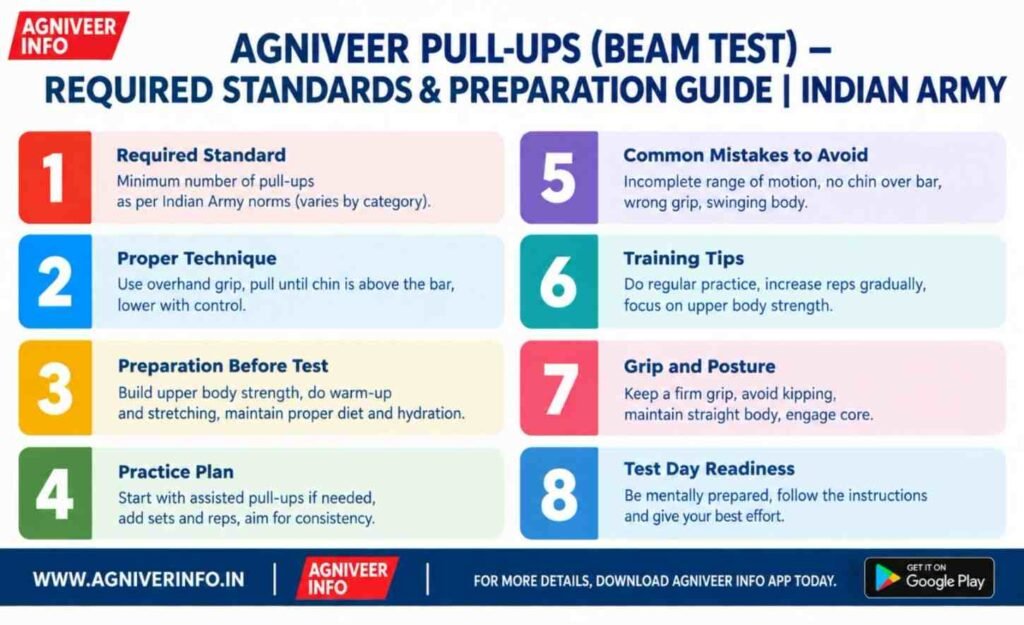
Conclusion
Getting good at the Agniveer Beam Test needs patience, a smart plan, and steady, ongoing effort. Do not get discouraged if you currently struggle to do even one or two proper pull-ups.
By breaking your training down into manageable steps, focusing on grip endurance, building back strength, perfecting your form, and allowing your muscles proper time to recover, you can steadily increase your repetitions over time.
Avoid shortcuts, stay away from unsafe supplements, and train with strict, rally-style discipline in every practice session.
Always check the latest official Indian Army recruitment notice for the most accurate and updated physical testing rules, marking system, and rally guidelines.
Stay committed to your daily routine, train smart, and work steadily towards getting the maximum marks at your selection rally.
Get the latest Agniveer updates by joining our WhatsApp channel
Frequently Asked Questions
Q1. What are the current Agniveer pull-up standards?
A1. The standard Agniveer physical rally test requires candidates to do strict pull-ups on a horizontal beam. Completing 10 pull-ups gives the maximum score of 40 marks, while completing 6 pull-ups earns 16 marks. Completing fewer than 6 pull-ups leads to instant disqualification.
Q2. How many pull-ups are required for Army Agniveer?
A2. To clear the Agniveer Physical Fitness Test for General Duty and Tradesmen categories, you must complete at least 6 clean pull-ups. That said, candidates should aim for 10 full repetitions, to score maximum physical marks and improve their final overall selection merit.
Q3. How are pull-up marks awarded?
A3. For Agniveer GD and Tradesmen, the marks follow a fixed scale: 10 pull-ups give 40 marks, 9 give 33, 8 give 27, 7 give 21, and 6 give 16 marks. Doing fewer than 6 pull-ups results in zero marks and physical failure.
Q4. Is the pull-up standard the same for every Agniveer category?
A4. While the actual movement stays the same, the marking system changes by category. For Agniveer GD and Tradesmen, your beam performance adds up to 40 marks directly to your physical score. For technical or administrative categories, the physical test is usually just a pass-or-fail stage, as given in the official notice.
Q5. How can I do my first pull-up?
A5. Start by practising daily dead hangs, to build up your grip strength. Add slow negative pull-ups, by jumping up to the top position and lowering yourself down slowly over 5 seconds. Combine these with bodyweight inverted rows, until your upper back is strong enough for a full pull-up.
Q6. How can I increase my pull-up repetitions?
A6. Increase your repetitions by training 3 to 4 times a week, using sub-maximal sets rather than going to complete failure every time. Improve your forearm grip with farmer carries, do negative pull-ups, work on losing extra body fat, and keep your movement technique strict and consistent.
Q7. Should I practise pull-ups every day?
A7. No, practising your maximum number of pull-ups every day leads to serious shoulder tiredness, joint swelling, and slower overall progress. Your muscles need 24 to 48 hours to recover and rebuild stronger, so train your pulling exercises 3 to 4 days a week, with planned rest days in between.
Q8. What should I do if I cannot meet the required pull-up standard?
A8. If you cannot reach the 6-repetition minimum, break your training down into basic parts. Focus on building grip strength with dead hangs, reducing your body weight through cardio, practising negative repetitions, strengthening your core, and training consistently, without rushing or trying dangerous shortcuts,
READ ALSO: AGNIVEER PHYSICAL TEST TIPS — WHAT TO EXPECT ON RALLY DAY