
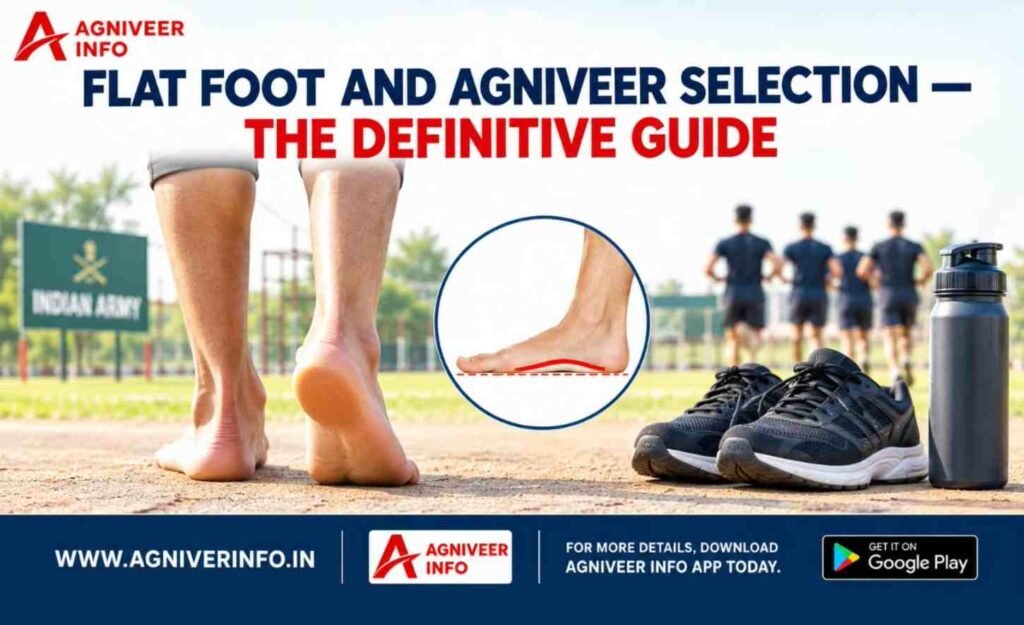
Many Agniveer aspirants worry about flat feet, because they have heard that a flat arch can lead to instant rejection in the Army medical examination. Flat foot is one of the most misunderstood medical topics among young defence candidates today.
One candidate looks at his own feet and thinks that he has flat feet, while another does a home test that he saw on the internet and feels sure that he will fail the medical board, but neither of these ways is reliable enough to tell whether you are really fit for the Army.
The best way to prepare without needless panic is to understand the official standards and the way the check is done. This guide explains what flat feet really mean, the different types, how they are checked during recruitment, the current medical standards, the common myths, the practical steps to take before the exam and the official appeal process. Please remember that the final medical decision is always made by the authorised medical board as per the official standards.
1. WHAT IS FLAT FOOT?
Flat foot is a condition in which the inner arch of the foot is flattened, or is completely missing, when you stand. In a normal foot, a springy upward curve works like a natural shock absorber when you walk, jump or run. When a person has flat feet, the whole sole touches the ground, or nearly touches it. Many people naturally have a lower arch because of the shape of their bones, loose ligaments (the tough bands that hold the joints together) or the traits that run in their family, and they never face any physical limit because of it.
Doctors generally divide flat feet into two main types, which are flexible flat foot and rigid flat foot. In flexible flat foot, the arch can be seen when a person sits or stands on his toes, but it goes away when the weight of the body is put on the foot. In rigid flat foot, the arch is completely missing in every position, because the joints are stiff or the bones are fixed in one position.
2. DOES FLAT FOOT AUTOMATICALLY MEAN AGNIVEER REJECTION?
Having a lower foot arch does not automatically mean permanent medical rejection, because a proper check by a doctor has to be done first. Judging yourself or going by opinions on the internet is never enough to decide your fitness for the military. The official result depends on whether the condition is flexible or rigid, whether it comes with a serious defect in the structure of the foot, and whether it makes the foot weak during hard physical duties.
Agniveer recruitment needs high staying power for marching, tactical drills and physical training. The medical officers check whether the structure of your foot will cause severe pain, frequent injuries or a lasting disability when you carry a load. A mild flexible arch that gives no pain and keeps its strength usually gets a careful military check, and not an instant rejection.
3. WHAT ARE THE CURRENT AGNIVEER FLAT FOOT STANDARDS?
The Armed Forces keep fixed medical standards so that candidates can handle military training. As per the medical guidelines of the Indian Armed Forces:
- Rigid Flat Feet: Candidates with flat feet that are fixed, painful or rigid are generally declared medically unfit, because the risk of injury is higher.
- Flexible Flat Feet: A flexible arch that gives no pain and works fully may be accepted if it passes the clinical tests that check it in movement.
- Surgical Marks: If a candidate has had a major surgery on the foot to build an arch, it needs a strict medical check.
- Associated Deformities: If serious hallux valgus (a bent big toe), claw toes or an inward tilt of the heel (valgus deformity) are present along with the flat feet, it usually leads to rejection.
4. HOW IS FLAT FOOT TESTED IN THE ARMY MEDICAL EXAMINATION?
In the recruitment medical board, the doctors do a check step by step, and they do not depend on one quick look. The examination has these parts:
- Standing Assessment: The doctor looks at both your feet from the front, the side and the back while you stand barefoot on a flat surface.
- Weight-Bearing Test: The medical officers check how the arches of your feet line up under the full weight of your body.
- Tiptoe Test: You are asked to stand on your toes, to see whether the arch comes back by itself.
- Functional Movements: Walking, squatting and other movements are checked, to make sure that the joints of the foot stay flexible and pain-free.
5. HOME TESTS FOR FLAT FEET — ARE THEY RELIABLE?
Many aspirants do the popular wet footprint test at home, in which they wet their soles and step on dry paper or on the floor. This gives a rough idea of the shape of your foot, but it cannot decide whether you are medically fit for the Army.
Home tests cannot measure how flexible your joints are, how strong your ligaments are, how your bones line up, or how much staying power your foot has under military conditions. A wet footprint may show a broad and flat shape, and yet the foot may work perfectly well in the clinical tests done by trained military doctors.
6. SYMPTOMS AND PROBLEMS LINKED WITH FLAT FEET
A large number of people with flat feet live a completely normal life without any discomfort. But when problems do come, they usually show up as:
- A constant aching pain in the heel, the arch or the ankle joint
- Swelling on the inner side of the foot after long walks
- Tiredness in the calf muscles and discomfort in the lower back while running
- Quick or uneven wear on the inner edges of your everyday footwear
7. CAN FLAT FEET BE IMPROVED?
A serious defect in the structure, or a rigid bone condition, cannot be cured by magic, but the flexibility and the muscle strength around the arch can often be improved:
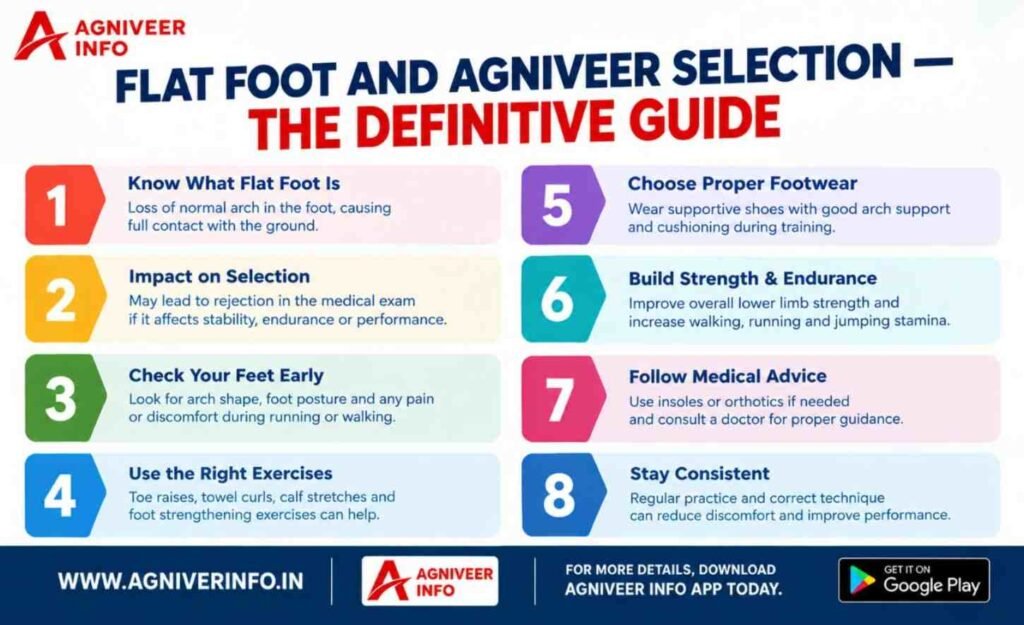
- Arch-Strengthening Exercises: Exercises like towel curls, picking up marbles with your toes and calf stretches make the muscles of the foot stronger.
- Footwear Support: Using supportive sports shoes during your daily training keeps too much stress off the fascia (the tough band under the foot).
- Physiotherapy: Planned physical therapy helps to stretch a tight Achilles tendon (the thick cord at the back of the ankle) and makes the ankle steadier.
- Weight Management: Keeping your body weight at the right level reduces the extra pressure on the arches of your feet.
8. WHAT SHOULD AGNIVEER ASPIRANTS DO BEFORE THE MEDICAL EXAM?
If you are worried about the arches of your feet before the recruitment drive, follow these practical steps:
- Avoid Panic: Do not believe the rumours on the internet or the fake guaranteed cures that are sold online.
- Consult a Specialist: Get checked by a qualified bone doctor (orthopaedic) or a military medical expert, so that you get an exact opinion.
- Focus on Fitness: Keep the strength of your whole body, the steadiness of your core and your running posture in good shape.
- Follow Guidelines: Depend only on the official Indian Army recruitment notices for the medical rules.
- Be Honest: Go to your medical examination with confidence, without trying any tricks or false postures.
9. COMMON FLAT FOOT MYTHS AMONG AGNIVEER ASPIRANTS
- Myth 1: Every candidate with flat feet is rejected at once.
Fact: Mild flexible flat feet without pain or defect are checked fully and may be accepted. - Myth 2: The wet footprint test is the official Army test.
Fact: Military doctors use clinical tests, weight-bearing tests and movement tests, and not simple footprints. - Myth 3: Running barefoot on sand cures flat feet completely.
Fact: Running on sand makes the foot muscles stronger, but it cannot change bone structures that are fixed. - Myth 4: You can easily hide flat feet during the medical exam.
Fact: The medical officers are very experienced, and they easily find false foot postures.
FLAT FEET VS ARMY MEDICAL FITNESS — WHY SELF-TESTING IS NOT ENOUGH
| Flat Foot Concern | What It Means | What the Candidate Should Do |
| Flat Footprint | Complete sole touches the ground during wet footprint test | Avoid self-diagnosis and seek a clinical assessment |
| Flexible Arch | Arch appears on tiptoes but flattens while standing | Perform arch-strengthening exercises regularly |
| Rigid Arch | Arch remains flat even on tiptoes with joint stiffness | Consult an orthopedic surgeon for professional guidance |
10. WHAT IF YOU ARE DECLARED MEDICALLY UNFIT?
If you get a temporary or a permanent rejection in the first medical exam, stay calm and follow the official appeal steps:
- Get the official medical slip that clearly states the reason for the rejection.
- Ask for an Appeal Medical Board (AMB) or a Review Medical Board (RMB) within the time given in your recruitment notice.
- Report to the designated Military Hospital on the date that is given to you, for a fresh check by senior specialists.
- Do not bring certificates from private hospitals unless you are clearly asked for them, because only the evaluations of the military board are binding.
CONCLUSION
Flat feet should never be judged only by myths on the internet, by home footprint tests or by advice on social media. Having a low arch does not automatically mean that your dream of joining the Armed Forces is over.
When you understand the difference between flexible and rigid flat feet, you can prepare in a realistic way without panic. Focus on building your physical staying power, do the arch-strengthening exercises and keep your fitness at a good level. Always depend on the official recruitment notices for the medical rules, and not on claims that have no proof.
Get the latest Agniveer updates by joining our WhatsApp channel
FREQUENTLY ASKED QUESTIONS
Q1. Does flat foot cause Agniveer rejection?
A1. Flat foot causes rejection if it is rigid, painful or comes with defects in the structure of the foot. Flexible flat feet that give no pain and pass the military tests of movement may be declared medically fit by the authorised doctors.
Q2. What are the current Army standards for flat feet?
A2. The Armed Forces need feet that are flexible and that work well, so that they can handle heavy physical stress. Rigid flat feet, or conditions that cause constant pain, swelling and stiff joints, lead to medical rejection.
Q3. How does the Army test flat feet?
A3. Medical officers do standing checks, weight-bearing checks and tiptoe checks of the arch, and they also check how the joints move, so that they can judge how flexible the foot is and how well it lines up.
Q4. Can I check flat feet at home?
A4. You can do a wet footprint test or a tiptoe check at home to get a basic idea, but these self-tests cannot take the place of the official medical examination.
Q5. Is the wet footprint test accurate for Army selection?
A5. No, the wet footprint test only shows how much of the sole touches the ground. It does not measure how flexible the ligaments are, what the bone structure is like, or how much staying power is needed for military duty.
Q6. Can exercises improve flat feet?
A6. Exercises like toe curls, calf stretches and arch-strengthening movements make the muscle support and the flexibility better, though they may not change bone structures that are fixed.
Q7. What should I do if I am worried about flat feet before the medical exam?
A7. Meet a qualified orthopaedic doctor or a military specialist for a check before the medical, and do the foot-strengthening exercises that are prescribed, under proper guidance.
Q8. What happens if I am declared medically unfit because of flat feet?
A8. You can apply for an Appeal Medical Board (AMB) within the time that is officially allowed, so that specialist military doctors can examine you again at a designated hospital.
READ ALSO: ARMY HEARING TEST STANDARDS — WHAT GETS YOU REJECTED