

Getting ready for an Indian Army recruitment rally needs a lot of hard physical training, but thousands of aspirants face the same problem, which is that they have no easy access to official grounds, special obstacle tracks or local coaching academies.
Many candidates have to start their physical training at home, using the local roads, open spaces and very little equipment. A home setting can never fully copy the pressure, the crowd or the exact conditions of an official recruitment rally, but candidates can still build, step by step, the physical strength that is needed to pass the selection.
Home training must be done with a clear plan. If you try to build rough and dangerous obstacles from things lying around the house, you can get badly hurt, and such an injury can end your military dream for good. So good home preparation focuses on the basic physical qualities that the official test checks, which are stamina of the heart and lungs, staying power of the muscles,
leg power, grip strength and a steady core. If you know how to train these demands safely, you can build a very strong base of fitness. This guide explains how to plan your home training in a smart way, how to build the strength for each event safely, how to keep track of your progress, and how to move on to real test conditions while keeping to the safety rules.
CAN YOU REALLY SIMULATE THE ARMY RALLY AT HOME?
To answer this honestly, we must separate building fitness from copying the exact event. Candidates can build a high level of stamina, explosive leg power, staying power in the upper body and good balance while moving, all at home or in the local neighbourhood.
But home preparation cannot fully copy the exact layout, the official scoring set-up or the mental pressure of an Army recruitment rally. Running stamina can be trained well on safe local roads or open paths, strength can be built with bodyweight exercises or simple tools, and balance can be built with controlled movement drills.
What candidates must strictly avoid is trying to make home-made copies of the official recruitment obstacles with unsafe household things. Makeshift structures, unsteady raised surfaces and home-made ditches carry a high risk of joint injuries and broken bones. So you should see home preparation as a strong way to build the basic fitness that the Army needs, and not as a way to build an obstacle course.
UNDERSTAND THE ACTUAL ARMY PHYSICAL TEST FIRST
Before you make any home training plan, you must carefully read the current official Indian Army or Agniveer recruitment notice that applies to your own category. The rules for the physical fitness test, which include the running distance, the time limits, the way pull-ups are scored, the ditch-jump details and the balance needs, are fixed by official rules, and they can differ by trade,
region or recruitment cycle. Candidates must never depend on old rumours, advice from the internet that nobody has verified, or standards that they only assume. The official notices give the exact order of the physical events, the minimum qualifying marks and the marks that are cut for mistakes. When you know these conditions,
you can match your home training with what is really expected from you. If you keep the official standards and the home methods separate in your mind, you train with a clear purpose and aim at targets that can be checked, and not at general fitness goals that have no standard.
HOW TO SIMULATE THE RUNNING TEST AT HOME
Building the stamina of the heart and lungs, and the ability to keep running fast, is the cornerstone of Army physical preparation. Continuous running should be done on safe and flat outdoor places such as a local track, a quiet road or an open ground, and not inside the house, but candidates can plan their running workouts so that they put the same kind of stress on the body as the rally does. A balanced home running plan uses different types of training to work on different energy systems:
- Easy Aerobic Runs: Steady runs at a moderate pace for a longer time, which build the basic stamina of the heart and lungs and also help the body to recover.
- Interval Training: Changing between short bursts of fast running and short rests, which improves your stamina and your speed over a distance.
- Tempo Pacing Sessions: Long runs at a hard but controlled pace, which teach you how to manage your body and stay disciplined in your mind when you are tired.
If you use a reliable stopwatch or a simple mobile app to track your runs, you can see your progress without depending on guesses.
HOW TO SIMULATE PULL-UP AND UPPER-BODY DEMANDS
Strength for pulling and the staying power of the grip are very important parts of the recruitment test. Candidates who have a secure pull-up bar that has been fitted properly can practise normal pull-ups directly. When such equipment is not there, candidates can build the same muscles with safe bodyweight steps.
Incline push-ups, flat push-ups and bodyweight rows using a door frame work on the back muscles, the shoulders, the chest and the core, which are needed for pulling your body up. Grip strength can be improved by hanging still from a safe bar or by carrying weighted household things with controlled form.
Candidates must strictly stay away from hanging on doors that are not reinforced, plastic pipes, weak tree branches or unsteady furniture. Push-ups and rows build basic strength, but they only support your training and are not a direct replacement for strict pull-ups.
HOW TO SIMULATE TEST-DAY FATIGUE SAFELY
Learning to manage your body when you are tired is an important part of physical preparation, but candidates must not mix up smart handling of tiredness with unsafe overexertion. Your body truly adapts when it recovers from stress that is controlled.
Candidates can copy tiredness by doing core or balance drills right after a running interval or a circuit set, so that the nervous system has to stay focused while the body is tired. But training methods that involve keeping yourself without water on purpose, cutting food to extreme levels, going without sleep or testing your maximum effort every day are very dangerous and do more harm than good.
Safe training in tiredness means keeping your exercise form strict even when your heart rate is high, so that the body adapts slowly without the risk of complete burnout or sudden strain.
WHAT YOU SHOULD NEVER TRY AT HOME
- Building homemade ditches: Digging pits or jumping over rough trenches creates a serious risk of broken ankles and torn ligaments, because the ground you land on is not steady.
- Using furniture for pull-ups: Hanging from door frames, chairs or pipes that are not fixed firmly often leads to the structure failing and to sudden falls.
- Jumping from elevated heights: Doing hard drop jumps off walls or roofs puts too much stress on the joints, and it causes shin splints and tendon pain (tendonitis).
- Excessive daily plyometrics: Doing maximum jumps every day without enough rest leads to long-lasting swelling in the joints and to overtraining syndrome, which means the body is worn out from too much training.
- Training through sharp pain: If you ignore pain in a joint or muscle that does not go away, a small strain turns into a long-term injury that stops you from taking part in the rally.
- Replicating extreme fatigue artificially: Cutting water or food before training causes serious dehydration, heat illness and problems in how the body works.
HOW TO TRACK YOUR PROGRESS
Keeping a regular record gives you clear proof of how your fitness is improving, and it stops your training from getting stuck at one level. Candidates should keep a special notebook or a digital log and note down the main numbers every week.
Write down things like the time taken to run a known distance, the total number of strict push-ups and pull-ups, how long you can hold a plank, and how hard the circuits felt to you. If you look at the trends over blocks of four to six weeks, you can find your weak points and change the amount of your training.
Progress should be judged by steady small gains, and not by big jumps from one day to the next, so that your body adapts slowly and the risk of injury stays low.
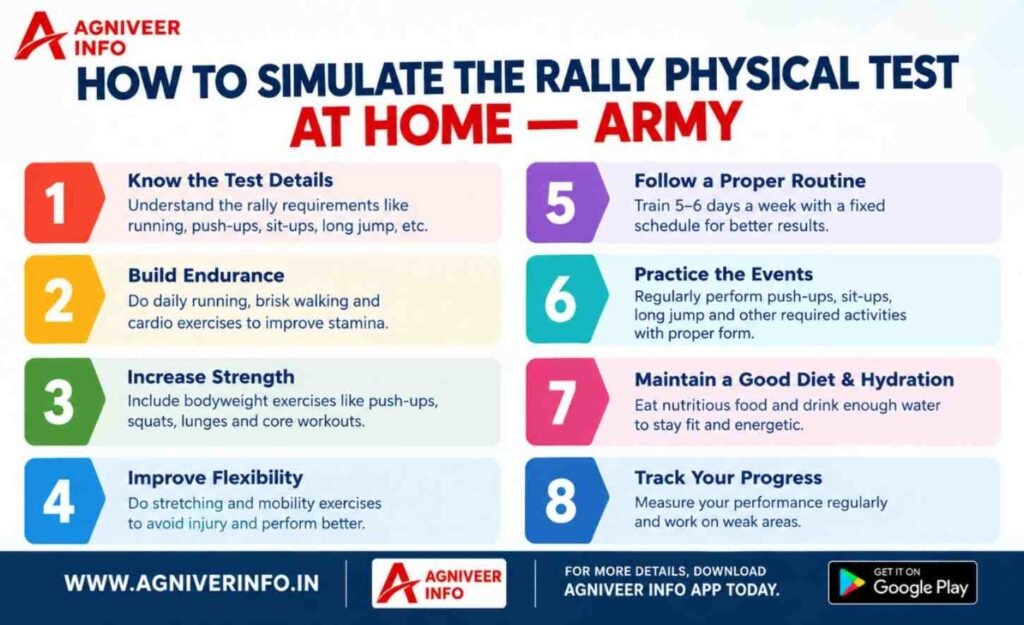
OVERVIEW OF HOME SIMULATION METHODS
| Physical Demand | Home Simulation | Main Benefit | Important Limitation |
| Running | Road intervals and pacing runs | Builds cardiovascular stamina and running economy | Traffic and hard road surfaces require careful management |
| Upper-Body Strength | Push-ups, bodyweight rows, and bar hangs | Develops shoulder, back, and grip muscular endurance | Cannot fully replace standard strict pull-up mechanics |
| Jumping Power | Squats, lunges, and soft-ground broad jumps | Increases explosive leg power and joint stability | Lacks the exact psychological context of obstacle jumps |
| Balance | Line walking and single-leg balance drills | Enhances dynamic stability and spatial awareness | Ground-level drills do not simulate elevated track conditions |
CONCLUSION
Getting ready for an Indian Army recruitment rally from home needs a disciplined and smart approach, in which building fitness is more important than copying risky obstacles. If you build the stamina of your heart and lungs,
your upper-body strength, your leg power and your balance step by step, using safe bodyweight exercises and planned running, you can create a base of fitness that is able to meet the hard standards of the military. Success depends on doing the work without a break,
raising your workload slowly, taking enough rest and checking your progress against the official recruitment rules. Home preparation puts you in control of your own physical readiness in a safe way, so that you reach the recruitment ground fit, strong and fully ready to perform.
Get the latest Agniveer updates by joining our WhatsApp channel
FREQUENTLY ASKED QUESTIONS
Q1. Can I prepare for the Army physical test at home?
A1. Yes, candidates can build very good stamina, upper-body strength and core staying power at home, by using planned bodyweight workouts and safe local running routes.
Q2. How can I practise Army running at home?
A2. Run on safe local roads or open paths, using interval sessions, tempo runs and easy aerobic workouts that are planned well, so that you build steady speed and staying power.
Q3. Can I safely practise ditch-jump exercises at home?
A3. You can safely build explosive leg power with bodyweight squats, lunges and broad jumps on soft grass, instead of building dangerous rough ditches.
Q4. How can I improve balance without Army obstacles?
A4. Practise single-leg holds, heel-to-toe walking along a line and controlled agility drills on flat ground marked with tape or chalk, so that you build steadiness in a safe way.
Q5. Can home workouts replace actual rally practice?
A5. Home workouts build the physical fitness that you need, but candidates should also practise on real running tracks and open grounds in the end, so that they get used to real testing conditions.
Q6. How often should I train for Army physical preparation?
A6. Train five to six days in a week, and change between running, strength training and agility work, while keeping at least one full day for complete rest.
Q7. What equipment is useful for home Army preparation?
A7. A secure pull-up bar, proper running shoes, a stopwatch and simple markers like chalk or cones are enough for good physical preparation at home.
Q8. Where should I check the latest Army physical-test requirements?
A8. Always check the standards of the physical test, the order of the events and the scoring rules directly in the current official Indian Army recruitment notice that is published for your category.
READ ALSO: ARMY LASIK SURGERY RULES — ELIGIBILITY & HEALING PERIOD