
To understand the money side of the Agnipath scheme properly, candidates need to be clear about the difference between the gross figure and the actual amount that lands in their bank account.
Many candidates who look at recruitment notices see the gross monthly package, such as ₹30,000 in the first year, and assume this is the final cash amount deposited into their account, but the real Agniveer in-hand salary is different from the advertised customised package, because of the compulsory monthly amount that goes into a special fund.
Under the current official rules set by the Ministry of Defence, every recruited candidate has 30% of their monthly customised package go into the Agniveer Corpus Fund, and the Central Government adds an equal 30% on top of that, rupee for rupee. This saved-up amount forms the main part of the Seva Nidhi package, which is paid out once the four-year service period is complete. On top of this, the take-home pay can also change based on duty-specific allowances, the location a soldier is posted to, and any approved field adjustments. Depending on random online calculators or unofficial salary blogs can give you a wrong idea of what to expect, so this guide explains the official salary structure, how the deductions work, the different allowances, and what you get financially after your service ends, across the Indian Armed Forces.
What Is Agniveer In-Hand Salary?
The Agniveer in-hand salary is the actual amount that gets credited to a candidate’s salary account every month, after the required deductions have been made. While the official recruitment notices highlight the monthly customised package, that figure is really just the gross starting amount, before any deductions.
The main difference between the advertised package and the amount that is actually credited comes from the 30% share that is compulsorily deducted from the candidate before the salary is paid out. On top of this, the final amount that gets transferred each month can go up or change slightly, depending on any allowances a soldier has earned in that particular pay cycle. Looking only at the gross package gives you an incomplete picture, so candidates should check the official service pay structure to understand what they will actually take home.
Agniveer Salary Package vs In-Hand Salary
To read a pay slip correctly under the Agnipath scheme, candidates need to understand the difference between the gross amount, their own savings, and the government’s contribution:
- Monthly Customized Package: The full official amount set for a particular year of service.
- Candidate Contribution: A compulsory 30% that is automatically deducted from the monthly package and put into the Agniveer Corpus Fund.
- Government Contribution: An equal 30% that the Central Government adds on its own into the corpus fund. This amount is not paid out as monthly cash to the soldier.
- In-Hand Salary: The remaining 70% of the customised package, along with any allowances that apply for that month.
- Seva Nidhi: The full amount that builds up over time, made up of the candidate’s own contribution, the government’s matching share, and the interest earned, all paid out together as a lump sum when the soldier leaves service.
Agniveer In-Hand Salary Year-Wise
The customised package for Agniveers goes up every year over the four years of service, following a set structure. In the first year, the gross monthly package is ₹30,000, which gives a basic in-hand amount of ₹21,000. In the second year, the customised package goes up to ₹33,000, which brings the basic net monthly pay to ₹23,100.
In the third year, the gross package rises to ₹36,500, giving a basic take-home amount of ₹25,550 per month, and by the fourth year, the monthly customised package reaches ₹40,000, giving a basic in-hand pay of about ₹28,000. These basic take-home amounts are the 70% left after deduction, before adding any operational or field-level allowances.
What Is Deducted From Agniveer Salary?
The main deduction from an Agniveer’s monthly salary is the 30% share that goes into the Agniveer Corpus Fund, and this rule is the same across all three services.
There are no unverified fees, non-official charges, standard provident fund taxes, or unexpected administrative costs deducted from the customised package, so the only deduction is the candidate’s own 30% share, which is held back at source by the financial authorities, and while this lowers the monthly cash in hand right away, it builds up long-term savings for the soldier. The government adds its own matching share in full, without cutting this amount from the candidate’s own salary.
Agniveer In-Hand Salary After Seva Nidhi Contribution
The 30% that is deducted every month from an Agniveer’s salary is not a cost or an expense, and instead it works as a structured, compulsory savings plan under the Agnipath framework.
Once 30% is taken out of the gross package, the remaining 70% becomes the main monthly in-hand pay, and the deducted amount goes into a special account managed under the Agniveer Corpus Fund. Since the government deposits an equal amount every month as well, the total savings in the corpus fund actually become double the amount the candidate has personally put in, by the end of the four years.
Agniveer Allowances and Their Effect on In-Hand Salary
While the basic take-home pay is set at 70% of the customised package, the operating conditions of a posting can add to the monthly bank credit through specific allowances:
- Risk and Hardship Allowance: Given based on where a soldier is deployed, whether that is a high-altitude area or a difficult field posting.
- Dress Allowance: Regular financial help given for maintaining and buying the official uniform.
- Ration / Travel Entitlements: Ration benefits, or a cash allowance instead of them, along with official duty travel allowances, given as per service rules.
These allowances depend on the specific posting and are not given to every candidate at all times.
Army vs Navy vs Air Force In-Hand Salary
The basic salary structure, which includes the customised monthly package, the 30% deduction, and the matching government contribution, is exactly the same across the Indian Army, Indian Navy, and Indian Air Force (Agniveervayu).
Any difference in the actual amount credited to the bank each month, between the three branches, comes from the type of posting and the specific allowance rules of each service, rather than from any change in the basic pay. So a Navy Agniveer posted at sea, an Army Agniveer posted at a high-altitude border post, and an Air Force Agniveervayu posted at a technical airfield will all end up with a different net monthly amount, because of the field-specific risk and hardship allowances that apply to each of them.
How Much Money Does an Agniveer Actually Receive Every Month?
An Agniveer gets a monthly bank deposit made up of their basic take-home pay, which is 70% of that year’s customised package, plus any operational allowances earned in that particular period.
The gross monthly package should not be confused with the actual credit shown in the bank account, and without any special field deployment allowances, a first-year recruit gets around ₹21,000. The official monthly pay slips issued by the defence accounting authorities remain the only real proof to check the exact amount paid.
Does In-Hand Salary Increase Every Year?
Yes, the in-hand salary goes up every year because of the fixed annual increase built into the four-year customised package.
As the gross monthly package rises from ₹30,000 in Year 1 to ₹40,000 in Year 4, the matching 70% take-home pay also grows from ₹21,000 to ₹28,000. At the same time, the monthly 30% deduction goes up from ₹9,000 to ₹12,000, which speeds up the growth of the Seva Nidhi fund in the final years of service.
What Happens to Salary After Four Years?
Once the four-year service period is complete, the fixed monthly package structure comes to an end, and at this point, candidates move into one of two paths, based on the organisation’s requirements and merit:
Up to 25% of each batch may be taken into the regular cadre of the Armed Forces, and those who are selected move on to the regular service pay scales, military service pay, and standard allowances. The remaining 75% leave military service and receive the full, tax-free Seva Nidhi package, which is around ₹10.04 lakh, plus the interest earned, coming to a total of around ₹11.71 lakh. Agniveers who exit at this point do not get any ongoing pension or monthly regular-service payment after that.
Is Agniveer In-Hand Salary Taxable?
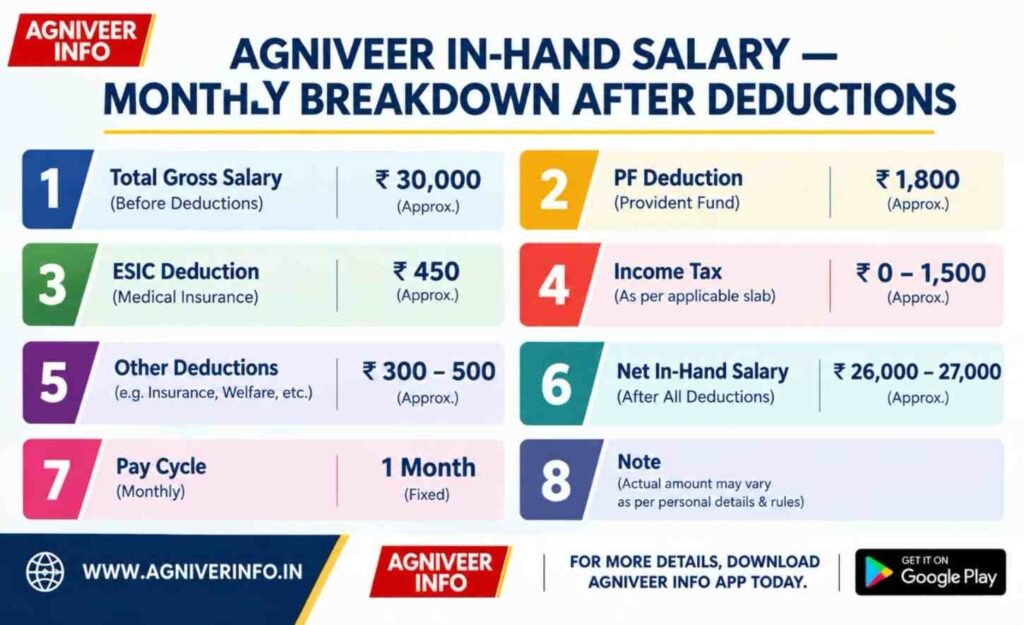
The regular monthly salary and allowances that Agniveers receive follow the normal Income Tax rules under Indian tax law, and deductions, exemptions, and tax slabs apply based on the total yearly taxable income and the tax regime the person chooses.
However, the official Agnipath notices clearly state that the one-time Seva Nidhi lump sum received after the four years, which includes the candidate’s own contribution, the government’s matching share, and the interest earned, is fully exempt from income tax. Candidates should check the official tax guidelines or speak to a qualified professional for their own personal tax planning.
| Service Year | Monthly Package | Candidate Contribution | Approximate In-Hand Salary |
| Year 1 | ₹30,000 | ₹9,000 (30%) | ₹21,000 + Allowances |
| Year 2 | ₹33,000 | ₹9,900 (30%) | ₹23,100 + Allowances |
| Year 3 | ₹36,500 | ₹10,950 (30%) | ₹25,550 + Allowances |
| Year 4 | ₹40,000 | ₹12,000 (30%) | ₹28,000 + Allowances |
Conclusion
To understand the money side of the Agnipath scheme, you need to separate the monthly cash you actually get from the total amount you build up over time. The Agniveer in-hand salary is 70% of the customised package, and the remaining 30% goes straight into the candidate’s own long-term Seva Nidhi corpus fund.
While the monthly bank deposit starts at around ₹21,000 in Year 1 and goes up to ₹28,000 in Year 4, the actual take-home pay can be higher, depending on location-based allowances. The 30% deduction is fully matched by the Central Government, which builds up into a large, tax-free lump sum at the end of the four years of service. Candidates should rely on the official Ministry of Defence documents to correctly work out their expected earnings and long-term benefits.
Get the latest Agniveer updates by joining our WhatsApp channel
Frequently Asked Questions
Q1. What is Agniveer in-hand salary?
A1. Agniveer in-hand salary is the net monthly amount credited to a candidate’s account, after the compulsory 30% contribution towards the corpus fund has been deducted.
Q2. Is Agniveer package salary the same as in-hand salary?
A2. No, the gross package is the full monthly amount set for that year, while the in-hand salary is the 70% that is actually received after the Seva Nidhi deduction.
Q3. How much is deducted from Agniveer salary?
A3. Exactly 30% of the monthly customised package is deducted at source, to fund the candidate’s own share of the compulsory Seva Nidhi corpus.
Q4. Does Agniveer in-hand salary increase every year?
A4. Yes, the in-hand salary goes up every year along with the fixed increase in the customised package, rising from ₹21,000 at first to ₹28,000 in Year 4.
Q5. Do allowances affect Agniveer take-home salary?
A5. Yes, allowances that apply, such as risk, hardship, uniform, and travel payments, are added on top of the basic take-home pay, which increases the final monthly deposit.
Q6. Is Seva Nidhi deducted from monthly salary?
A6. Only the candidate’s own 30% share of the Seva Nidhi fund is deducted every month, while the government adds an equal matching amount separately into the fund.
Q7. Do Army, Navy and Air Force have the same in-hand salary?
A7. The basic monthly package and the deduction rule are exactly the same, though the actual net pay can differ depending on the service-specific posting location and duty allowances.
Q8. Does Agniveer salary continue after four years?
A8. The monthly Agniveer salary stops after four years, and while exiting candidates receive the Seva Nidhi lump sum, the up to 25% who are absorbed into the regular cadre continue to receive regular pay.
REAS ALSO: AGNIVEER HEIGHT REQUIREMENT — CATEGORY-WISE STANDARDS (ALL INDIA)