
Many young candidates who are preparing for Indian Army recruitment put all their energy into running practice, and while running does matter a lot, overall body strength also plays a big part in building real military fitness.
Many candidates keep searching for the exact number of push-ups needed in the physical test, and whether this changes for different Agniveer categories like General Duty, Technical, Tradesmen, or Clerk. Unfortunately, candidates often end up depending on old physical test charts, or false information floating around on social media, and this confusion leads to the wrong kind of preparation and unnecessary worry before the recruitment rallies.
This detailed guide clears up all your doubts about push-up requirements in Indian Army recruitment. We will explain whether push-ups are officially part of the current selection test, the standards by category, how performance is judged, the proper technique, common mistakes, and how a beginner should build up over time. We will also cover safe training tips,
exercises that support your progress, recovery habits, and the common myths around this topic. Finally, remember that the latest official recruitment notice, published on the official Join Indian Army website, always remains the final word on the current physical requirements.
Are Push-Ups Part of the Agniveer Physical Test?
To prepare correctly for Indian Army recruitment, you first need to understand what the official Physical Fitness Test actually includes. In the official Indian Army Agniveer Physical Fitness Test, male candidates are checked on the 1.6 km run, beam pull-ups, the 9-foot ditch jump, and the zig-zag balance test. Push-ups are not listed as an official scored or qualifying event in Indian Army rallies. While push-ups are great for general physical preparation, they carry no direct selection marks in the official Army rally testing.
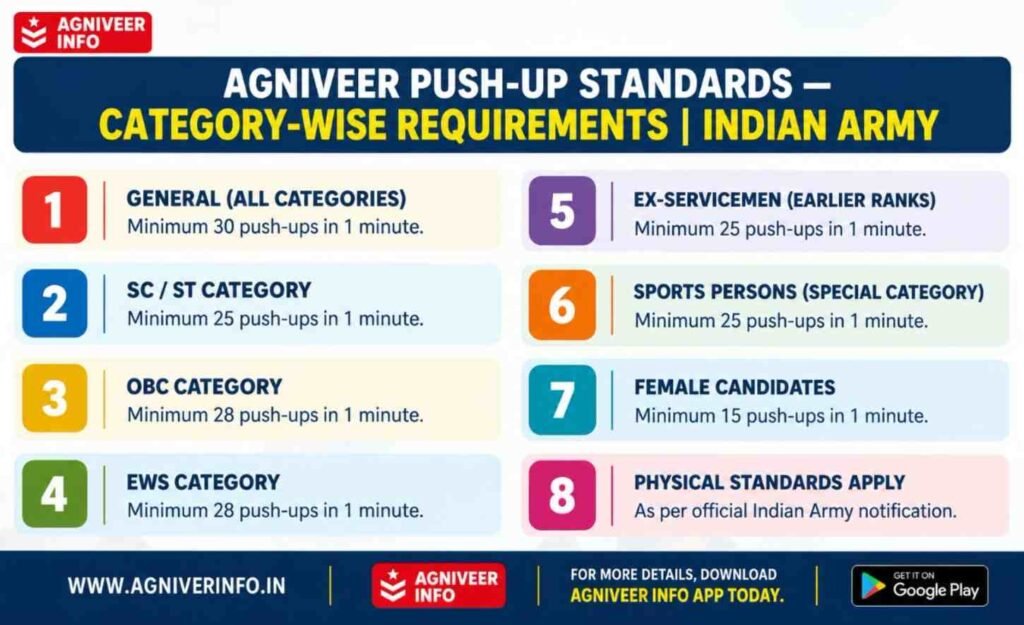
Agniveer Push-Up Standards — Category-Wise Requirements
Because push-ups are not an official selection event in the Indian Army Agniveer Physical Fitness Test, there are no official push-up standards or repetition targets set for any category. Whether you are applying for Agniveer General Duty, Agniveer Technical, Agniveer Clerk, or Agniveer Tradesmen, there is no official push-up rule set by the Army for any of these. Candidates should focus on the official selection events, like pull-ups, and use push-ups as a way to build general bodyweight strength.
Category-Wise Push-Up Requirements at a Glance
| Agniveer Category | Push-Up Requirement | Status / Remarks |
| Agniveer General Duty | No official requirement | Not an official selection event; useful for fitness |
| Agniveer Technical | No official requirement | Not an official selection event; useful for fitness |
| Agniveer Office Assistant | No official requirement | Not an official selection event; useful for fitness |
| Agniveer Tradesmen | No official requirement | Not an official selection event; useful for fitness |
What Is the Correct Way to Do a Push-Up?
Performing push-ups with proper form is more important than completing a large number of incomplete repetitions. A correctly performed push-up helps strengthen the chest, shoulders, arms, and core, making it an important exercise for overall military fitness. Follow these steps for the right technique:
- Position your hands slightly wider than shoulder-width, keeping your fingers directed forward.
- Maintain a straight body position from your head through your heels, with your feet kept close together.
- Slowly lower your body toward the ground until your chest comes close to touching the floor.
- Press your body back up with control while keeping your core engaged and maintaining steady breathing.
Common Push-Up Mistakes
Many beginners make simple technique mistakes while practising push-ups on the ground, and these mistakes lower the quality of the exercise and raise the risk of injury to the joints. Common errors that candidates should avoid include:
- Letting your lower back or hips sag towards the floor.
- Raising your hips too high in the air.
- Doing a partial repetition, without lowering your chest fully.
- Placing your hands incorrectly, and letting your elbows flare outward awkwardly.
- Moving too fast, without properly controlling your body’s movement.
- Holding your breath during repetitions, instead of breathing smoothly.
How to Start If You Cannot Do Many Push-Ups
Beginners who find it hard to do a standard push-up should start from wherever their current fitness level actually is. Using simple, step-by-step progress helps you build strength safely, without putting too much strain on your muscles or joints. Try these beginner-friendly steps:
- Start with wall push-ups, by pushing against a flat wall.
- Move on to incline push-ups, using a bench or a sturdy box.
- Practise knee-assisted push-ups on the floor, to reduce the resistance.
- Do slow, controlled negative push-ups, lowering yourself down to the floor.
- Move up to standard push-ups as your strength steadily improves.
How to Increase Push-Up Repetitions
Increasing how many push-ups you can do needs regular practice, gradual progress, and manageable sets during training. Doing your maximum effort every single day just causes muscle tiredness. Follow these practical guidelines to improve:
- Practise several manageable sets throughout the day.
- Slowly increase your total repetitions, week by week.
- Keep strict technique on every single repetition.
- Allow proper rest between your workout sessions, so your body can fully recover.
- Focus on steadily building your general upper-body strength.
Strength Exercises That Can Help
Getting better at push-ups depends on more than just your chest strength, since your shoulders, triceps, back, and core muscles all support this bodyweight movement. Some useful supporting bodyweight exercises include:
- Standard planks, to strengthen your core stability and keep your spine aligned.
- Chair dips, to work your upper arm triceps muscles effectively.
- Light shoulder presses or pike push-ups, for shoulder strength.
- Bodyweight rows, to smoothly strengthen your upper back muscles.
How Often Should You Practise Push-Ups?
Practising push-ups every day at your maximum effort can lead to muscle tiredness and overuse injuries, so recovery is essential for building real strength. Training three to four days a week is ideal for steady progress. Make sure to include rest days, listen to how your body feels, and avoid overtraining during your recruitment preparation.
Push-Ups and Army Physical Preparation
Although push-ups are not an official qualifying event in Indian Army recruitment, they are still very useful for your general physical preparation, since they build upper-body endurance, core stability, and functional bodyweight strength. Regular practice also prepares your chest and arms well for the official beam pull-up test during the recruitment rally.
Official Requirement vs General Army Fitness — Know the Difference
Candidates need to understand the difference between the official selection standard and general fitness preparation, since an exercise can be excellent for your overall preparation without being an official recruitment test event. Candidates should be able to tell the difference between the official standard and general advice from coaches, since charts found on social media can often be outdated. Only the latest official Army recruitment notice should be used for the actual selection standard.
Beginner Training Approach
Here is a simple weekly plan to help beginners improve their push-up ability safely:
- Monday: Push-up practice with manageable sets, core training, and tracking your progress.
- Tuesday: Running stamina practice and lower-body mobility drills.
- Wednesday: Incline push-ups, triceps dips, and upper-body strength work.
- Thursday: Core strengthening exercises and light running practice.
- Friday: Standard push-up form practice and bodyweight rows.
- Saturday: Full-body fitness, combining pull-ups, push-ups, and core work.
- Sunday: A complete rest day, to let your body recover.
Food and Recovery
Building physical fitness needs balanced meals and proper rest habits. Eat natural sources of protein, like pulses, milk, and eggs, along with whole wheat and rice. Stay hydrated with clean water. Get 7 to 8 hours of sleep to let your body recover. Avoid steroids, performance-enhancing drugs, unsafe supplements, or extreme dieting during your recruitment preparation.
Safety Section
Always put safety first while preparing for recruitment. Warm up properly before every training session. Keep proper technique, and increase your repetitions gradually over time. Do not train through sharp or severe joint pain. Take rest whenever needed, and see a doctor if the pain does not go away, rather than ignoring the injury.
Common Myths
- “Push-ups are definitely an official Agniveer selection test.” Fact: Official Army physical rallies score beam pull-ups, not push-ups.
- “Doing push-ups every day is always best.” Fact: Muscles need rest days to rebuild and grow stronger.
- “More repetitions always mean better fitness.” Fact: Quality and proper technique matter more than doing quick, incomplete movements.
- “Incomplete push-ups count as full repetitions.” Fact: A partial repetition gives fewer benefits and builds a poor habit.
- “Old Army physical-test charts online are always correct.” Fact: Charts found online are often outdated or completely wrong.
- “Push-ups alone are enough for Army physical preparation.” Fact: Candidates need balanced fitness, including running stamina, core stability, and pull-up power.
Conclusion
Preparing for Indian Army Agniveer recruitment needs clarity, discipline, and accurate official information. Always check the latest official Agniveer recruitment notice, and do not trust outdated physical-test charts found online. Understand the clear difference between the official selection requirement and general fitness exercises.
Practise the proper push-up technique, build your upper-body and core strength, progress gradually, and give your body enough recovery time between sessions. Avoid unsafe shortcuts, extreme dieting, or unverified performance supplements. Always remember that the latest official Indian Army recruitment notice, published on the official recruitment website, is the final word on the current physical-test requirements. Train consistently, prepare smartly, and go into your recruitment rally with complete confidence.
Get the latest Agniveer updates by joining our WhatsApp channel
Frequently Asked Questions
Q1. Are push-ups part of the current Agniveer physical test?
A1. In the official Indian Army Agniveer Physical Fitness Test, push-ups are not listed as an official qualifying or scored event. The official physical test is made up of the 1.6 km run, pull-ups on the beam, the 9-foot ditch jump, and the zig-zag balance test.
Q2. What are the Agniveer push-up standards?
A2. The Indian Army does not set any official push-up standard for Agniveer recruitment rallies. Selection scoring depends on the beam pull-ups, while push-ups remain a recommended exercise for building general upper-body and core strength.
Q3. Are push-up requirements different by Agniveer category?
A3. No, there is no official category-wise push-up standard for Agniveer General Duty, Technical, Clerk, or Tradesmen categories. The physical selection standard across all recruitment categories follows the official guidelines published in the latest recruitment notice.
Q4. How many push-ups should an Agniveer candidate practise?
A4. Candidates should aim to do 20 to 30 clean, continuous push-ups during their general bodyweight training. Building this basic upper-body strength helps candidates perform much better during the official beam pull-up test.
Q5. How can I increase my push-up repetitions?
A5. Increase your repetitions through regular practice, gradual progress, several manageable sets, proper rest, good technique, and general upper-body strength exercises. Avoid pushing to your maximum effort every single day, to prevent muscle exhaustion.
Q6. How often should I practise push-ups?
A6. Practising push-ups 3 to 4 days a week is ideal for building upper-body strength safely. Allow rest days between your practice sessions, to give your body enough time to recover and avoid painful overtraining injuries.
Q7. What is the correct push-up technique?
A7. The correct technique needs a straight body line from your head to your heels, hands placed slightly wider than your shoulders, lowering your chest close to the floor, pushing back up smoothly, and keeping your core steady throughout every repetition.
Q8. Are push-ups useful even if they are not an official selection event?
A8. Yes, push-ups build your upper-body endurance, chest strength, and core stability. This functional bodyweight strength directly supports how well you do in the official beam pull-up test, which carries up to 40 valuable marks.
READ ALSO: AGNIVEER RALLY KYA HOTA HAI — COMPLETE PROCESS EXPLAINED (HINDI)