
Source: Join Indian Army
Many defence aspirants feel worried the moment they hear that “knock knees” can lead to rejection in an Indian Army medical examination. This is a common fear among candidates who are preparing for the NDA, CDS, or Agniveer entries. But having knees that look close together does not mean you are automatically unfit for service, because every person’s leg structure is different, and something that looks like a problem to an ordinary person may be completely fine to a trained medical officer.
Your final fitness result depends fully on the official medical standards and on the check-up done by authorised military doctors. This article explains what knock knees really means, how the Armed Forces check your legs, why online self-tests cannot be trusted, and how the official appeal process works if you are declared unfit. Please remember that this guide is only for learning and cannot replace the check-up by a military medical board, so always read the latest official recruitment notification for the most correct and binding information about your own entry.
1. What Are Knock Knees?
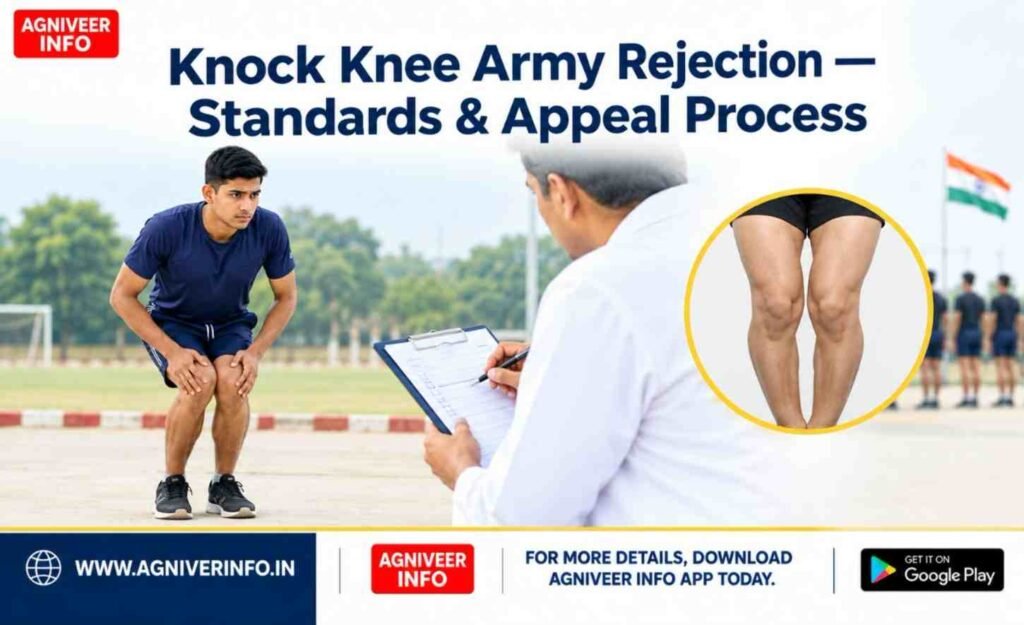
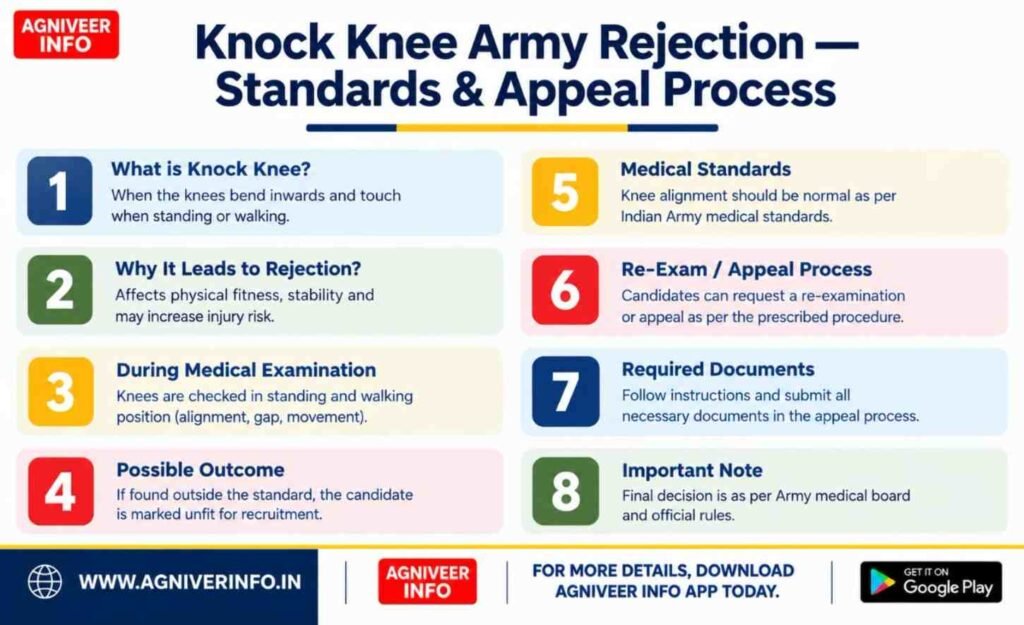
In medical language, knock knees are called Genu Valgum. It is a condition where your knees bend inward and touch each other when you stand with your ankles kept apart. For most people, this is just a natural difference in body shape and not a serious disease.
When you stand straight with your feet together, your knees should ideally sit in a natural line without touching too much or overlapping. In people with knock knees, the gap between the ankles is clearly wider than the gap between the knees. This shape is common in small children while they grow, and it often corrects itself on its own. In adults, it is usually a harmless body trait, even though in extreme cases it can sometimes affect the way a person walks or runs over long distances.
2. Does Knock Knee Automatically Mean Army Rejection?
No, having knock knees does not mean you will be rejected automatically. Many candidates wrongly think that if their knees touch during a self-test, they will be marked “unfit.” The Indian Army medical board looks at whether your body works well, and not at whether your legs look perfect.
The main worry for the Armed Forces is whether your leg shape will stop you from doing hard physical work like marching, running with a heavy load, or going through combat training. If your knees touch a little but you have no pain, no shakiness, and no trouble in moving, you may still be considered medically fit, because the medical officers are trained to tell the difference between a small natural variation and a real disability.
3. What Are the Army Standards for Knock Knees?
The Indian Armed Forces follow the Medical Examination Standards for Entry into the Armed Forces. These rules are made so that every soldier can handle the physical hardships of military life. Doctors use measurements like the inter-malleolar distance (the gap between your ankles) during the check-up, but there is no single fixed number that applies to every candidate, whatever their height or build.
Medical boards look at the “degree of valgus” (how much the legs angle inward). If the gap between the ankles is too big when the knees are touching, it may be noted as a point of concern, but the final decision is based on these things:
- Symmetry: Whether both legs have the same shape.
- Functionality: Whether you can stand and move without any discomfort.
- Pathology: Whether the condition is caused by an old bone injury or a disease.
Always check your own recruitment notification, because the standards can sometimes be different for technical and non-technical branches, or for different age groups.
4. How Is Knock Knee Tested During Medical Examination?
During your Army medical examination, a medical officer will check how your lower legs are lined up. You will be asked to stand in a relaxed, natural position, and the doctor will watch how you stand from the front. The doctor may also ask you to do simple movements, like walking or squatting, to check your balance and how well your joints move.
The doctor is looking for big differences that could make you tired too soon or cause an injury during service. They do not use complex machines or online calculators, but depend on many years of experience. The test is simple, because if you can stand and move normally without any physical problem, your condition is not likely to be a reason for rejection.
5. Home Tests — What Can They Tell You?
You may find many “DIY” (do-it-yourself) tests online that claim to tell you whether you will be rejected. These tests usually ask you to stand with your heels together and measure the gap between your knees, or the other way round. They may help you understand your general body shape, but they cannot decide whether you are medically fit for the Army.
Online tests do not have the clinical background that a proper check-up has. A doctor looks at your bone structure, your muscle mass, and the overall health of your joints, and a simple tape measure test misses all of these. You should use home tests only as a signal to meet a doctor if you feel real pain or have trouble running, and you should never use them to diagnose yourself or to give up before the official medical board has checked you.
6. Why Can Knock Knees Become a Medical Concern?
Knock knees are mostly harmless, but they can become a concern if they cause problems in movement. If the inward angle is very big, it can change your gait (the way you walk) and put uneven stress on your knee joints, ankles, and hips. Over time, this may lead to:
- Knee pain that keeps coming back during high-impact activities.
- A higher risk of ligament injuries.
- Faster wear and tear of the cartilage in the knee.
If a candidate has these problems, the medical board may mark the condition, because it is a long-term risk to the soldier’s ability to work well.
7. Can Knock Knees Be Corrected?
Whether it can be corrected depends fully on your age and how strong the inward angle is. For children, braces or physical therapy can work well, but in adults the bones have usually stopped growing, which means exercise will not “change” the bones. Still, regular strength training can help you in these ways:
- It builds more muscle support around the knee joint.
- It fixes the imbalance in the muscles of the legs.
- It improves your overall balance and how well you move.
You should meet an orthopaedic specialist (a bone and joint doctor) to find out whether your condition is only about the structure of your bones or whether it can be improved with proper physiotherapy. Never try “bone-breaking” or other extreme correction methods, because they are dangerous and doctors do not recommend them.
8. What Should a Defence Aspirant Do If Worried?
If you are worried about your physical eligibility, you can follow this simple and logical way:
| Concern | What It Means | What the Candidate Should Do |
| Knees touch | Likely a common body variation. | Keep your fitness up and get a professional opinion. |
| Pain/Discomfort | Possible problem in movement. | See an orthopaedic doctor for a check-up. |
| Medical Doubt | Not sure about your fitness. | Check the official standards and stay honest. |
- Stay Calm: Do not panic because of rumours on the internet.
- Professional Check: Visit a qualified orthopaedic doctor to talk about any pain or worry about how your legs work.
- Focus on Fitness: Keep your overall health good through regular exercise and core strengthening.
- Be Transparent: Go to the official medical exam and be honest, and do not try to hide your legs or change your posture on purpose.
9. What to Do If You Are Declared Medically Unfit
If the medical board declares you “Unfit” because of knock knees, do not lose hope. The board will give you a formal reason for the rejection, so read the medical slip that you get very carefully. If the recruitment notification allows it, you have the right to ask for a Review Medical Examination (RME).
This is a formal appeal process in which a different board of specialists examines you again. You must follow the instructions on your rejection slip, including paying the fees (if there are any) and keeping to the strict deadlines that are given. Do not trust private agents who say they can “guarantee” a medical pass, because this is often a scam. The appeal process is the only proper way to challenge the first decision.
10. Knock Knee Myths Defence Aspirants Should Ignore
- Myth: Everyone with knock knees is rejected. Fact: Only the cases that cause a real problem in movement are rejected.
- Myth: A home test confirms that you are fit. Fact: Only an authorised medical board decides your fitness.
- Myth: You can hide it during the exam. Fact: Doctors are trained to spot problems in the way your legs are lined up, so hiding it is not possible and it is also dishonest.
- Myth: Special shoes fix the shape of the bones. Fact: Insoles give comfort, but they do not change your bone structure for the medical clearance.
Conclusion
Understanding your physical health is important for every defence aspirant. Knock knees are a common topic of discussion, but they are rarely the end of a career for candidates who are otherwise physically fit. Do not judge your eligibility from online myths, home measurements, or advice that is only meant to scare you, and instead focus on keeping your fitness, strength, and overall health at a high level.
If you are worried about how your legs are lined up, meet a medical professional and ask for an honest opinion. In the end, remember that the authorised medical board, and not an online article, is the only authority that makes the final decision about your medical fitness, so go to your medical exam with confidence, honesty, and good preparation.
Get the latest Agniveer updates by joining our WhatsApp channel
Frequently Asked Questions (FAQs)
Q1. Does knock knee cause rejection in the Indian Army?
A1. Not automatically. You are rejected only if the condition is bad enough to cause problems in movement or a risk of injury during hard military training.
Q2. What is the Army standard for knock knees?
A2. There is no single “magic number.” The medical boards look at how your legs are lined up, how steady they are, and whether you can do physical tasks without pain.
Q3. How is knock knee tested during Army medical examination?
A3. Doctors check how you stand, how your legs are lined up, and how you walk, so that they can be sure your joints work properly when they carry weight.
Q4. Can exercise correct knock knees?
A4. In adults, exercise cannot change how the bones are lined up, but making the muscles around the knee stronger can improve balance and how well you perform.
Q5. Can running fix knock knees?
A5. No, running does not change the shape of the bones. It is only a test of your stamina and how steady your joints are.
Q6. Can I check knock knees at home?
A6. You can look at how you stand, but home tests cannot match the check-up of a military doctor, so do not depend on them to guess your fitness.
Q7. What should I do if I am declared medically unfit?
A7. Read your medical rejection slip carefully, understand the exact reason, and apply for a Review Medical Examination (RME) if the recruitment rules allow it.
Q8. Can I appeal an Army medical rejection for knock knees?
A8. Yes, if the entry you applied for has an appeal or review process, you have the right to ask for another check-up by a higher medical board.
READ ALSO: PRE-MEDICAL SELF-CHECKLIST FOR AGNIVEER CANDIDATES