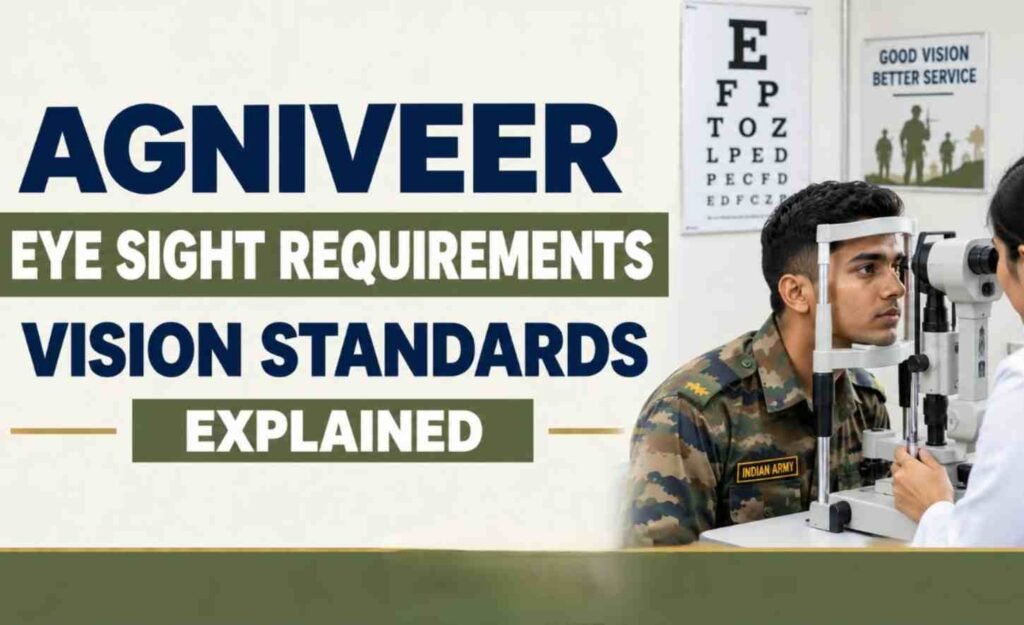
Checking your eye sight is a very important part of the Agniveer medical fitness examination across the Indian Armed Forces. Candidates who want to serve in the Indian Army, Indian Navy, or Indian Air Force need to meet certain vision standards, so that they can work efficiently, stay safe, and help the mission succeed.
In military recruitment, having good vision means more than just being able to see far away, because a candidate might see clearly in everyday life and still fail the full military medical check due to hidden refractive errors, small eye health problems, or trouble telling colours apart.
It is important to understand that sharp eyesight alone does not mean your eyes are fully fit, because the armed forces medical boards check the structure of the eye, how well both eyes work together, how stable the vision is, and how well a person can see colours.
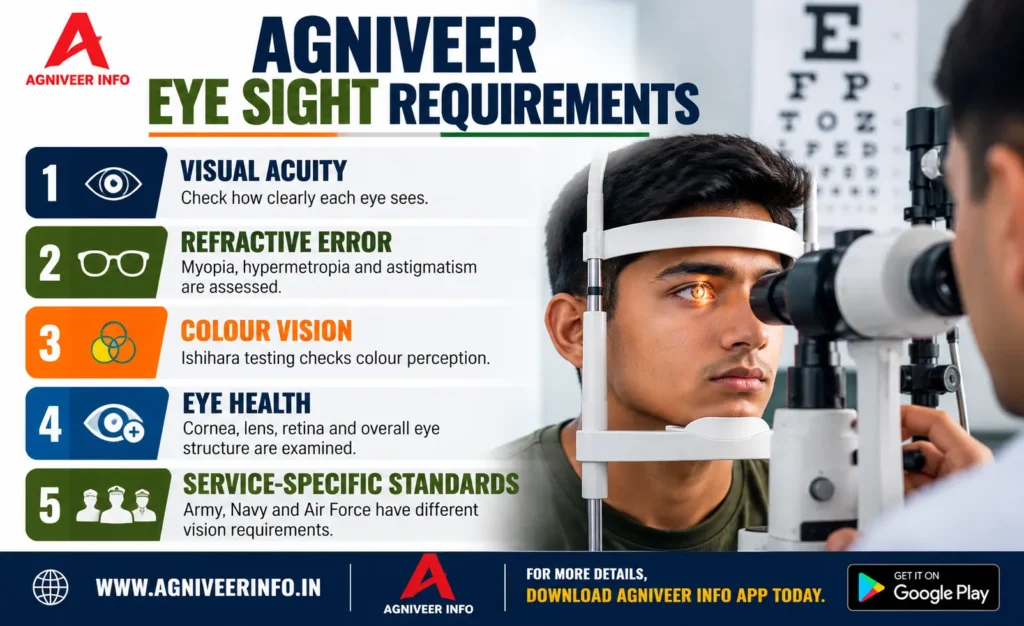
It also matters that the Indian Army, Indian Navy, and Indian Air Force do not follow one single, identical vision standard, since each service works in a different kind of environment, ranging from ground combat and sea operations to high-altitude flying, and this is why each one sets its own vision rules. This guide explains the vision standards across all three services, and helps you understand visual sharpness, how the testing is done, the limits on refractive errors, and how to check your medical eligibility correctly.
What Are Agniveer Eye Sight Requirements?
Agniveer eyesight requirements cover the full picture of what is expected from a candidate’s vision during the military medical check. Visual acuity, which is how sharply a person can see, forms the basic part of this check, and it is measured by how clearly a candidate can read letters or symbols placed at a fixed distance. Medical boards check both uncorrected vision, meaning how well you see without glasses, and corrected vision, meaning how clearly you see using the glasses prescribed to you.
Along with sharpness, military doctors also check for refractive error, which means optical problems like myopia, hypermetropia, and astigmatism that stop light from focusing correctly on the retina. At the same time, they look closely at the overall health of the eye, to check for any active infection, structural problem, scarring on the cornea, or disease in the retina. To be medically fit, a candidate needs both clear outer vision and healthy inner eye structure, so that they can handle tough operational environments.
How Is Eyesight Tested During the Agniveer Medical Examination?
The medical board carries out a proper eye check using standard clinical tools during the recruitment rallies and at the selection centres. The vision test usually starts with the Snellen chart, kept at a fixed distance, where candidates read smaller and smaller lines of text with each eye checked separately. If any problem is found, a refraction test is done next, to see whether using spherical or cylindrical lenses can improve the sharpness of vision. Medical officers also check colour vision using Ishihara plates, which are special charts used to check whether a person can tell colours apart correctly.
A slit-lamp exam and an ophthalmoscopy are also done, so doctors can look closely at the cornea, lens, and the back of the eye for any hidden problem. Candidates should know that the exact testing can change depending on the entry, the technical trade, and the service branch, which means some specialised roles may involve extra eye tests.
What Does 6/6 Vision Mean?
When measuring visual sharpness, 6/6 vision means normal sharpness recorded at a distance of six metres. The first number shows the testing distance of six metres, while the second number shows the distance at which a person with normal eyesight can comfortably read the same line on the eye chart. A reading of 6/6 means the sharpest, clearest vision, while readings like 6/9 or 6/12 mean the uncorrected vision is somewhat weaker.
Having 6/6 vision in both eyes is a good sign, but it does not automatically mean you are fully fit medically if there is a structural problem or a colour vision issue underneath. On the other hand, some non-combat military roles allow small variations in vision, within limits that are clearly stated in the official notice.
Myopia, Hypermetropia and Astigmatism
Refractive errors are common eye conditions that can affect whether a candidate is suitable for military service. Myopia, or short-sightedness, happens when far-off objects look blurry because light focuses in front of the retina instead of directly on it. Hypermetropia, or long-sightedness, makes it hard to focus on close objects, because in this case light focuses behind the retina. Astigmatism happens when the cornea or the lens is not shaped evenly, which causes blurred or distorted vision at different distances.
During the Agniveer medical check, doctors measure these errors in a unit called dioptres. Having a refractive error does not mean instant rejection for every trade, but each entry sets a clear limit on how much spherical and cylindrical correction is allowed, so that operational safety is maintained out in the field.
Can Candidates Wearing Spectacles Apply for Agniveer?
Yes, candidates who wear prescription glasses can apply for certain Agniveer entries, as long as their corrected vision meets the official service standard and their refractive error stays within the allowed limit in dioptres. Whether you are eligible depends a lot on the specific branch, the entry stream, and the kind of duty assigned. While technical or office-based trades in some services allow a small amount of correction with glasses, roles that involve heavy combat on the ground, or specialised naval and flying branches, often need strict uncorrected sharpness.
So simply wearing glasses does not lead to automatic rejection, but candidates need to make sure that both their uncorrected vision and their corrected vision match what is stated in the current recruitment notice for their chosen trade.
Colour Vision and Agniveer Eyesight
Colour vision is another important part of the military medical check, and it is separate from refractive error or general sharpness. Military personnel need to correctly identify signals, navigation lights, camouflage patterns, and tactical markers, often in difficult conditions, so a problem in telling red from green, or blue from yellow, can affect operational safety and how well a mission is carried out.
Candidates are tested using Ishihara colour plates, which decide their colour vision grade. The exact colour vision standard changes quite a bit depending on the service branch and the type of duty, which means a candidate with sharp 6/6 vision could still be marked unfit if their colour vision does not meet the level required for their chosen branch.
Army Agniveer Eye Sight Standards
The Indian Army sets detailed vision standards for its different Agniveer categories, which include General Duty, Technical, Clerk, and Tradesmen entries. Combat-focused entries such as Agniveer General Duty usually need high uncorrected sharpness, so that soldiers stay fully ready in combat areas. Technical and office-based categories may allow a small amount of correction, as long as the corrected vision reaches the required standard.
Colour vision expectations stay high across the board, especially for roles that need precise target spotting and tactical signalling. Candidates should check the trade-specific medical standards given in the official rally notice, since the physical and visual requirements are different for general combat roles compared to specialised technical support roles.
Navy Agniveer Eye Sight Standards
The Indian Navy sets strict vision rules for both the Agniveer SSR (Senior Secondary Recruit) and MR (Musician/Chef/Steward) branches, because of the special challenges of working at sea. Naval personnel work on ships, submarines, and coastal stations, where low-light navigation, signalling, and the safety of the vessel matter a great deal, so uncorrected visual sharpness is strictly required for seamanship and other operational duties.
Corrected vision with glasses is only allowed within a set refractive limit for certain non-operational entries. Colour vision standards remain very strict across most naval branches, because being able to tell apart navigation lights, night flares, and sea signals is vital for the safety of the ship and everyone on board.
Air Force Agniveervayu Eye Sight Standards
The Indian Air Force sets its own vision rules for Agniveervayu entries, with clear standards for both the Science and Non-Science streams. The vision standards for ground duties are quite different from those for specialised flying or flight-line roles. Even though candidates often assume that the very strict vision rules for flying branches apply to every Air Force role, ground support branches actually allow a certain limit of refractive error and correction with glasses.
Candidates need to meet the stated visual sharpness standard along with an acceptable level of colour vision. Air Force medical boards also carry out a detailed eye exam to check binocular vision, eye muscle balance, and overall eye health, to make sure candidates can safely handle the specialised work at an air base.
Common Eye Conditions Candidates Ask About
Aspirants often ask about common eye conditions and how they affect their medical fitness for recruitment. Conditions such as squint (called strabismus), drooping eyelids (called ptosis), long-term eyelid inflammation (called blepharitis), scarring on the cornea, and diseases of the retina are all closely checked by the military medical board. Structural problems or an imbalance in the eye muscles that affect how well both eyes work together, or reduce the field of view, generally lead to a candidate being marked unfit.
Eye injuries that have left permanent scarring on the cornea, or cloudiness inside the eye, are also checked in detail. In the end, the final medical decision is made only by authorised military medical officers, based on a proper clinical exam, following the medical manual used for armed forces recruitment.
Does LASIK or Previous Eye Surgery Affect Agniveer Eligibility?
Refractive surgeries such as LASIK, PRK, and SMILE are a common concern for candidates who have had vision correction done. The military rules on past corneal surgery change depending on the service branch, the type of entry, the candidate’s age, how stable their eyes are after the surgery, and the thickness of the cornea. Some entries do not allow any past refractive surgery at all, and mark candidates who have had LASIK as unfit, because of the risk of problems with the corneal flap under extreme stress or pressure.
Where surgery is allowed, strict conditions apply, such as a minimum waiting period after the surgery, stable vision, a normal shape of the cornea, and no complications. Candidates should never go for refractive surgery just assuming it will guarantee that they qualify, without first checking the official rules.
| Vision Area | Army | Navy | Air Force |
| Visual Acuity | Standards vary by trade; combat entries mandate high uncorrected visual sharpness. | Uncorrected sharpness required for seamanship; specific entries permit corrected vision. | Varies by stream; ground duties permit specified corrected visual metrics. |
| Refractive Error | Strict limits apply; minor spherical or cylindrical corrections allowed for technical roles. | Permissible limits restricted based on branch; non-operational roles allow specific corrections. | Defined dioptric limits apply; specific entries permit limited optical lens corrections. |
| Colour Vision | High color perception required; thresholds depend on combat and technical allocations. | Rigid color vision standards enforced due to maritime signaling and vessel navigation needs. | Color perception standards enforced according to ground support and technical duty demands. |
| Role-Specific Requirements | General Duty demands strict field fitness; technical trades allow defined spectacle usage. | Maritime operational roles enforce uncorrected sharpness; administrative roles permit limited correction. | Aviation-adjacent entries enforce strict visual criteria; general ground duties allow minor variations. |
Conclusion
Understanding the Agniveer eyesight requirements matters a lot for candidates who are getting ready to join the Indian Army, Indian Navy, or Indian Air Force. Being fit in terms of vision covers sharpness, stable refraction, healthy eyes, and good colour vision, and since the working conditions differ from one service to another, each branch sets its own vision standard based on its trades and duties.
Wearing glasses or having a small refractive error does not lead to automatic rejection everywhere, and having perfect 6/6 vision also does not guarantee that you are fit, if there is a structural or colour vision problem underneath. Candidates should get their eyes checked properly through a certified clinical exam, and should always check the exact numbers against the official recruitment notice. Taking this informed and proactive approach will help aspirants prepare well for their medical screening.
Get the latest Agniveer updates by joining our WhatsApp channel
Frequently Asked Questions
Q1. What eyesight is required for Agniveer recruitment?
A1. The eyesight required changes across Army, Navy, and Air Force entries, and it is judged on uncorrected visual sharpness, corrected vision, limits on refractive error, and colour vision standards.
Q2. Is 6/6 vision mandatory for every Agniveer entry?
A2. No, 6/6 uncorrected vision is not required for every entry, since certain technical and non-combat trades allow small variations in vision or correction with glasses.
Q3. Can candidates wearing spectacles apply for Agniveer?
A3. Yes, candidates who wear spectacles can apply for specific Agniveer trades, as long as their corrected vision and refractive error stay within the limits given in the official service notice.
Q4. Are Army, Navy and Air Force eyesight standards identical?
A4. No, the standards for the Army, Navy, and Air Force are quite different, since each service sets its vision requirements based on its own unique operational and environmental needs.
Q5. Does colour blindness affect Agniveer eligibility?
A5. Yes, colour blindness or any trouble in telling colours apart affects eligibility, since each service branch sets a specific colour vision grade needed for operational safety and tactical duties.
Q6. Can myopia or hypermetropia affect medical fitness?
A6. Yes, refractive errors like myopia or hypermetropia can affect your fitness if the dioptre value goes above the maximum limit set for that particular entry.
Q7. Does LASIK affect Agniveer medical eligibility?
A7. The rules on LASIK depend on the service branch, the entry stream, the waiting period after the surgery, how stable the cornea is, and the specific medical standards given in the official notice.
Q8. Where can candidates verify official eyesight standards?
A8. Candidates should check the official eyesight standards only through the current recruitment notices published on the official recruitment portals of the Indian Armed Services.
👉 Check the knock knee rejection criteria and appeal process.