

Source: Join Indian Army
When you see an Indian Army soldier in uniform, you have probably noticed the shiny stars, golden stripes, or metal badges on their shoulders, and these are not there just for decoration. They are the official Indian Army rank insignia (the badges that show a soldier’s rank), and each one tells you the person’s position, how senior they are, and how much responsibility they carry. In the army, rank is the base of discipline and command, because it tells everyone who is in charge and who must handle which task, whether during training or on the battlefield.
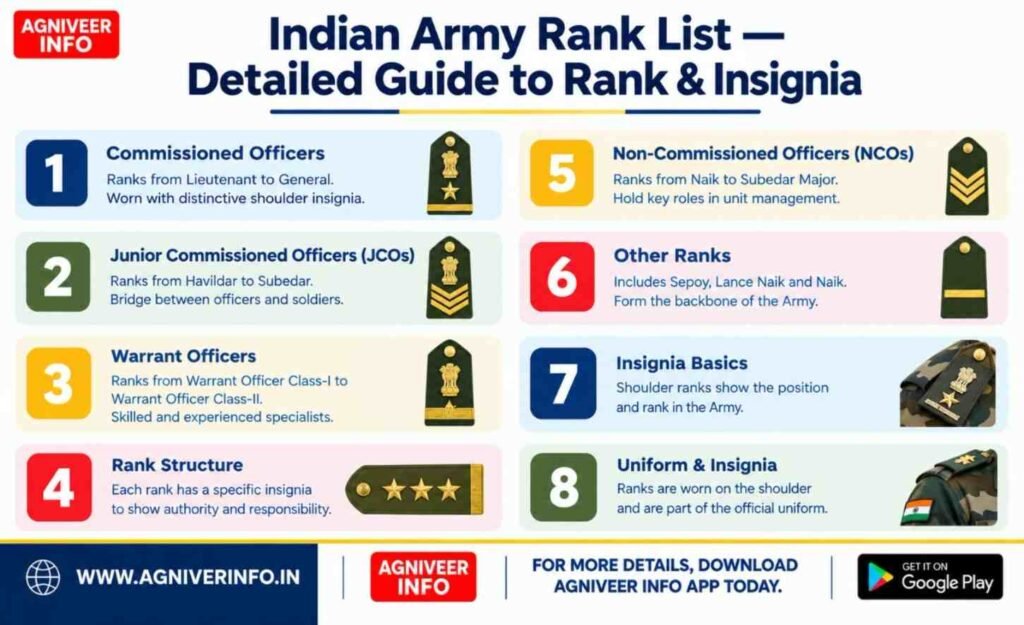
The Indian Army follows a well-planned hierarchy (a ladder of ranks) with three main groups: Commissioned Officers, Junior Commissioned Officers (JCOs), and Other Ranks (ORs). Knowing this system is important if you care about the country’s security or want to build a career in the defence forces. It may look complicated at first, but it follows a clear pattern of who gives orders and who follows them, and this guide will explain the Indian Army rank list and what the symbols on the uniform really mean in simple words.
1. WHAT IS AN ARMY RANK?
A military rank is a grade that shows how much authority and responsibility a person has inside the army. You can think of it like a ladder in a company, except that here the decisions can affect lives. Rank makes sure there is always a clear chain of command, so when an order is given, everyone knows whom to follow. The insignia, which are the metal or embroidered symbols worn on the shoulders, work like a visual language, and they let a soldier see how senior another person is at a glance, even if they have never met before.
2. INDIAN ARMY RANK STRUCTURE
The Indian Army is led by Commissioned Officers. These officers hold a “President’s Commission,” which means the President of India has officially appointed them to command troops.
Commissioned Officer Ranks
- Lieutenant: This is the first rank of a commissioned officer, and a Lieutenant usually commands a platoon of about 30–40 soldiers.
- Captain: A Captain is an officer with a few years of experience, and usually commands a company or works as a staff officer.
- Major: This is a mid-level rank, and a Major takes bigger tactical decisions and looks after administrative work inside a battalion.
- Lieutenant Colonel: A Lieutenant Colonel often commands a battalion, which has several hundred soldiers.
- Colonel: This is a senior rank, and a Colonel commands a battalion or works in high-level staff jobs.
- Brigadier: A Brigadier commands a brigade, which is a group of three or more battalions.
- Major General: A Major General commands a division, which has around 15,000 soldiers.
- Lieutenant General: A Lieutenant General commands a corps, which can have 40,000 to 80,000 soldiers.
- General: This is the highest active rank in the Indian Army, and it is held by the Chief of the Army Staff.
3. JUNIOR COMMISSIONED OFFICER (JCO) RANKS
JCOs are the backbone of the Indian Army, because they connect the commissioned officers with the soldiers. They are very experienced soldiers who have moved up through the ranks because of their years of service and their ability to lead.
- Naib Subedar: This is the first JCO rank.
- Subedar: A Subedar is a senior JCO with a lot of experience in handling troop discipline and training.
- Subedar Major: This is the highest JCO rank in a unit, and the Subedar Major works as the main adviser to the Commanding Officer.
4. OTHER RANKS (ORs)
The “Other Ranks” group includes the soldiers who make up most of the army’s strength, and they are the ones who carry out the missions on the ground.
- Sepoy: This is the first rank for a new recruit.
- Lance Naik: A Lance Naik is a soldier with some seniority, and is often given small leadership tasks.
- Naik: A Naik is a non-commissioned officer (a leader who rose up from the soldiers, not through an officer’s commission) and is responsible for leading small teams.
- Havildar: A Havildar is a senior non-commissioned officer who helps keep discipline at the platoon level.
QUICK REFERENCE TABLE: INDIAN ARMY RANKS
| Category | Rank | Basic Insignia | Position |
| Officer | General | State Emblem & Baton/Sabre | Army Chief |
| Officer | Colonel | State Emblem & Two Stars | Unit Commander |
| Officer | Lieutenant | Two Stars | Platoon Commander |
| JCO | Subedar Major | State Emblem & Gold Strip | Unit Advisor |
5. HOW TO IDENTIFY AN ARMY OFFICER’S RANK
To find out an officer’s rank, always look at the shoulder boards, which are also called epaulettes, because officers wear their rank insignia on their shoulders.
- Stars: These are the most common signs of rank, so a Lieutenant wears two stars, a Captain wears three, and a Major wears the State Emblem (the Ashoka Lion).
- The State Emblem: This is the highest symbol of authority, and it appears on ranks from Major up to General.
- Crossed Baton and Sabre: General-rank officers use this symbol to show top-level command.
6. DIFFERENCE BETWEEN RANK AND APPOINTMENT
A common mistake among beginners is to mix up rank and appointment. Rank is your permanent place in the army ladder, for example Colonel, while an appointment is the particular job you are doing at the moment, for example Commanding Officer. A Colonel may be the Commanding Officer of a battalion today, and next year the same Colonel may be an Instructor at an academy, so the rank stays Colonel but the appointment changes according to what the army needs.
7. RANK VS. REGIMENT VS. CORPS
It is important to know how these three identifiers are different from each other.
- Rank: This is your position on the ladder, for example Major.
- Regiment: This is your organisational family, for example the Sikh Regiment or the Gorkha Rifles, and soldiers wear a special cap badge to show which regiment they belong to.
- Corps: This is your professional function, for example the Corps of Engineers or the Army Medical Corps, and it shows your technical skill, such as building bridges, handling supplies, or giving medical care.
8. COMMON CONFUSIONS
Please keep these common wrong ideas in mind so that you do not fall for them.
- Badges vs. Ranks: Do not take a qualification badge, like a Parachute Wing or a Commando badge, for a rank, because many soldiers wear skill badges that have nothing to do with seniority.
- Service Branch: Do not compare Army ranks with Navy or Air Force ranks, because even though the levels are similar, the names and the insignia are completely different.
- JCOs: People often think JCOs are Commissioned Officers because they wear badges on their shoulders, but JCOs are a separate category that sits between Other Ranks and Officers.
CONCLUSION
The Indian Army rank system is a carefully made framework that keeps the work efficient and the leadership clear. Once you understand the difference between Commissioned Officers, JCOs, and Other Ranks, it becomes easier to see how the army works. A soldier’s identity comes from their rank, their regiment, and their corps together, and even though insignia are a quick way to see seniority,
they really stand for a lifetime of hard work, training, and service to the nation. In the future, whenever you want to check a rank, rely on official Indian Army sources so that you avoid common wrong ideas, whether you are an aspiring candidate or just a curious citizen, because knowing these symbols is the first step toward respecting the system that keeps our borders safe.
Get the latest Agniveer updates by joining our WhatsApp channel
FREQUENTLY ASKED QUESTIONS (FAQS)
Q1. What is the highest rank in the Indian Army?
A1. The highest active rank is General, which is held by the Chief of the Army Staff. There is also a ceremonial rank called Field Marshal, which is a five-star rank, but it is only an honorary rank today and not an active one.
Q2. What is the lowest commissioned officer rank?
A2. The lowest commissioned officer rank is Lieutenant, and an officer gets it after finishing training at places like the Indian Military Academy (IMA) or the Officers Training Academy (OTA).
Q3. How can you identify an Army officer’s rank?
A3. You can find an officer’s rank by looking at the shoulder epaulettes, which usually have a mix of metal stars and the State Emblem (the Ashoka Lion) to show how senior the officer is.
Q4. What are the JCO ranks?
A4. The three Junior Commissioned Officer ranks are Naib Subedar, Subedar, and Subedar Major, and they act as the main link between the officers who plan the operations and the soldiers who carry them out on the ground.
Q5. What are the ranks below JCO level?
A5. The ranks below the JCO level are called Other Ranks (OR), and they include Sepoy, Lance Naik, Naik, and Havildar, who are the main fighting force and also hold important non-commissioned leadership roles.
Q6. What is the difference between rank and appointment?
A6. Rank is your permanent level of seniority in the army, while an appointment is the particular duty given to you, such as “Adjutant” or “Company Commander,” so one rank can hold many different appointments over time.
Q7. What do stars and other insignia mean?
A7. Stars and symbols work like a visual code for the ladder of ranks, so more stars, or the State Emblem added to them, show a higher level of command and more responsibility, and this lets soldiers see a leader’s authority at once.
Q8. Are Indian Army ranks different from Navy and Air Force ranks?
A8. Yes, they are different, because even though the command structure is similar, the names are not the same. For example, an Army General is equal to a Navy Admiral and an Air Force Air Chief Marshal, and the style of insignia also differs a lot between the three forces.
READ ALSO: KNOCK KNEE ARMY REJECTION — ELIGIBILITY STANDARDS & APPEAL PROCESS