

Getting through the Indian Army physical efficiency test needs a good mix of strength, stamina, and careful control of your body. Among the many physical challenges checked during recruitment rallies, the Agniveer Zig-Zag Balance Test stands out as a special test of balance and coordination.
While events like the sixteen-hundred-metre run test your stamina, this obstacle checks how well a candidate controls their body weight while moving in different directions. Aspiring candidates often make the mistake of treating every recruitment event as a test of pure speed, but rushing through an obstacle that is all about balance, without understanding how the movement actually works, often leads to sudden slips, loss of control, and instant disqualification.
To do well, candidates need to understand that steady balance, careful foot placement, and a calm mind matter just as much as raw athletic power. This complete guide explains how the test is conducted, the main skills it checks, useful practice routines, common mistakes to avoid, and safe ways to prepare.
What Is the Agniveer Zig-Zag Balance Test?
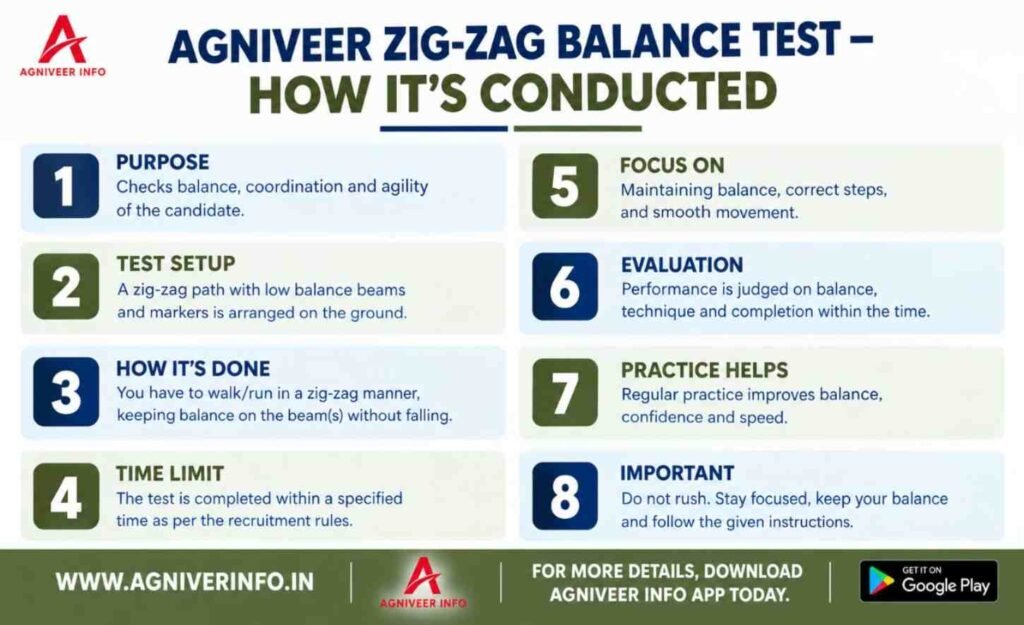
The Agniveer Zig-Zag Balance Test is an important physical screening event, designed to check an aspirant’s balance while moving, their agility, and how well their body parts work together. In real military operations, soldiers often have to move over uneven ground, narrow paths, raised structures, and sudden obstacles, all while carrying equipment.
This physical fitness test copies those real demands, by asking candidates to cross a narrow path that changes direction, without stepping off or losing balance.
It is not just a drill for leg strength, and it is really a full movement check that looks at how stable your lower body is, how well your joints sense their position, and how aware you are of the space around you, all under pressure. Candidates should understand that the official recruitment notice decides the exact design, length, and layout of the obstacle. While the main aim stays the same across recruitment rallies, the exact equipment setup or the size of the structure may differ, depending on the arrangements made by the recruitment board at that ground.
How Is the Zig-Zag Balance Test Conducted?
Knowing how the test is actually carried out helps candidates walk up to the starting line with confidence. On rally day, candidates are called forward in organised batches, to try the obstacle under the watch of the recruitment officers. The test starts with the candidate standing at a marked starting point, at one end of the narrow zig-zag track. Once the evaluator gives the signal, the candidate moves along the path, keeping their balance the whole time, while changing direction at each turn of the structure.
A successful attempt means moving through the whole path smoothly, without touching the ground outside the marked track, or falling off the structure. Depending on the specific rally guidelines for a category, evaluators also check whether the movement is finished in a steady flow, without stopping. Losing your balance, stepping off the raised structure, or not following the marked track counts as a failed attempt. Since the specific rules on the number of attempts or scoring can differ by recruitment notice, candidates need to listen carefully to the officer’s instructions during the briefing before the test.
What Skills Does the Zig-Zag Balance Test Require?
Getting across a narrow path that keeps changing direction needs several physical qualities to work together. The main skill is balance while moving, which lets the body stay steady even when it is in motion. Supporting this is the strength of your joints, especially your ankles and knees, which take the sideways force during sharp turns. Core strength is just as important, since it keeps your upper body straight and stops it from swaying too much, which could throw off your balance.
On top of this, control of the lower body and awareness of space let candidates judge distances properly, and place their feet firmly. Quick changes of direction need controlled speeding up and slowing down, which depends on muscles working well together, rather than just brute force. Finally, a focused mind matters a great deal, since nervousness or rushed movement breaks your body’s rhythm, and leads to misplaced steps.
Correct Technique for Better Balance
Learning the correct body technique greatly lowers the chance of making mistakes during the test. Candidates should keep an upright but flexible posture, with the knees slightly bent, to lower the body’s centre and absorb the movement smoothly. Instead of staring straight down at their feet, which can spoil your posture, candidates should look a few steps ahead along the path.
Steps should be controlled, short, and steady, rather than long or rushed. Using your arms naturally, like counterweights, gives you instant balance correction when you change direction. Keeping your body relaxed stops it from getting stiff, and lets you adjust smoothly at every turn.
How to Improve Balance for the Test
Building better balance needs targeted physical training that strengthens the muscles that steady your ankles, hips, and core. Adding simple balance exercises into your daily training builds long-term joint strength and control over your movements.
- Single-Leg Balance Stand: Standing on one foot builds ankle strength and joint stability.
- Heel-to-Toe Walking: Walking in a straight line, with your feet placed close together, improves your control of space.
- Controlled Step-Ups: Stepping onto a stable platform improves the strength of each leg and your hips.
- Single-Leg Calf Raises: Slowly lifting your heel builds strength in the calf muscles and the ankle joints.
Practice Drills for Zig-Zag Movement
Moving from standing balance to balance while moving needs structured practice drills. Building up step by step lets the body adjust safely to quick changes of direction.
- Straight-Line Balance Walk: Practise walking along a narrow line drawn on flat ground, to build steady foot placement.
- Cone-Based Zig-Zag Walk: Set up cones in a staggered pattern, and walk smoothly between them, focusing on clean direction changes.
- Cone-Based Zig-Zag Jog: Slowly increase your speed to a controlled jog, focusing on steady footwork rather than high speed.
- Controlled Deceleration Drills: Practise coming to a balanced, controlled pause at each turn point, to master body stability.
Speed vs Balance — What Should You Prioritize?
When trying an obstacle that is all about balance, speed without control almost always leads to failure. Candidates often make the mistake of sprinting into the obstacle, only to lose control at the very first turn. Giving balance more importance than raw speed lets you place your feet precisely, and keep a steady rhythm. As your muscle memory and stability improve through regular practice, your speed goes up naturally, without putting your safety at risk. During the actual test, keeping a steady, controlled pace works far better than moving recklessly fast.
Common Mistakes Candidates Make
- Moving Too Quickly: Sprinting makes you lose control, and leads to stepping off the path.
- Looking Stiffly Downward: Staring straight at your feet spoils your posture, and upsets your overall balance.
- Taking Overly Long Strides: Taking huge steps unsettles your body’s centre during turns.
- Flailing Arms Uncontrollably: Wild arm swings build unnecessary momentum, and pull your upper body off balance.
- Ignoring Ankle Conditioning: Skipping ankle stability exercises leaves your joints open to sudden wobbles.
- Panicking During Minor Wobbles: Overreacting to a slight loss of balance often leads to falling off completely.
Warm-Up Before Balance Practice
A proper warm-up gets your nerves and joints ready for balance work. Candidates should begin with light cardio, such as easy jogging, to raise the body’s temperature. Ankle rotations, leg swings, and hip movement exercises get the lower body ready for quick changes of direction. Adding short single-leg holds wakes up your core and the muscles that steady you, before you start the balance drills.
How to Practise Safely
Safety must always come first during every preparation session. Candidates should train on flat, non-slippery ground, free from debris or anything dangerous. Homemade raised structures that carry a high risk should be strictly avoided, to prevent falls and injuries. Stop training right away if you feel pain in a joint, and take enough rest between sessions.
How to Prepare in the Final Week
The final week before the rally should focus on recovery, light polishing of your technique, and mental preparation. Avoid heavy or tiring workouts that could strain a muscle, or leave your ankles tired. Keep yourself hydrated, get restful sleep, and go over the smooth movement technique in your mind.
What to Expect on the Day of the Test
On rally day, arrive well rested, and listen carefully to all the official briefings given by the officers. Watch other candidates to understand how the test flows, but stay completely focused on your own attempt. Stay calm at the starting line, take a deep breath, and carry out the obstacle with controlled, confident footwork.
| Preparation Area | Main Focus | Why It Matters | Common Mistake |
| Balance | Single-leg stability | Prevents wobbling on turns | Moving too quickly |
| Footwork | Controlled step placement | Ensures track alignment | Taking oversized steps |
| Core Control | Torso posture upright | Maintains centre of mass | Leaning forward excessively |
| Direction Changes | Smooth hip rotation | Allows seamless turn execution | Stopping momentum completely |
Conclusion
To clear the Agniveer Zig-Zag Balance Test, you need a mix of balance while moving, strong core control, steady ankles, and a focused mind. By understanding how the test is conducted, and avoiding common mistakes like rushing or poor posture, candidates can get through the obstacle smoothly. Always check the latest official Indian Army recruitment notice for the correct rules on the physical test requirements.
For daily update join our WhatsApp channel
Frequently Asked Questions
Q1. What is the Agniveer Zig-Zag Balance Test?
A1. It is an Army physical efficiency test that checks an aspirant’s balance while moving, agility, and body control along a narrow path that changes direction.
Q2. How is the Zig-Zag Balance Test conducted?
A2. Candidates move along a narrow zig-zag track, with an evaluator watching, and they need to keep their balance the whole time, without stepping off or falling during the attempt.
Q3. Which exercises improve balance for the test?
A3. Single-leg balance holds, heel-to-toe walking, controlled step-ups, single-leg calf raises, and basic core exercises build very good stability and ankle strength.
Q4. Should I focus on speed or balance first?
A4. Candidates should give balance and control priority first, since speed improves naturally once proper posture, footwork, and core stability are fully developed.
Q5. How can I improve footwork for zig-zag movement?
A5. Practise cone drills on flat ground, take short, controlled steps, keep your knees flexible, and keep a steady rhythm through each change of direction.
Q6. Should I practise the balance test every day?
A6. Heavy daily practice is not needed. Practising balance drills three times a week gives enough adjustment to the body, while avoiding tiredness and too much strain on the joints.
Q7. What mistakes should I avoid during the test?
A7. Avoid rushing carelessly, staring straight at your feet, taking oversized steps, swinging your arms wildly, and panicking when you feel a small shift in your balance.
Q8. Where can I check the latest Agniveer physical-test requirements?
A8. Always check the current physical standards, test format, and rally instructions directly on the official Indian Army recruitment website and in the latest official recruitment notice.
READ ALSO: AGNIVEER VAYU (IAF) – TECHNICAL & NON-TECHNICAL TRADES GUIDE