Source: Official sites: Join Indian Army | Join Indian Navy | Indian Air Force
Going through the medical standards for Indian defence recruitment needs very careful attention, especially when it comes to body art. The Tattoo Policy for Agniveer candidates across the Indian Armed Forces works as an important filter during the first physical and medical examinations. Many aspirants wrongly think that a small or decorative tattoo will pass the check without any problem.
But the recruitment boards do not judge body art only by its size, because they carefully look at the exact place on the body, how visible it is in the standard service uniform, and what the design actually shows. Since military service needs uniform discipline and a professional look that is the same for everyone, candidates should study the official guidelines well before they turn up for the selection tests.
Whether a tattoo is accepted or not is quite different depending on the branch of service, the entry category, and the candidate’s own background. The Indian Army, Indian Navy, and Indian Air Force follow more or less the same idea about looking uniform, but each service’s own instructions have small differences about body areas and the exceptions that are allowed.
There are also clear exceptions for recognised tribal communities, as long as they meet the official documentation rules. Aspirants should never trust old blogs or unchecked charts found online, since the official notification published for each recruitment rally is the final word. This guide explains the areas that are allowed, the areas that are restricted, the kind of content that is not allowed, and the rules that are specific to each service in defence recruitment.
What Is the Defence Tattoo Policy?
The defence tattoo policy is a set of medical and appearance rules that decides whether a candidate’s permanent body art can be accepted for military service. These standards are set directly by the medical authorities of the armed forces, and they make sure that personnel look the same across every branch. The policy judges permanent marks on two main points, which are where they are on the body and what the picture or text actually shows.
The recruitment medical boards check every candidate to see that these rules are followed. Small marks that cannot be seen may be allowed in certain cases, but body art on parts of the body that are easily seen usually leads to rejection. Aspirants should not depend on unofficial charts found online, because the official defence medical standards are changed from time to time to match the current recruitment rules for Agniveer entries.
Why Are Tattoos Restricted in Defence Recruitment?
The main reason for putting limits on body art in defence recruitment is to keep military discipline, a professional look, and the same appearance for everyone. When wearing the standard service uniform, sportswear, or combat dress, service members are expected to look neat and the same as one another, and permanent marks on parts of the body that are easily seen break this uniform look.
Also, some marks can cause problems in the field, or become a security risk, because they can be used to identify a person too easily. The limits also stop offensive, vulgar, or politically loaded symbols from being shown, since these go against the fair and disciplined spirit of the Indian Armed Forces. Having clear medical guidelines makes sure that all recruits are judged fairly under one single, standard policy.
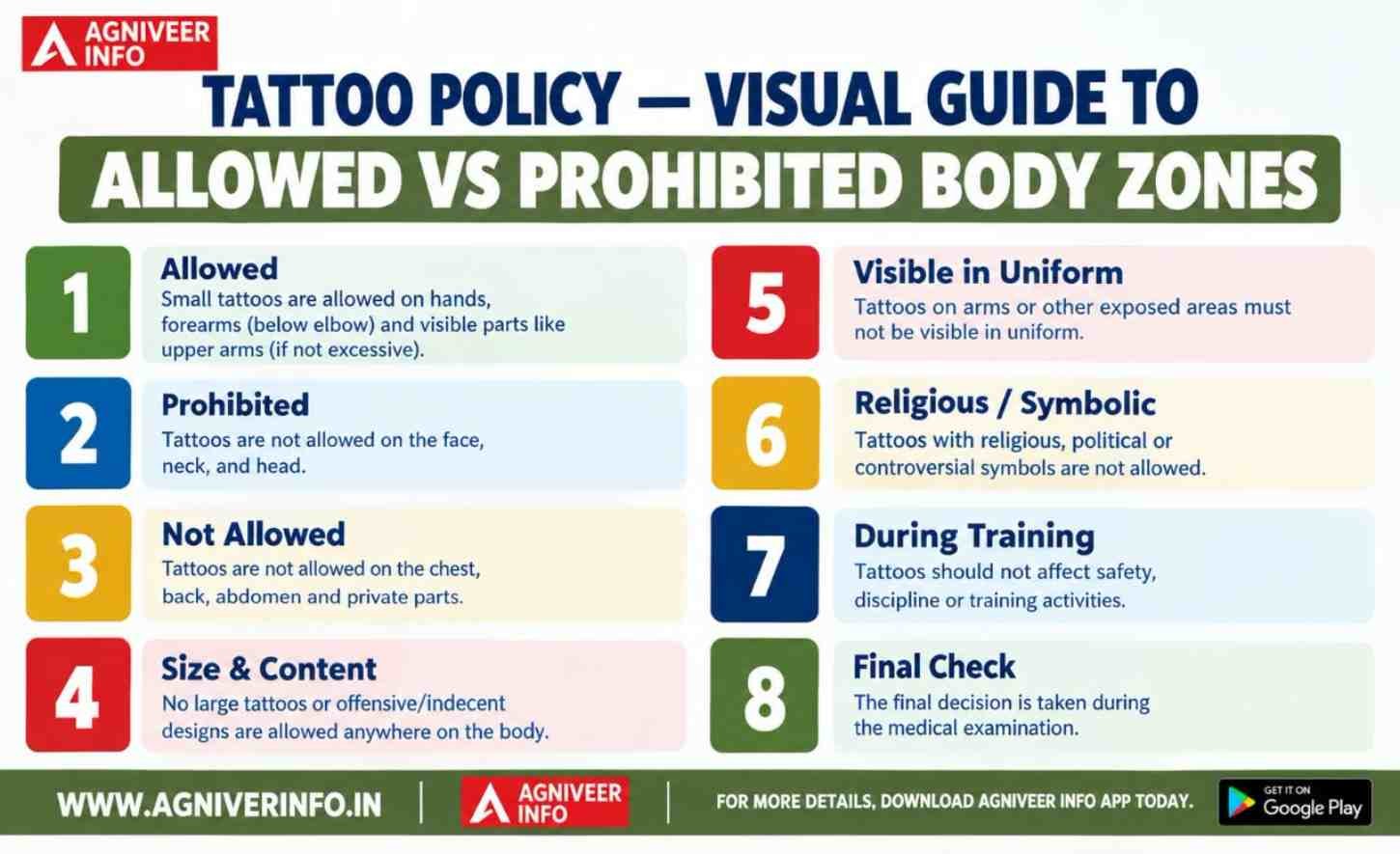
Allowed Tattoo Zones — What Candidates Should Know
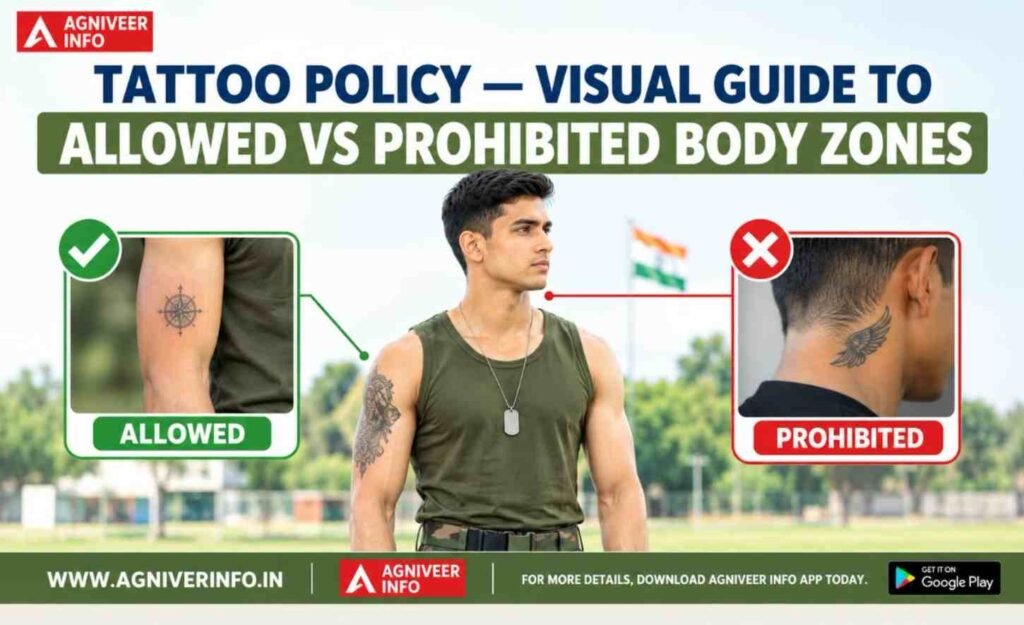
The body art that is allowed is usually kept to the parts of the body that stay fully covered by the standard military dress, or that match certain traditional customs. Under the standard guidelines, permanent body art is usually allowed only on the inner side of the forearm, which means from the inside of the elbow to the wrist, and on the back of the hand or the palm’s reverse side.
But even in these allowed areas, there are strict limits on the size, design, and content of the tattoo. The marking must not spread onto the outer forearm or cover a large area of skin. Also, the allowed areas are still checked strictly during the first medical examination, so candidates should understand that an area allowed for one service entry does not mean it will be accepted for every recruitment category.
Prohibited Tattoo Zones
The prohibited tattoo zones cover any part of the body that is seen while wearing the standard uniform or sportswear, and also areas that the medical boards judge as unsuitable. These restricted zones include:
- Face and Head: Any marking on the forehead, cheeks, jaw, ears, or scalp.
- Neck: The whole area around the neck, going down to the collarbone.
- Chest and Torso: Large body art covering the chest, ribs, stomach, or lower back.
- Upper Arms and Shoulders: Marks on the biceps, triceps, or the outer surface of the arm above the elbow.
- Legs and Feet: Permanent marks on the thighs, calves, knees, ankles, or feet.
- Outer Forearms and Fingers: The outer surface of the forearms and the individual fingers.
Tattoos in these restricted areas of the body usually lead to immediate medical rejection at the recruitment rallies.
Tattoo Content That Can Cause Rejection
Even if a permanent mark is on a body zone that could otherwise be allowed, wrong content leads straight to medical rejection. The recruitment boards keep a strict, no-tolerance rule about offensive or objectionable pictures. Content that leads to immediate rejection includes:
- Obscene, vulgar, or sexually explicit drawings or text.
- Symbols, figures, or words linked to extremist, racist, or hate-based ideas.
- Criminal symbols, gang-related marks, or symbols that show violence.
- Political slogans, party symbols, or statements that favour one side.
- Any picture or lettering that is thought to harm military discipline or national pride.
The final decision about whether the content of any body art is acceptable rests fully with the medical board officers who are present.
Tribal and Community Exceptions
Special rules exist for candidates who belong to officially recognised tribal communities, also called Scheduled Tribes (ST). Candidates from named tribal areas, who have traditional face or body markings that come from long-standing cultural customs, may be given an exemption.
But this exception is not a general permission for every tribal applicant to have a modern tattoo anywhere on the body. Tribal candidates must show official certificates given by authorised district authorities, confirming their community status and proving that the markings match traditional customs. The medical board checks these certificates against the related service instructions before it allows the candidate to be eligible.
Army Tattoo Policy
The Indian Army has clear instructions about the tattoo policy standards for Agniveers. The markings that are allowed are usually kept to the inner side of the forearm and the back of the hand, as long as the content is not objectionable.
The Army keeps a strict ban on visible marks anywhere else on the body, especially on the face, neck, and outer arms. Candidates from recognised tribal communities are allowed traditional markings, subject to their documents being checked. Candidates should look at their specific rally notification, because the medical rules are applied very strictly during recruitment.
Navy Tattoo Policy
The Indian Navy has its own set of Agniveer Tattoo Rules, to keep high standards for how personnel look and to keep the uniform look for those who serve on naval ships and at shore bases. The rules on body art in the Navy strictly limit any marks that are visible while wearing the working uniform.
Permanent marks on body parts that are easily seen, such as the face, neck, upper arms, and legs, are strictly not allowed. Small marks on the inner forearm may be checked under the standard guidelines, but the Navy checks candidates carefully to make sure the skin is healthy and that they are ready for their duties. Applicants should check the latest Navy recruitment notifications for the exact rules of their entry.
Air Force Tattoo Policy
The Indian Air Force follows strict medical standards for Agniveervayu recruitment entries. The tattoo rules for defence recruitment in the Air Force say that candidates must not show marks that spoil a clean, professional uniform look.
Body art on the face, neck, head, or outer limbs is strictly not allowed. There are only a few exceptions, and they are carefully controlled, mostly applying to traditional tribal customs that are backed by valid documents. Candidates who apply for Air Force selection must make sure they fully follow the Air Force medical instructions published in the official notifications.
What Happens If You Already Have a Tattoo?
Candidates who already have permanent body art should follow a practical, step-by-step approach before they go for recruitment:
- Find out the exact place, size, and nature of the body art.
- Read the official Agniveer medical tattoo rules for the service branch you are aiming for.
- Check whether the mark falls in the allowed inner-forearm areas or in the areas that are not allowed.
- Check if you qualify for the official tribal community exception, with valid documents.
- Talk to certified medical professionals if you are thinking of safe laser removal, and do this well in advance.
- Tell the truth about the mark openly during the first registration and medical screening.
If you try to hide or cover up body art during the medical examination, it can lead to disciplinary action and permanent rejection.
Can Tattoo Removal Make You Eligible?
Going through laser tattoo removal can make a candidate eligible, as long as the whole process is finished before the medical examination begins. The treated part of the skin must be fully healed, with no leftover colour, open wounds, active swelling, or big raised scars.
But tattoo removal does not give you a sure guarantee of selection. If the removal leaves large keloids (raised scars), a change in skin colour, or deep scars on the tissue, the medical officers may still declare the candidate medically unfit. Aspirants should only go for laser removal through licensed skin doctors, and should stay away from risky home remedies or chemical treatments that are not checked.
Common Tattoo Mistakes Candidates Make
- Assuming small size guarantees approval: Thinking that a tiny mark on a restricted zone like the neck will be missed by the medical boards.
- Ignoring location rules: Focusing only on the design or meaning of the mark, while ignoring the fact that it sits on a restricted part of the body.
- Assuming all services share identical rules: Believing that the Indian Army, Navy, and Air Force guidelines have no differences from service to service.
- Relying on outdated online charts: Following old graphics on the internet or advice on social media, instead of the official recruitment notifications.
- Attempting to hide markings during screening: Using make-up, bandages, or other tricks to try to pass the medical check-up.
- Getting new body art before recruitment: Getting a fresh permanent mark just before going for the Agniveer selection rallies.
| Tattoo Factor | Army | Navy | Air Force |
| Permitted Areas | Inner forearm and back of hand only | Inner forearm evaluated under specific entry rules | Inner forearm evaluated strictly per notifications |
| Restricted Areas | Face, neck, head, outer arms, chest, legs | Face, neck, head, upper arms, legs, torso | Face, neck, head, outer limbs, torso |
| Content Restrictions | No obscene, political, or offensive imagery allowed | No vulgar, political, or offensive designs permitted | Strict prohibition on offensive or objectionable content |
| Exceptions | Recognised tribal customs with official certificate | Recognised tribal customs per official rules | Tribal candidates verified per official instructions |
Conclusion
Understanding the Tattoo Policy for Agniveer recruitment matters a lot for candidates who want to join the Indian Armed Forces. Whether body art is accepted depends heavily on its exact place, how visible it is in uniform, and what the design shows. While the inner forearm area may be allowed under certain conditions, restricted areas such as the face, neck, and outer limbs lead to being declared medically unfit.
Exceptions are kept strictly limited to recognised tribal traditions that are backed by official documents. Candidates should stay away from unofficial online charts, avoid unverified removal methods, and check the latest official recruitment notification for the final rules of their service.
Get the latest Agniveer updates by joining our WhatsApp channel.
Frequently Asked Questions
Q1. Are tattoos allowed for Agniveer candidates?
A1. Whether a mark is allowed depends on its exact place on the body, its content, and the entry rules. Some inner-forearm marks or tribal customs may be allowed under the official rules.
Q2. Which tattoo locations are generally restricted?
A2. The restricted areas include the face, head, neck, outer forearms, upper arms, chest, back, legs, feet, and fingers, across all defence recruitment entries.
Q3. Can Army, Navy and Air Force tattoo rules differ?
A3. Yes, each service’s own instructions have small differences about body areas and entry standards, so candidates must check the rules directly from their own official service notification.
Q4. Can a small tattoo still create a problem?
A4. Yes, even a small mark placed on a restricted body zone like the neck, face, or outer arm can lead to immediate medical rejection.
Q5. Are religious or tribal tattoo exceptions available?
A5. Exceptions exist mainly for recognised tribal communities with traditional markings. Candidates must give valid official certificates from local district authorities to have this checked.
Q6. Can tattoo removal guarantee medical acceptance?
A6. Full laser removal can bring back eligibility if the skin heals properly, but severe scarring or leftover colour can still lead to being declared medically unfit at the check-up.
Q7. Can a tattoo with objectionable content cause rejection?
A7. Yes, any mark that has obscene pictures, political slogans, hate symbols, or offensive text leads to immediate rejection, no matter where it is on the body.
Q8. Should candidates check the latest recruitment notification before applying?
A8. Yes, candidates must read the official recruitment notification for their own entry carefully, because the guidelines given there are the final word on the selection standards.
READ ALSO WEIGHT LOSS GUIDE FOR OVER-BMI AGNIVEER CANDIDATES