Source: Official sites: Join Indian Army | Join Indian Navy | Indian Air Force
Body weight and overall fitness matter a lot during the recruitment of Agniveer candidates across the Indian Army, Indian Navy, and Indian Air Force. During the recruitment medical test, candidates are checked to make sure they have the stamina, strength, and health needed to handle hard military training. Body Mass Index, which is commonly called BMI, is often used as a first screening tool to see whether a candidate’s weight matches their height.
But BMI alone does not tell you the full story about a person’s fitness or true health, so since the recruitment medical standards are different depending on the branch of service, the trade, the age, the height, and the entry rules, candidates should check the current official notification for their own category carefully, instead of trusting general assumptions.
Trying to lose weight fast just before the physical test is a wrong and unsafe approach. Crash diets, extreme dehydration (not drinking enough water), or too much exercise without proper food can cause heavy muscle loss, less stamina, joint injuries, and a worse performance in the physical fitness test.
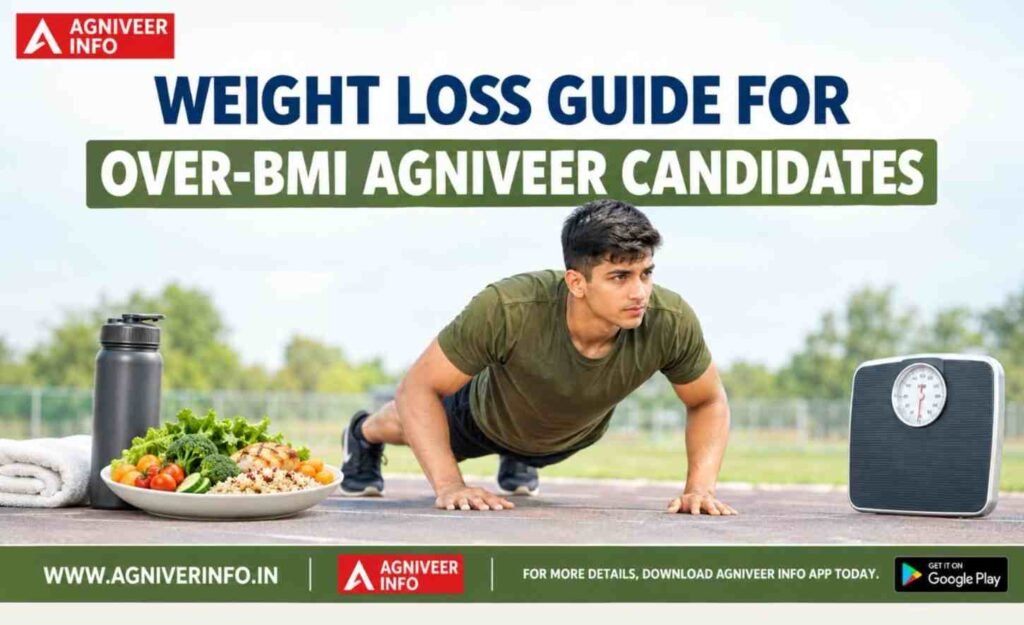
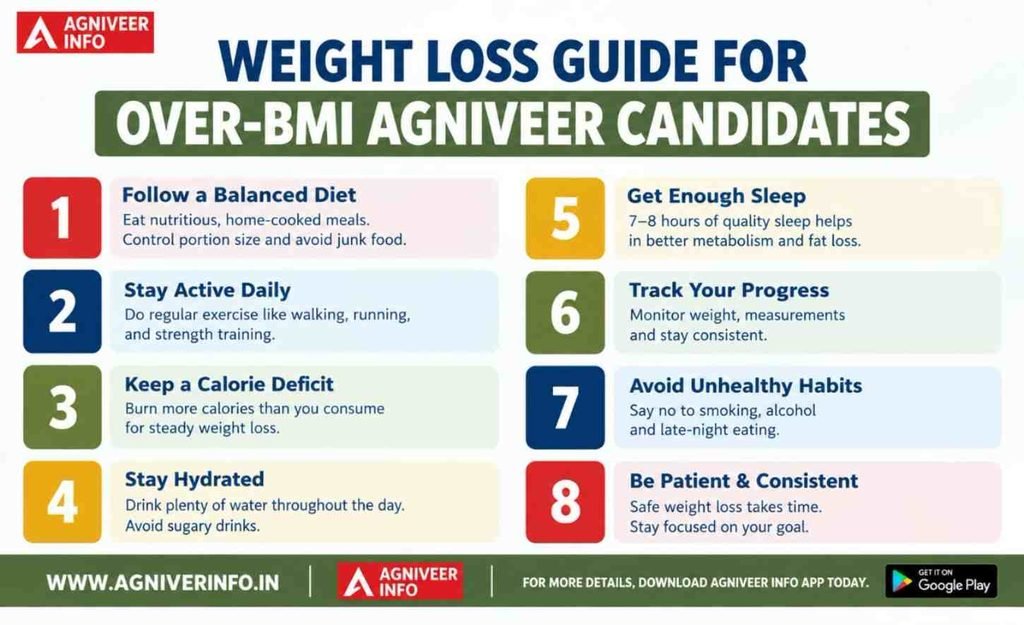
A safe and lasting way is to mix slow fat loss with a proper plan for physical conditioning, and food, running for stamina, strength training, and enough sleep must all work together to get the body ready safely.
Candidates should avoid dangerous methods such as starving themselves, taking laxatives, or using fat-burning supplements that are not checked. Every candidate has a body that is different from another’s, so understanding a safe and realistic way to manage your weight is the best way to build fitness that lasts, while also working toward meeting the recruitment medical standards.
What Does BMI Mean for Agniveer Candidates?
Body Mass Index is a number worked out by dividing a candidate’s weight in kilograms by their height in metres, squared. The recruitment medical boards use BMI as a first, quick sign to spot possible weight problems in a large number of applicants. But BMI is not a direct measure of how much body fat you have, or of your overall health.
Since the formula only looks at total weight compared to height, candidates who have a lot of muscle from regular strength training may show a higher BMI, even though they have low body fat. On the other hand, a person with very little muscle may show a normal BMI while still carrying a lot of body fat compared to their size.
The recruitment medical officers judge candidates using a full set of measures, looking at the overall body frame, chest measurements, and how the muscle is spread, along with the standard charts. Candidates should always check the official service notifications for the exact numbers that apply to them.
How to Know Whether You Actually Need to Lose Weight
It is important to understand the difference between your total body weight and your body fat when you judge your physical readiness. Height and weight should always be looked at together to get a proper baseline, because your weight on the scale changes every day due to water held in the body, the salt you eat, what is in your stomach, and how much water you have drunk, which means that a sudden change on the scale often shows a shift in fluid and not a real gain or loss of fat.
Candidates should watch the wider trend over several weeks, instead of reacting to the change they see every day. Some signs that losing fat may help you are extra fat around the stomach, less stamina while running, and trouble doing bodyweight exercises. If a candidate is not sure whether their weight comes from muscle or from extra fat, talking to a qualified sports nutritionist or a medical professional can help set realistic health goals.
Safe Weight-Loss Strategy for Agniveer Preparation
A good weight-loss plan for defence preparation needs a moderate calorie deficit, which means eating a little fewer calories than your body uses in a day through activity and physical training. Carbohydrates should not be cut out completely, because they give the glycogen (stored energy) that is needed for running and stamina workouts, and eating enough protein is very important to repair muscle tissue and stop muscle loss while you are eating less.
Your diet should focus on whole foods that are rich in nutrients, such as whole grains, lean protein, vegetables, and healthy fats, all in controlled amounts. Candidates should cut out sugary drinks, packaged snacks, and deep-fried food, because these add calories with little real value. Making progress that lasts means losing weight at a slow pace, which keeps up your energy for training, instead of turning to extreme starving methods.
Budget-Friendly Indian Foods for Weight Management
Managing your weight well does not need costly imported food or special supplements. Traditional, low-cost Indian foods give very good nutrition when they are cooked with little oil and served in the right amount. Pulses like dal, whole chana, and rajma give plenty of fibre and plant protein, which help you feel full through the day.
Eggs, curd, skimmed milk, and soy chunks are cheap sources of protein that help your muscles recover. Vegetables that are in season, and fresh local fruits, give you the vitamins, minerals, and water your body needs. Basic carbohydrates such as whole-wheat roti, brown or white rice in a controlled amount, and oats give you steady energy for running. Small amounts of peanuts or roasted chana make good, nutrient-rich snacks between your training sessions.
Running and Cardio Plan for Overweight Candidates
Overweight candidates should take up running step by step, so that they avoid stress fractures, shin splints, and swelling in the joints. Beginners should not run long distances every day, and starting with a planned walk-run interval programme lets the tendons, ligaments, and joints get used to the impact safely, while building the basic stamina of the heart and lungs.
As your fitness improves, you can move on to easy, steady jogging, and slowly increase the distance you cover each week. Once you have built a good base of stamina over several weeks, you can add controlled fast running and interval sessions, to improve your speed and how well you run. Adding activities that do not put much stress on the joints, such as brisk walking or gentle mobility sessions, keeps your fitness improving steadily without causing overuse injuries.
Strength Training for Fat Loss and Physical Preparation
Strength training is a very important part of getting ready physically for Agniveer selection. Adding bodyweight and resistance exercises helps you keep your lean muscle while your body is using fewer calories than it needs, so that the weight you lose comes mostly from fat and not from your muscle, and strong muscles also keep your joints steady while you are running with high impact.
The main exercises are bodyweight squats, lunges, push-ups, core planks, and pull-ups. You should focus on doing each movement correctly and slowly raising the number of reps or the resistance, instead of doing careless, endless repeats. Getting enough rest between your strength workouts lets your muscle tissue rebuild and grow stronger, which improves how you perform during recruitment tests.
Sample Daily Diet Structure
- Breakfast: Boiled eggs or paneer with whole-wheat roti or oats cooked in milk, along with a piece of fruit.
- Lunch: A balanced portion of rice or roti, a bowl of dal or chana, a mixed vegetable curry, and a serving of plain curd.
- Pre-Workout: A banana or a small handful of roasted chana, to give quick energy for exercise.
- Post-Workout: Protein-rich food such as boiled egg whites, cooked soy chunks, or paneer.
- Dinner: A light meal of vegetable soup, grilled lean protein or lentils, and a controlled portion of whole grains.
Common Weight-Loss Mistakes Agniveer Candidates Should Avoid
- Crash Dieting: Cutting your calories too much causes muscle loss, deep tiredness, and worse running performance.
- Skipping Meals Excessively: Fasting without control often leads to strong hunger, drops in energy, and eating too much in the evening.
- Completely Eliminating Carbohydrates: Cutting out carbs takes away the fuel your muscles need for hard running and stamina tests.
- Excessive Daily Cardio: Running too many miles without rest causes heavy strain on the joints, overtraining, and loss of muscle.
- Dehydration Methods: Limiting water or using saunas to lose weight fast causes dangerous dehydration and hurts your medical performance.
- Using Unverified Fat Burners: Chemical fat burners bring a big risk to your heart and give no real lasting benefit.
- Ignoring Strength Training: If you do not train your muscles, you lose the strength you need for push-ups and rope climbing.
- Expecting Instant Results: Losing fat in a way that lasts needs steady effort over weeks, and not sudden changes in a few days.
How to Track Weight-Loss Progress
To track your progress well, you need to look at more than just the number on the bathroom scale. You should weigh yourself under the same conditions each time, such as early in the morning before breakfast, and look at the average over a week rather than the change you see every single day.
Candidates should also keep an eye on their waist size, how their clothes fit, their running time, and how many push-ups they can do. More physical energy, faster recovery, and better running stamina are strong signs that your body is genuinely getting into better shape.
Final Weeks Before the Agniveer Physical or Medical Test
In the final weeks before the recruitment test, candidates should avoid making sudden changes to their diet, or trying extreme, last-minute ways to cut weight. Cutting your calories severely, or dehydrating yourself on purpose just before the physical tests, hurts your performance, makes you feel dizzy, and puts your medical health at risk.
Keep a steady, nutrient-rich way of eating, and drink enough plain water. Your training should be reduced a little, so that your body gets full physical recovery and your muscles are properly rested. Give importance to good sleep, going through the official instructions, keeping your original documents ready, and reaching the venue feeling fresh and prepared in body.
| Area | Practical Approach | Main Purpose | Key Caution |
| Nutrition | Keep a moderate calorie deficit, with balanced protein and carbohydrates. | Support slow fat loss while keeping muscle and training energy. | Avoid extreme starving diets that harm your performance and stamina. |
| Running | Move slowly from walk-run intervals to steady conditioning runs. | Build stamina and speed for the physical test. | Do not run too much every day without proper rest days. |
| Strength | Do bodyweight exercises like push-ups, squats, and pull-ups, and slowly increase the challenge. | Keep your muscular strength, improve your posture, and protect your joints. | Focus on doing the movement correctly, rather than doing too many reps, to avoid injury. |
| Recovery | Get seven to eight hours of sleep and drink enough water every day. | Help your tissues repair, and keep your nervous system ready. | Avoid using severe dehydration methods to change the number on the scale quickly. |
Conclusion
Managing your body weight safely for Agniveer recruitment needs a proper, long-term plan that combines food, physical training, and enough rest. Body Mass Index is used as a first screening measure in recruitment, but real preparation needs you to build your fitness through fat loss that lasts, and not through sudden tricks on the scale. When you combine a balanced diet of whole Indian foods with running and strength training that build up slowly, you keep your muscle while cutting down extra body fat.
Losing weight too fast, crash dieting, and dehydration are dangerous habits that harm your physical performance and your readiness for the medical test. Candidates should keep checking the official recruitment notifications given by the Indian Armed Forces, to confirm the current entry standards. Applying sensible fitness ideas with patience and consistency remains the most reliable way to be ready for the physical test.
Get the latest Agniveer updates by joining our WhatsApp channel
Frequently Asked Questions
Q1. Can overweight Agniveer candidates reduce weight safely before recruitment?
A1. Yes, candidates can reduce weight safely by keeping a moderate calorie deficit, along with cardio and strength training that build up slowly, and enough rest, over several weeks.
Q2. Does BMI alone determine Agniveer medical eligibility?
A2. No, BMI is only a first screening measure, but the medical boards look at your overall body make-up, muscle mass, chest expansion, and health standards under the official rules.
Q3. How should an overweight beginner start running?
A3. Beginners should start with walk-run intervals on a soft surface, and slowly increase the time they run, so that the joints and tendons can adapt safely.
Q4. Should carbohydrates be completely removed during weight loss?
A4. No, carbohydrates give the energy needed for hard running and strength workouts, so they should be controlled in the amount you eat, and not cut out completely.
Q5. Are supplements necessary for Agniveer weight loss?
A5. No, costly supplements are not needed, because whole Indian foods like eggs, dal, curd, and vegetables give you full and affordable nutrition for safe weight management.
Q6. How quickly should candidates try to lose weight?
A6. Candidates should aim to lose weight slowly, at around half to one kilogram a week, so that they keep their muscle, stamina, and overall physical performance.
Q7. Can dehydration help candidates meet a weight requirement?
A7. No, dehydrating yourself on purpose is dangerous, it badly hurts your running performance during the test, it can cause your body to collapse, and it gives no real benefit for clearing recruitment.
Q8. Can weight loss guarantee Agniveer medical clearance?
A8. No, weight loss alone does not guarantee that you will be cleared, because candidates must also meet all the physical fitness tests, medical checks, and the service-specific standards that are officially set.
READ ALSO: WHAT HAPPENS DURING THE AGNIVEER MEDICAL EXAM? — COMPLETE GUIDE